12. December. 2025.
I had a compelling exchange with one of my Ph.D. supervisors about my reading of contemporary Draupadī retellings as Bildungsromans. I’d written positively about how some novels I am looking at in my thesis frame Draupadī’s final moments before her death as a resolution, and her story as an evolution to her desired self – in which she progressively comes to terms with her womanhood, achieves liberation from gender and from the memory of sexual assault, and returns to her metaphysical form.
In our last feedback session of the year, my supervisor pushed me to be more critical of it. Could I see any implications, any issues, in the very ideas of ‘evolution’ and ‘progression’?
I’ve been staying with it, looking at the stickiness of the very concepts of evolution and progression – beyond psychoanalyst and feminist scholarship, which my supervisor was getting at, but in my own awareness of how I process my own self.
It comes down to the premise of either evolution and progression inferring ideas of inferiority and superiority, good or bad – the movement from a ‘less than’ form of oneself to a ‘better than’ form of oneself.
Feminist scholars see this as potentially politically and socially disabling, whereas in my own experience I see how easily “self-betterment” becomes an unstable ground to live from.
When the self is constantly positioned as not-yet, not-quite, not-enough, it can lead to a perpetual disatisfied looping and striving outside of one’s self. The promise of resolution keeps receding, because the structure itself depends on the idea that where you are now is insufficient.
What I’m prompting myself to look at is how stories – and how we – can move without this ladder built in – operating from the standpoint of a transformation that does not presuppose an inferior point of origin, and no final evolved version of the self waiting at the end.
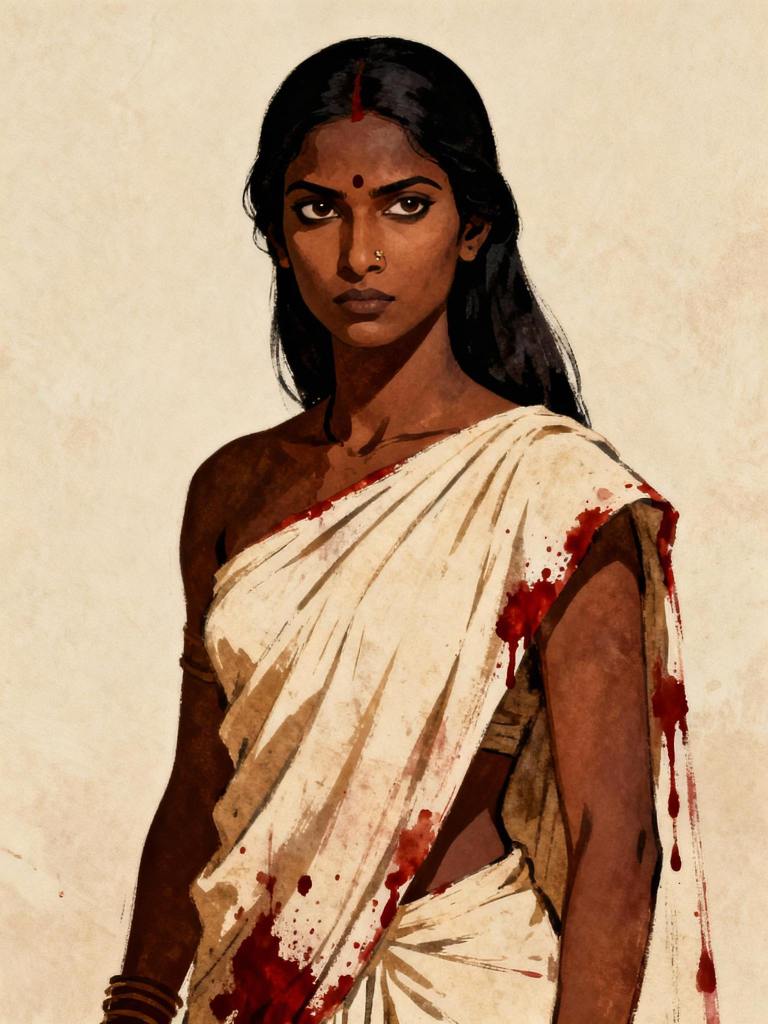
AI image generated for Draupadī after many prompts on my side. Beyond the inaccurate clothing, one of the most appropriate representations I’ve seen of her I believe, features-wise!