on writing as an act of transcendence

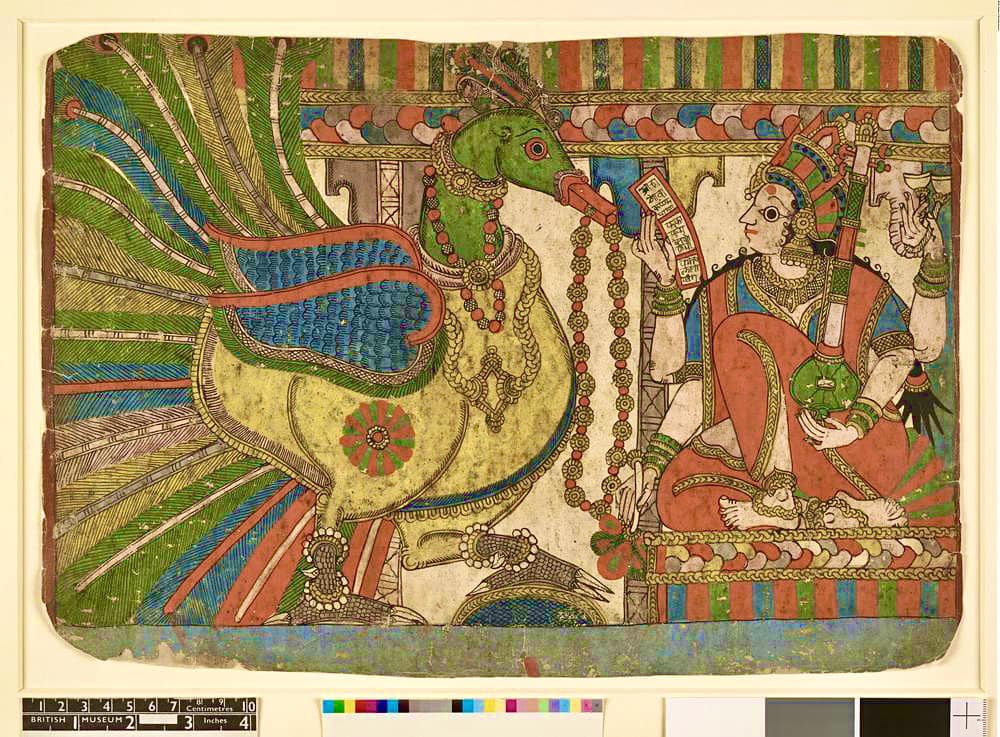
the beautiful image is a painting of Sarasvatī that belongs to a set of sixty which chronologically depict a tale told in the Mahābhārata (as well as in the Mārkaṇḍeya Purāṇa and in the Śrīmad Devībhāgavata), that of King Hariścandra. this painting is one of two beginning the set, and it depicts the invocation of Sarasvatī, the Goddess of knowledge, speech and poetry, who is invoked as the flow of (and to flow the) words and wisdom of the telling. Gaṇeśa is invoked, as well.

in a seminar i recently went to, we discussed sacred texts, and the invocation of Gods & Goddesses in their openings – the muse in the Iliad, the deities in the Sanskrit texts etc. it made me reflect on writing as an inherently transcendental act. as in, it is not you who writes (or creates etc). it is being written through you, and it is therefore futile to take ownership for it.

as a ‘writer’, i oftentimes read my work and feel as if it was written by someone else. of course, my biases seep in (in editing, especially), but if i fully connect, the experience is that of it being written through me, and not by me.

i understand the invocation of the muses and Goddesses to reflect, in part, this understanding: that the act of creation subsumes and transcends the self or ego, even if only momentarily. that in creating, we tap into and open pathways within that we usually do not access customarily, when we are so entrenched in our sense of self that the energy can only flow in one way (that of sustaining our identity and the patterns which construct it). in creating, the energy can be freed to flow in new or in more ways. this is how i understand the surrendering to the muse or to one’s art that is so lauded by poets. 🦢
Khaliya: birthday poem

the sun in my mind aging by one
the tinkle of golden anklets calling from the forest of monal
the blood of my womb coalescing into bruised grass
the clouds of silk blushing against my cheeks
the burn of my skin drying before the unforgiving light
the sound of my shame vibrating in my chest
the cold untangling my fingers’ grasp on fears seeded into me as child

i
sometimes wish i was satisfied by easy
by swinging my feet over the white picket fence holding hands with perfect suitability
but the fire in my belly scorches
and i know i’m not

i
sometimes wish to rest
but the fire in my belly scorches
and i know i have to keep moving

🏔 Khaliya, from my birthday poem. 🤎

welcoming the cold in the Himālayas

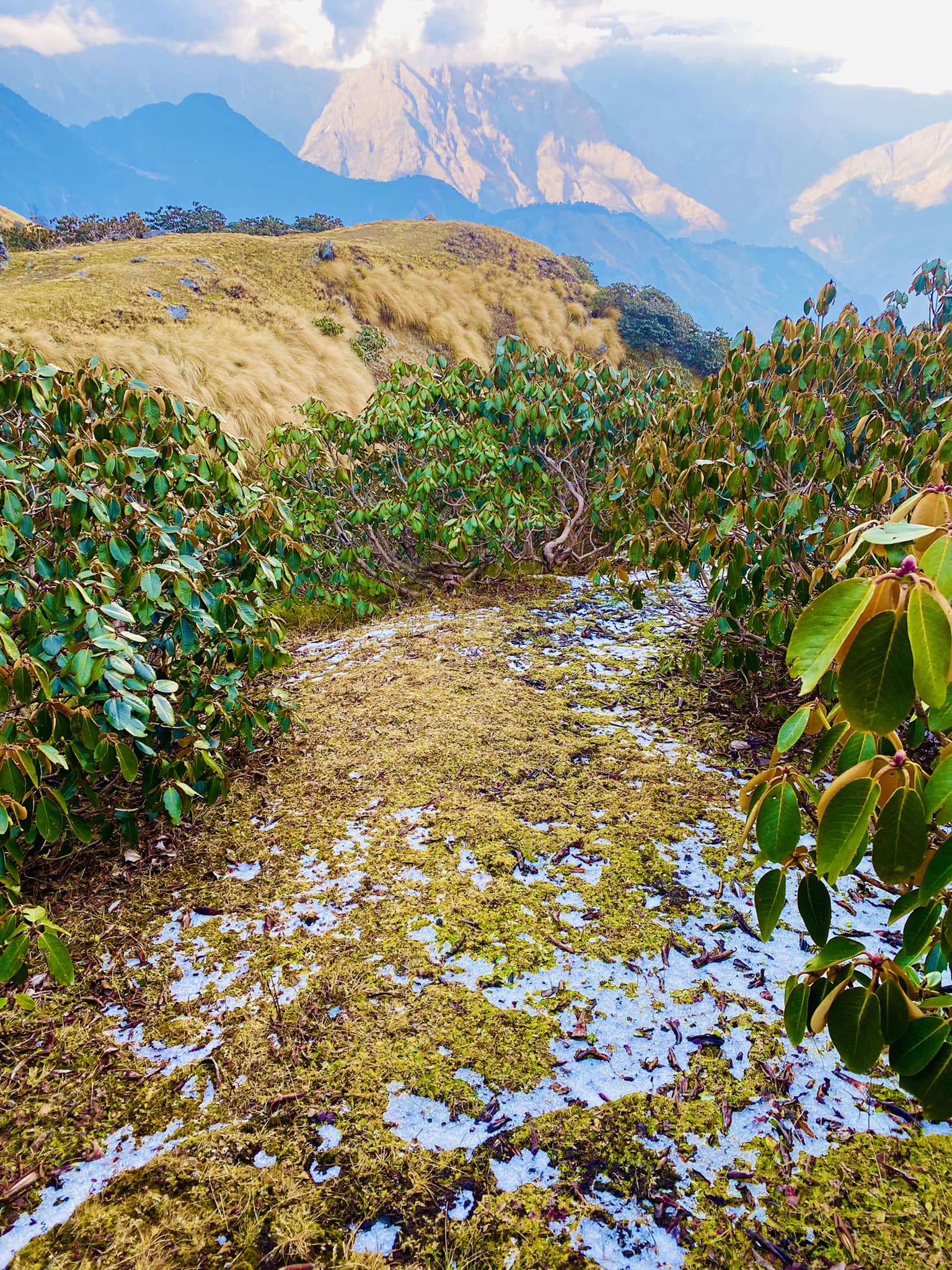
braving and welcoming the cold! 🏔 last year in the Himālayas, i was bundled up in dozens of layers, and sought with my all to be as warm and comfortable as possible (which, looking back, was a futile attempt regardless!). this year, i challenged myself to wear as minimal clothes as i could (although i did succumb to the puffer jacket at times!).

the downside of the controlled environments many of us are blessed to live in (meaning, those of us who have access to amenities such as hot water, AC etc) is that we become complacent and scarcely exposed to external stimuli; and, it is by exposing ourselves to such external stimuli and by bearing through that stress that expansion occurs.

the reason why most inspirational stories of transformation occur when a stressor is introduced (be it a harsh environment or an uncomfortable situation) is because of this – willingly subjecting ourselves to discomfort and to new stimuli increases resilience and opens new pathways in the mind through which the ways we perceive and engage with life are refined and transformed.

and, there is no need to travel across the world to do it! we cling to comfort (as well as to our patterns) on a moment to moment basis. i have found that a small change (such as cold showers or introducing oneself in a situation which our programming craves to avoid) can cause wonders. here’s to challenging ourselves & letting go of comfort 💥

#theashzeroexperience

25 in the Himālayas

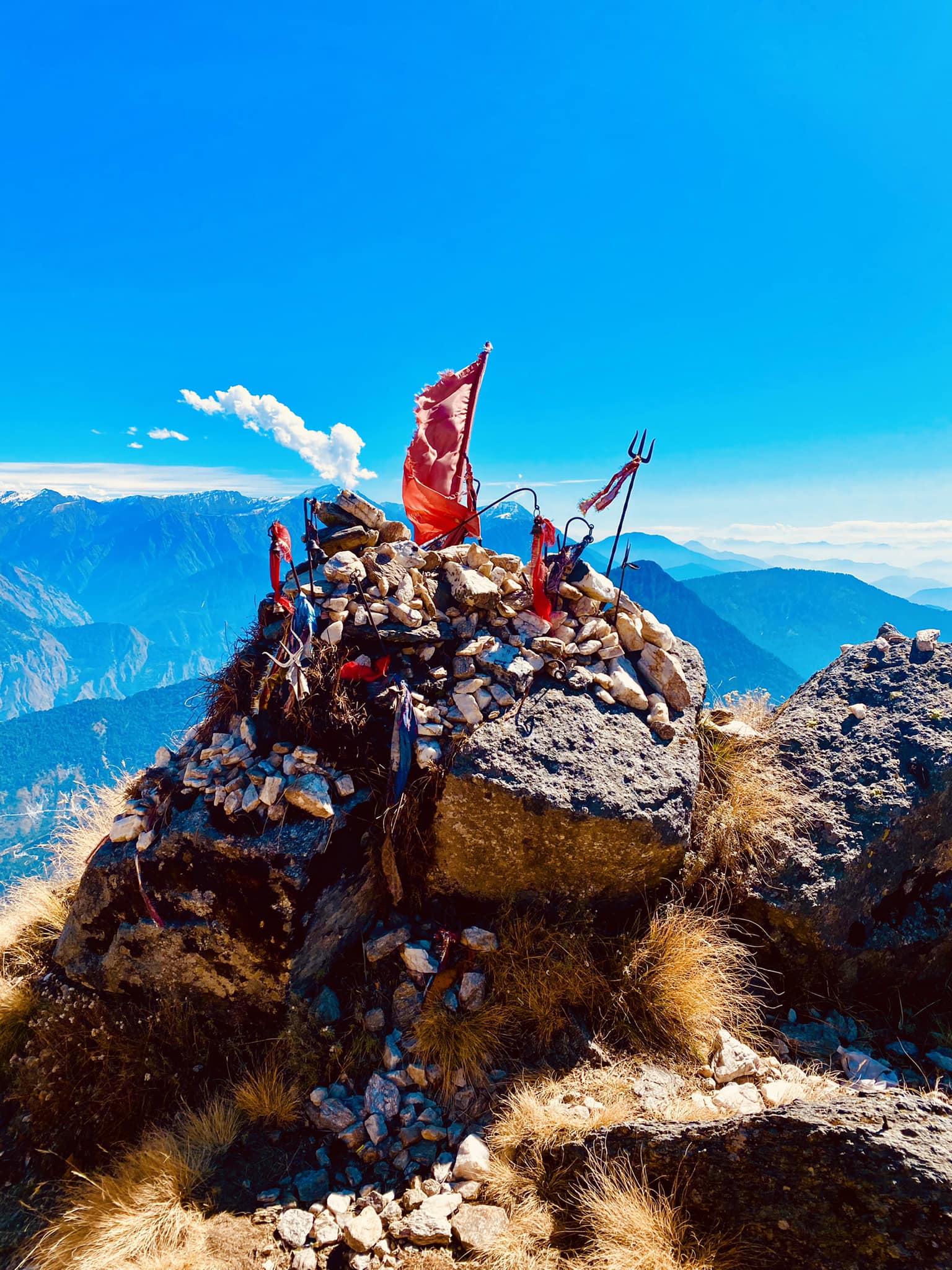
i turned 25 in the Himālayas, on the resplendent Khaliya trek, and camped in a remote meadow that can only be described as the land of the apasāras. ❤️‍🔥

hiking, i reflected on 24, which was the year of the great heartbreak: of fierce grace. the path burned through what i had worshipped as truth and held most dear, and violently pushed me to transform.

on last year’s pilgrimage to the Himālayas, i had prayed on a trek to Gomukh: “free me. i will do whatever it takes.” when the whatever it took came, it was not what i had imagined, and it broke my heart. i had thought i had known heartbreak, but all paled before the pain of facing the untruths i had clung to under the name of God. seeing through your own deceptions is a harsh business.

as the projections i had built my spiritual life around began crumbling, i was left feeling disillusioned, and i was tempted to renounce my search for God. one of the darkest nights of the soul of 24 was one of doubt, in which i doubted everything. i bitterly cursed my trust, and felt repulsed by the dynamics of modern spirituality. i reasoned, if such power dynamics can be built on spiritual teachings, then the teachings must be false.

and yet my intuition, which i had cut myself off from, arose gently; a tiny voice silently telling me that the truth i was seeking does exist. it is pulsing underneath the mirage. my intuition told me not to close myself. to trust the play and uncover the teachings. to keep moving and follow the energy.

diving deep into disillusionment paradoxically opened my system to increasing expansion as well as to a love of an encompassing nature that i had not tasted before.

followingly, one thing i have experienced, is this: freedom rests in autonomy on the spiritual path. the teachings, the dimensions of God, such as the Mahāvidyās, the Devas and Devīs, are real – only not in the way we tend to think about them and not in the way they are taught in modern spirituality. you have to experience them for yourself. you are intrinsically worthy of it. keep moving. ❤️‍🔥

my motto for 25 is: whatever it takes. ❤️‍🔥

AshZero Sound Explorations: The Mahāvidyā Kamalātmikā Algorithm

i have been exploring the algorithm of the Mahāvidyā Kamalātmikā through sound pathway as facilitated by the AshZero offering of “Sounds of Śakti” for which @lensonearth created a series of sounds distilled from bījā mantra. the sounds are not chants nor articulated resonance; instead, they are what we see as a container through which sound is projected as shape. this model of absorption is a near non-linear oral transmutation which aims to follow the siddhānta (algorithm) of ṛṣi darśanāta (to understand more, watch “Vedas: All You Wanted to Know” by Dr. Kesarkar which expounds on how the Vedas originated from sound: https://youtu.be/mK6KdrmyOcg?si=t7vuad5g9kiLXCyF).

after experimenting with various abstract sound combinations for a week, i began continuously looping through one particular waveform.

with the awareness that it is in our humanness to prefer what is amiable and to make choices (such as that of which sound to absorb) based on what resonates with our sense projections, i aimed to renounce any bias and to absorb the sound for 3 weeks without expectations, familiarity or target. i listened to it in the morning and in the evening, 4 times each round.

gradually, the sound became integrated in my system; i became able to access it spontaneously, in the sensory exchanges occurring in my regular days. i noticed change in my perception of the events arising in my life as well as in my actions. as instructed, i aimed to avoid the natural urge to linearly make sense of it or to differentiate positive and negative effects arising of this flow. thus, i will not pinpoint what exactly changed in my life through the means of this sound, nor do i think it would be feasible or fruitful, as it causes validation toward a process – which is not the aim of application-based Tantra.

however, as an exercise, i decided to jot down the unfolding of a sound exploration that transpired in my first night in Rishikesh without any rationale other than an opening to the process possibly unlocking something within without a specific subconscious target.

i’m not sharing this with the intention to construct a mystical halo. mystical / energetic experience is ultimately just an experience – it can greatly help us open or gain clarity, but it’s important not to get caught up in it. the experience i am sharing simply demonstrates how sound can be absorbed by the system and nothing more, and has no inherent specialness.

as i sat by the Gaṅgā, the sound i have been imbibing spontaneously rang in my right ear at low volume. after a small dram of whisky taken as sacrament, the sound boomed in both of my ears. my heartbeat increased and various bodyparts, such as navel, feet and hands began pulsing. what i understand as “pleasure pathways” in my system fired. followingly, i directly listened to the sound with headphones, eyes open. after i finished listening, the sound overturned my thoughts and my experience became an immersion in the five senses (sight, touch etc).

sacrament choice: 6 y/o Highland Park independent bottle, 60.1%, which i got from Cadenhead’s at a Whiskybaba.in immersion in summer – i’m not a fan of OB (original / official bottling) of Highland Park but their IB (independent bottling) i think is a must try. 🙂

in Gangotrī i screamed for the Lord (excerpt) | the Monsoon One and the pilgrim | téa nicolae

(..) my cheeks, full in lilies
my mind, anointed by the half-moon bathing the Śivling

i walked and walked and walked
hungry for a glimpse of your feet

at crossroads
my torturous One of Monsoon
devised a game:

i felt
his lips
hovering
on my hair, hands, and eyelids
yet when i turned
my mouth
to claim
my longing
i could only kiss
a devious scent of lotus

the empty air
and a devious scent of lotus

after ten, twenty
thirty turns
and one hundred and eight hot tears
the mountain road came to a halt

you, nowhere to be found.
only a devious scent of lotus.

a perfume so deceitful
that when the milky ocean
was churned in the first aeon
the asuras did not taste nectar
for they chose not the elixir
but the conch streaming it instead

last crossroads in sight,
i screamed

ENOUGH.
MY LORD, IT IS ENOUGH.

TEAR MY CENTER
WED MY NAVEL

DO NOT HIDE FROM ME.

Gangā sizzled as your lotus scent filled my nostrils
maddened, i looked around for You, when, a whisper:

𝒊𝒕 𝒊𝒔 𝒚𝒐𝒖 𝒘𝒉𝒐 𝒉𝒊𝒅𝒆𝒔.

🌙 excerpt from a poem from my upcoming collection “the Monsoon One and the pilgrim”. photo: Gangotrī at night. the Himālayas are calling again. 💛

Draupadī and the Dharma of Women

“Strī” translates from Sanskrit as “woman”, while “dharma” is a complex principle with manifold meanings, in this context bearing the significance of “duty”; in simple terms, it refers to an individual conduct that contributes to harmony in a greater framework, be it societal or cosmological.

Draupadī is lauded in the Critical Edition of the Mbh several times as being the epitome of strī-dharma, of the dharma of women. (2.62.20; 2.63.25-30; 2.64). Interestingly, she is most intensely praised as such after she angrily (yet elegantly!) questions the men of the royal court and demands justice, being anything but meek and demure. I would argue that this showcases that in the Mahābhārata voicing oneself and standing up for oneself are considered responsibilities belonging to the dharma of women.

To nuance this even more, Eknath Easwaran, an eminent translator of the Bhagavadgītā, highlights that, etymologically, the term “dharma” can be traced back to the root ‘dhri’, which means ‘to support, hold up, or bear’; “dharma” therefore translates as “that which supports”, and Draupadī’s conduct therefore supports both society and cosmology.

In the Sanskrit Mbh, Kṛṣṇa does not appear in the sabhā (royal hall) at the time of Draupadī’s attempted disrobing, and no direct mention of him is made during this episode. In a conversation with Dr. Brian Black, a Mbh researcher whom I had the honour to have as my MA supervisor, we talked about the implication of this, which is that Draupadī’s adherence to strī-dharma appears to be that which shields her. A question that could arise here could be whether there is a contradiction between the Critical Edition and modern renderings of the Mahābhārata, with Draupadī being shielded by her dharma as opposed to by Kṛṣṇa.

For me there is no contradiction.

Kṛṣṇa in the Bhagavadgītā establishes himself as ‘the eternal dharma’ (14.27); and so, Kṛṣṇa is all dharmas, including strī-dharma. We tend to associate Kṛṣṇa with a fully-fledged incarnation; but he is beyond that. I would maintain that, as the divine principle, he exists in Draupadī’s consciousness and in her actions as dharma (and not only!). The latter renditions, for me, in which he is physically there, only bring forth in tangible projections the internal process extending Draupadī’s consciousness.

I will write more about strī-dharma as it appears in the Mbh. ❤️‍🔥

You can find me on IG: @musingsonthemahabharata

and on Tumblr: https://www.tumblr.com/musingsonthemahabharata

Painting: Jadurani Dasi, 1986.

Kṛṣṇa and Draupadī Discuss Karma

One of my favourite interpolations from modern tellings of the Mahābhārata is a conversation between Draupadī and Kṛṣṇa that occurs after Draupadī’s sexual assault and attempted disrobing by the Kauravas.

Clutching his feet, Draupadī sobs: “Govind, why? Why did this happen to me? What sins did I commit? I am reaping the fruit of which actions of mine?”

Picking her up and caressing her hair, Arya tells her: “What happened was neither because of your ‘bad’ karma, nor did you reap the fruit of your past actions. It was the Kauravas who reaped the fruit of their past actions by engaging in such a grave misdeed. Sakhī, this is the meaning of karma.”

“But I am the one experiencing agony, Govind.”

“Then relinquish it, Sakhī. Although what happened was not the result of your ‘bad’ karma, the way you transform following these events will be your karma.”

This is such a beautiful and profound exchange which offers rich nuances to the teaching of karma. Oftentimes, when events we perceive as terrible happen to us, we create a story of unworthiness around them; we wonder if we are being punished, if the root cause is our evilness, if God or the universe are rejecting or dooming us. A question that rests on these lines that is often asked would be the common: “why do bad things happen to good people”. A first layer to this, in my view, is a deconstruction of ‘bad’ and ‘good’ as solid concepts. The second layer is the understanding that any event ‘just’ happens aleatorily, rises and falls, and karma is not a simplistic cause-effect reaction.

Karma encapsulates, in my understanding, the ingrained patterns held within us through which we act, react, and process the world around us and the events that occur in our lives. There is freedom from karma in finding new ways of reacting, engaging, processing.

Finally, a significant teaching encased in this interpolation is that the way someone treats us, ultimately, is a reflection of their karma (ingrained patterns), and not a reflection of our ingrained patterns. We cannot control another’s patterns, but we can aim to understand and rewire ours accordingly.

The magnificent art: @beauty_of_art_aditi 💙

My musings on the Mbh – IG: https://www.instagram.com/musingsonthemahabharata/
Tumblr: https://www.tumblr.com/musingsonthemahabharata

Glimpses in the Nature of Reality in the Mahābhārata

Something I find fascinating about the Critical Edition of the Mahābhārata is that the characters sporadically move from addressing Kṛṣṇa as an embodied mortal (as their friend, cousin, son-in-law etc) to addressing him as the Godhead; as Viṣṇu, as the Supreme Being, and as Īśvara. The succession of change between the modes of address can sometimes even happen on the same page, at a distance of a few lines. The veil is lifted, and the characters see through Kṛṣṇa’s illusion, and, through that, they become immersed in the nature of Reality; the veil promptly drops back, and God is lost.

An argument for this could be that the divine modes of address are interpolations, a theory being that Kṛṣṇa became identified with Viṣṇu only in later renditions of the Mahābhārata. While this could be true at the level of historical analysis of the epic, for me, there is a subtler teaching encased here: how all of us, without exception, glimpse into the nature of Reality as we move through life, yet we perpetually proceed to return to becoming engrossed in the superimpositions we project upon Reality; and the dance continues. From Truth to dream, from dream to Truth. It is quite endearing, really. What committed and imaginative dreamers we are! 💙

Adyashanti once talked about how one inadvertently glimpses truth; it is, after all, inescapable as it is our nature; the trick is not forgetting / losing the glimpse.

Gorgeous artwork of Kṛṣṇa: Awedict.

the flow of knowledge

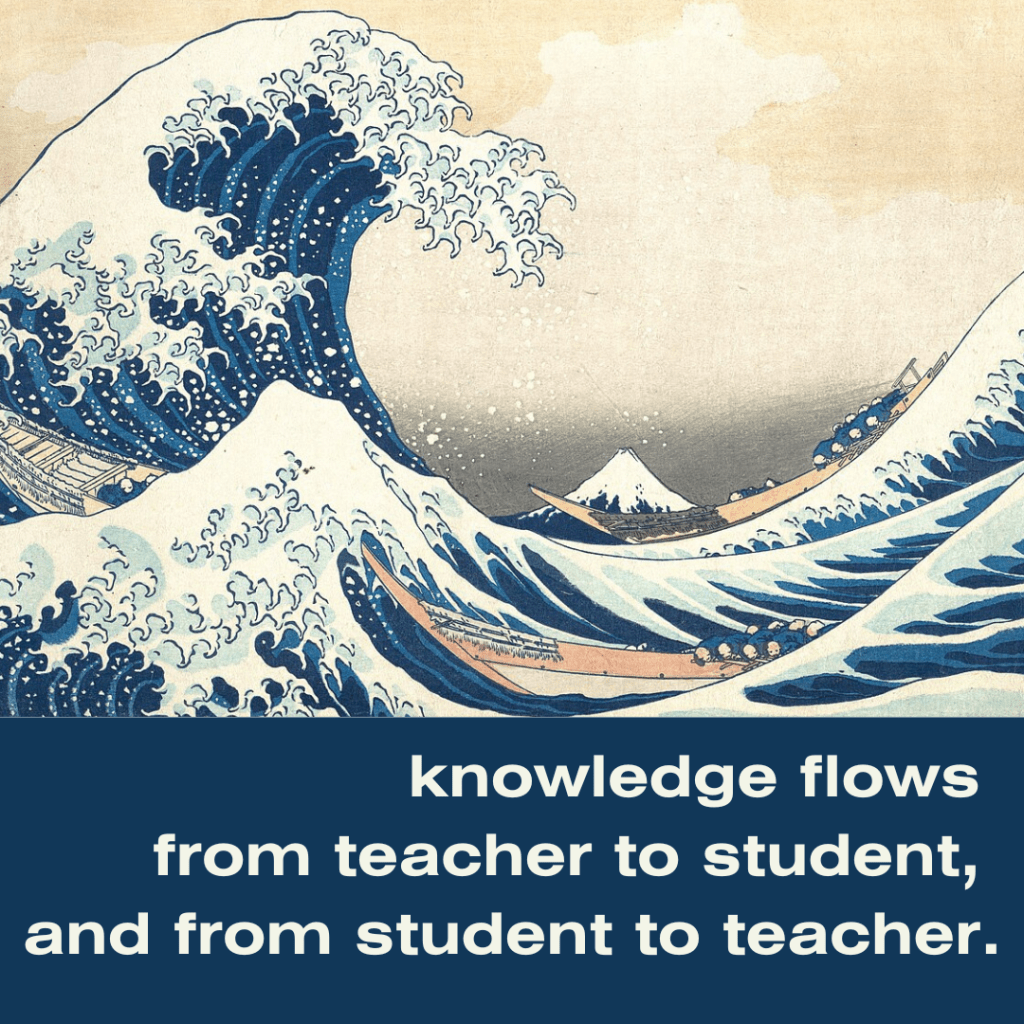
knowledge flows from teacher to student, and from student to teacher.

at the beginning of my academic journey, i was continuously surprised by the way the majority of our professors engaged with me and my colleagues; not only did they genuinely express interest in our opinions, but they also valued our input, ensured the openness of dialogue between us, and consistently encouraged us to become independent in thought and in writing. the learning environment i had been exposed to until then, namely secondary education in my home country, had been completely different: it had been one of strict hierarchy, in which plurality of thought was not existent, and in which the minds and experiences of students were not valued. it took me awhile to become used to – well, being valued, and to valuing my input myself.

i remember one particular exchange i had with a professor of mine, in which i expressed my understanding of one subject and proceeded to reflexively dismiss it by cloaking it in the “i am just a student, and who am i to say anything about this” garb. my professor stopped me and said something along the lines of: “yes, we are just people. but that doesn’t mean our contributions can’t be meaningful.”

the first week of my Ph.D. was similar: professors consistently reminded me and my colleagues that we are more than students, and they see us as valuable members of a research community that works together. they encouraged us to renounce our inhibitions, and to think, write and act as such.

it has become exceedingly important for me in my journey to be in such learning environments in which, past the roles of students and teachers that we play, there is an understanding of the flow of knowledge, which, in my view, would be limiting to think of as flowing rigidly in only one direction. knowledge flows from teacher to student, but also from student to teacher, and from student to student. i believe that to cut oneself off from receiving the flow from any source because of preconceived ideas of how it flows, and who to learn from, is a great loss.

sometime ago, i had a great conversation with my dear friend Avi Sato about how these same principles of knowledge flow apply in the area of spirituality as well, nuance which had long eluded me.