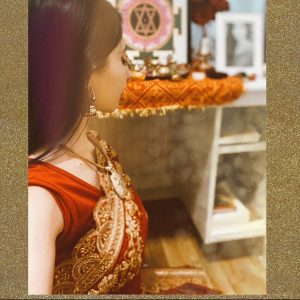
Barbie Mini-Review: Sweet yet an Encapsulation of the Deficiencies of Pop-Feminism

Sweet, energetic, and entertaining, Greta Gerwig’s Barbie is a delightfully camp blockbuster that I thoroughly enjoyed. The cinematography is excellent, the colour palette is perfect, and the actors are a treat. However, I did find its feminist thesis to be lacking. Although I acknowledge that the film is in itself a comedy which does not aim to solve social justice and functions primarily as entertainment, it still does construct a social, feminist commentary, which is why I found it fitting to utilise as a stimulus for analysing the deficiencies of pop-feminism culturally, as well as within myself.

Barbie offers its female characters the space and opportunity to muse on their condition and on the pains of being a woman, such as the contradictions of having to be extraordinary (attractive, successful, loving, kind, assertive) and yet contained, the ideal being achieving or conforming to a personal excellence that concomitantly is appeasing, controllable and tameable; yet never too much — not too powerful, nor too intimidating or destabilising.
A message of: Shine, but do not shine too much.

In my personal journey, I have recently been reflecting on my self-punishing tendencies and on my self-images of having to always be kind, never angered or envious, and, while watching Barbie, I was moved listening to the monologues of the female characters, and saw more clearly how much of my own ruptures in my identity are the legacy of having been conditioned and socialised as female growing up.

“I’m just so tired of watching myself and every single other woman tie ourselves into knots so that people will like us.” America Ferrera as Gloria in Barbie.

Indeed, I have found that men are less likely to have intense hang-ups around emotions such as anger, as it is viewed as more acceptable for them to express it. However, this binary contracts all gendered expressions, as male conditioning stereotypically also rejects its own emotional range of vulnerability and openness.

The human condition is such that we all are continuously split and stretched within between who we think we should be and who we truly are. We perpetually hide, repress, contort, and harm ourselves to mould into ideals and images which we innocently construct by absorbing various messages from society, culture, history. The Barbies are given the chance to see through the mirage of constriction, the Kens are not (which, in part, saddened me), however, neither fully glimpse through into the ultimate bondage: that of the gendered self.

To successfully break through the suffering caused by female conditioning, a deconstruction of the very concept of femaleness as a rigid reality must ultimately occur — along with a deep dive into gender as a construct, both which are unfortunately glossed over in Barbie, and, on a greater scale, in pop-feminism. In my understanding, complete liberation cannot be achieved while still operating in the gender binary, which is to be dismantled within in order to open to freedom from all self-images, internal conflicts and constrictions.

Barbie both delighted me with its vibrancy, playfulness and beauty, and also reminded me that, as a woman myself, I must push through myself more for my liberation.

My arguments are based on the work of feminist philosophers such as Simone de Beauvoir (see: The Second Sex), as well as on the precepts of non-dual ‘Eastern’ philosophy.
The Internal Freedom of the Mahābhārata’s Fire-born Heroine

Perhaps one of the most jarring episodes of the Mahābhārata, the disrobing of Draupadī has been etched to my mind since my first introduction to the epic. The story of the Mahābhārata’s fire-born heroine goes as follows: the empress Draupadī, an incarnation of the celestial Śrī, is violently dragged to the royal court after her husbands, the Pāṇḍavas, are enslaved through deceit. Draupadī is tearful, menstruating, and the Pāṇḍavas’ offenders, the Kauravas, attempt to enslave her. However, she fiercely debates them and proclaims her freedom. Enraged by her rebuttal, the Kauravas decide to disrobe her. When they mercilessly begin to pull her clothing, Draupadī’s garment endlessly unfolds, and she remains clothed — by what is presumed to be the grace of Lord Kṛṣṇa.
My fascination with Draupadī first began as awe of the female endurance she embodies. As a woman myself, I deeply identified with her pains, and found our sufferings to mirror each other. In my reflections, my being melded with her character, whom I felt connected to through the thread of shared female experience. I found comfort in her triumph. As I continued mulling over her story, I became inexplicably moved by the imposing testament of devotion that is showcased in her tale; in most renditions of the Mahābhārata, Draupadī, while being abused, earnestly prays to her dearest friend, confidant, and God, Kṛṣṇa, who, out of boundless compassion, answers to her calls and envelops her in his grace. It is a touching picture: as the men of the court hang their heads in shame, bound in silence and inaction by their royal vows, Draupadī, deserted by all, is shielded by her devotion to Kṛṣṇa — and her devotion is enough.
However, my greatest personal and transformational shift has occurred when, with my beloved guru’s guidance, I was able to deconstruct the tale of Draupadī’s anguish in order to delve deeper into the teaching encased in it. Before doing so, there was slight anxiousness in my heart: there was self-doubt, and there were questions; Draupadī had been ‘saved’ through her devotion, but would I be? Would I be saveable or worthy?
Indeed, my mistake had been not delving deeper into the teaching encased in Draupadī’s anguish by remaining stuck at the level of storytelling. The liberating conclusion I have reached is that, in truth, whether the empress’s garment endlessly expanded or not is irrelevant. The teaching veiled in Draupadī’s disrobing is that she was untouchable because she was internally free. The horror she was subjected to did not shake her internal freedom, nor did it dismantle her devotion. Throughout it all, she was rooted in her love for Kṛṣṇa, and immersed in her independent power. As she says in a recent rendition: “You cannot make me your slave because I do not allow it. Independence lies within me; it is not a piece of clothing you can snatch.” All along, the question was not whether I would have been saved; it was whether I could unearth Draupadī’s fearlessness in myself.
The Mahābhārata’s fire-born heroine has taught me that freedom lies within me. It is not given to me by others, and it cannot be taken from me. My freedom is married to my devotion, and my heart holds the keys to both.


This article has been published in the second volume of Śabda Magazine.

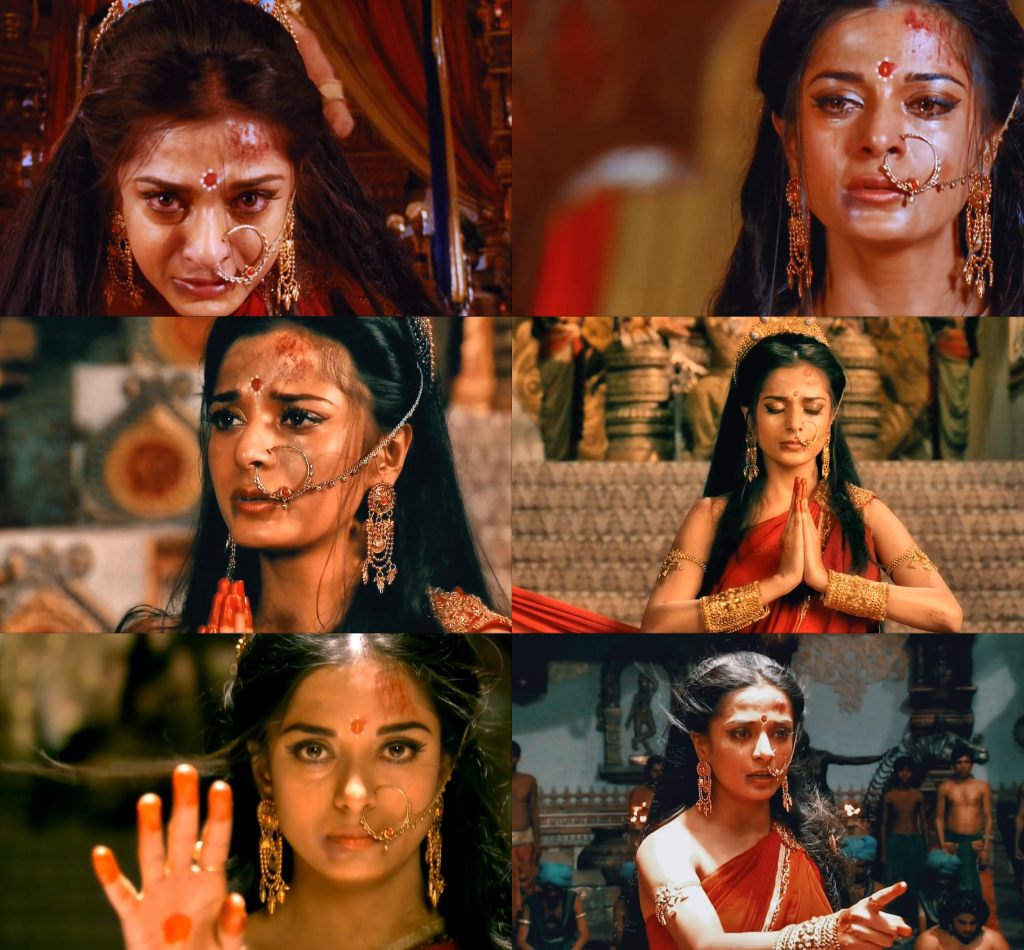
Collage I made of Pooja Sharma as Draupadī in the 2013 Mahābhārat. Although the TV series presents many distortions, her brilliant, fiery performance makes viewing it a joy for me.