In response to the article about Draupadī’s disrobing that I shared yesterday, Jim beautifully questioned whether the act of violence spurred from limited views around nudity and if it would have been avoided if nudity was perceived differently in that society (if it was common, seen as sacred or normal). This was a very rich ground of contemplation for me, and the reflections I have had are the following:
First, I would like to establish that Draupadī was not wearing a sari when her attempted disrobing took place. She was wearing a single cloth which covered her body through which she was menstruating, which was the custom at the time. It can be deduced through various references toward her appearance found throughout the Mbh that, outside of the timeframe of her menses period, she did not customarily wear an upper garment, so her breasts were uncovered. At the time of her attempted disrobing, she was wearing more clothes that she usually was. The men had already seen part of her body which they wanted to disrobe. There are scholars who argue that she was not wearing a single cloth at the time of her disrobing and she was instead wearing both an upper garment and a lower garment. I would argue that this is irrelevant, as the point still remains that her breasts were covered, and they usually were not.
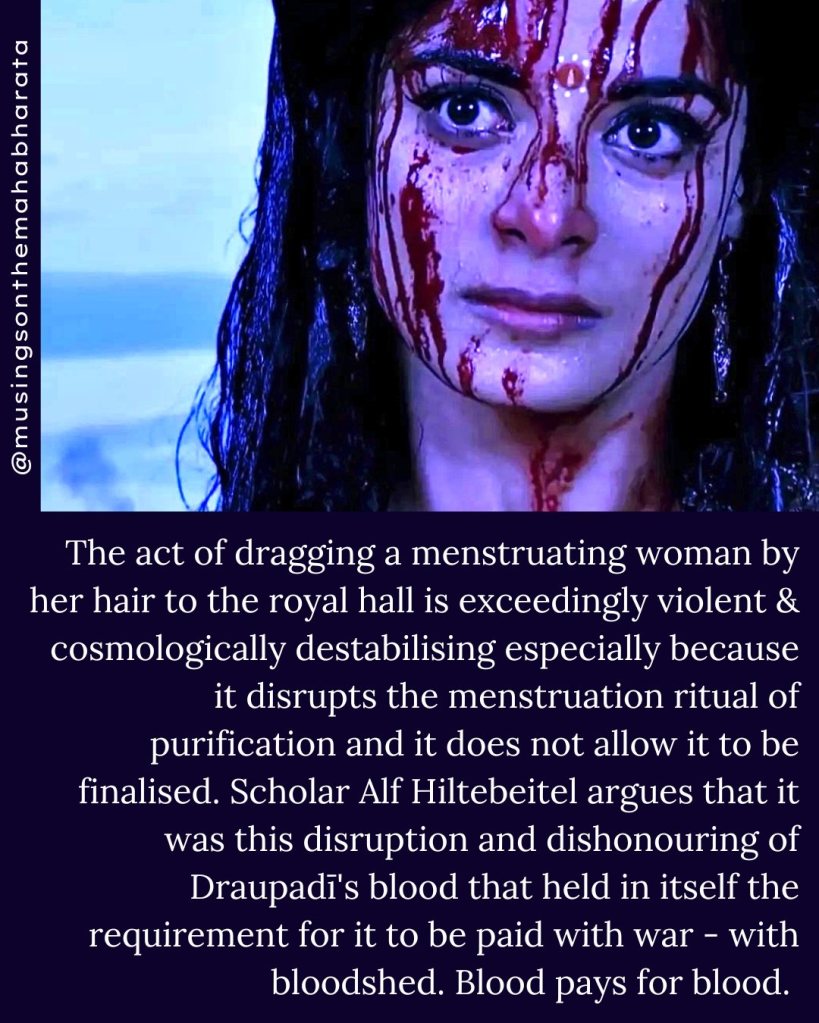
Second, I would maintain that, the disrobing episode, as most acts of sexual violence, was more about power than about sex or nudity, and that the key factor here, lost in so many adaptations, was not the attempted disrobing & possible nudity, it was the fact that Draupadī was menstruating, and she was brought to the royal hall in a stained garment through which she was free-bleeding. Menses was / is considered a period of purification. The act of dragging a menstruating woman by her hair to the royal hall – who, as I priorly mentioned, was wearing more clothes than usually – is exceedingly violent & cosmologically destabilising especially because it disrupts the menstruation ritual of purification and it does not allow it to be finalised. Further, hair in itself is a symbol of sexual power for a woman. Duśāsana grabbing Draupadī’s hair is an attempt to curb her sexual power and own her sexuality.
Draupadī bleeds in the hall and leaves Hastinapura bleeding through her clothes. Scholar Alf Hiltebeitel argues that it was the dishonouring of her blood that held in itself the requirement for it to be paid with war; with bloodshed. In the cosmological cycle, blood pays for blood.
The Kauravas wanted to humiliate, own and disempower Draupadī; nudity was one of the means to get there, along with disturbing her purification rituals, not the end goal. However, one could argue that in a society in which nudity was seen as sacred the intention to humiliate wouldn’t have arisen in that openness or expansion of consciousness – but maybe it would have just taken a different form and found different means.
Photo: Pooja Sharma as Draupadī, bathed in the blood of her principal offender. The cosmological cycle is finalised.
references on Draupadī, the symbols of menstruation as purification and hair as female sexual power: https://press.uchicago.edu/…/book/chicago/C/bo3626877.html
 amaryllis