amaryllis (/ˌæməˈrɪlɪs/[1]) – bears the name of the shepherdess in virgil's pastoral eclogues. it stems from the greek ἀμαρύσσω (amarysso), meaning "to sparkle", and it is rooted in "amarella" for the bitterness of the bulb. the common name, "naked lady", comes from the plant's pattern of flowering that blooms when the foliage dies. in the victorian language of flowers, it means "radiant beauty".
Perhaps one of the most jarring episodes of the Mahābhārata, the disrobing of Draupadī has been etched to my mind since my first introduction to the epic. The story of the Mahābhārata’s fire-born heroine goes as follows: the empress Draupadī, an incarnation of the celestial Śrī, is violently dragged to the royal court after her husbands, the Pāṇḍavas, are enslaved through deceit. Draupadī is tearful, menstruating, and the Pāṇḍavas’ offenders, the Kauravas, attempt to enslave her. However, she fiercely debates them and proclaims her freedom. Enraged by her rebuttal, the Kauravas decide to disrobe her. When they mercilessly begin to pull her clothing, Draupadī’s garment endlessly unfolds, and she remains clothed — by what is presumed to be the grace of Lord Kṛṣṇa. My fascination with Draupadī first began as awe of the female endurance she embodies. As a woman myself, I deeply identified with her pains, and found our sufferings to mirror each other. In my reflections, my being melded with her character, whom I felt connected to through the thread of shared female experience. I found comfort in her triumph. As I continued mulling over her story, I became inexplicably moved by the imposing testament of devotion that is showcased in her tale; in most renditions of the Mahābhārata, Draupadī, while being abused, earnestly prays to her dearest friend, confidant, and God, Kṛṣṇa, who, out of boundless compassion, answers to her calls and envelops her in his grace. It is a touching picture: as the men of the court hang their heads in shame, bound in silence and inaction by their royal vows, Draupadī, deserted by all, is shielded by her devotion to Kṛṣṇa — and her devotion is enough. However, my greatest personal and transformational shift has occurred when, with my beloved guru’s guidance, I was able to deconstruct the tale of Draupadī’s anguish in order to delve deeper into the teaching encased in it. Before doing so, there was slight anxiousness in my heart: there was self-doubt, and there were questions; Draupadī had been ‘saved’ through her devotion, but would I be? Would I be saveable or worthy? Indeed, my mistake had been not delving deeper into the teaching encased in Draupadī’s anguish by remaining stuck at the level of storytelling. The liberating conclusion I have reached is that, in truth, whether the empress’s garment endlessly expanded or not is irrelevant. The teaching veiled in Draupadī’s disrobing is that she was untouchable because she was internally free. The horror she was subjected to did not shake her internal freedom, nor did it dismantle her devotion. Throughout it all, she was rooted in her love for Kṛṣṇa, and immersed in her independent power. As she says in a recent rendition: “You cannot make me your slave because I do not allow it. Independence lies within me; it is not a piece of clothing you can snatch.” All along, the question was not whether I would have been saved; it was whether I could unearth Draupadī’s fearlessness in myself. The Mahābhārata’s fire-born heroine has taught me that freedom lies within me. It is not given to me by others, and it cannot be taken from me. My freedom is married to my devotion, and my heart holds the keys to both.
This article has been publishedin the second volume of Śabda Magazine.
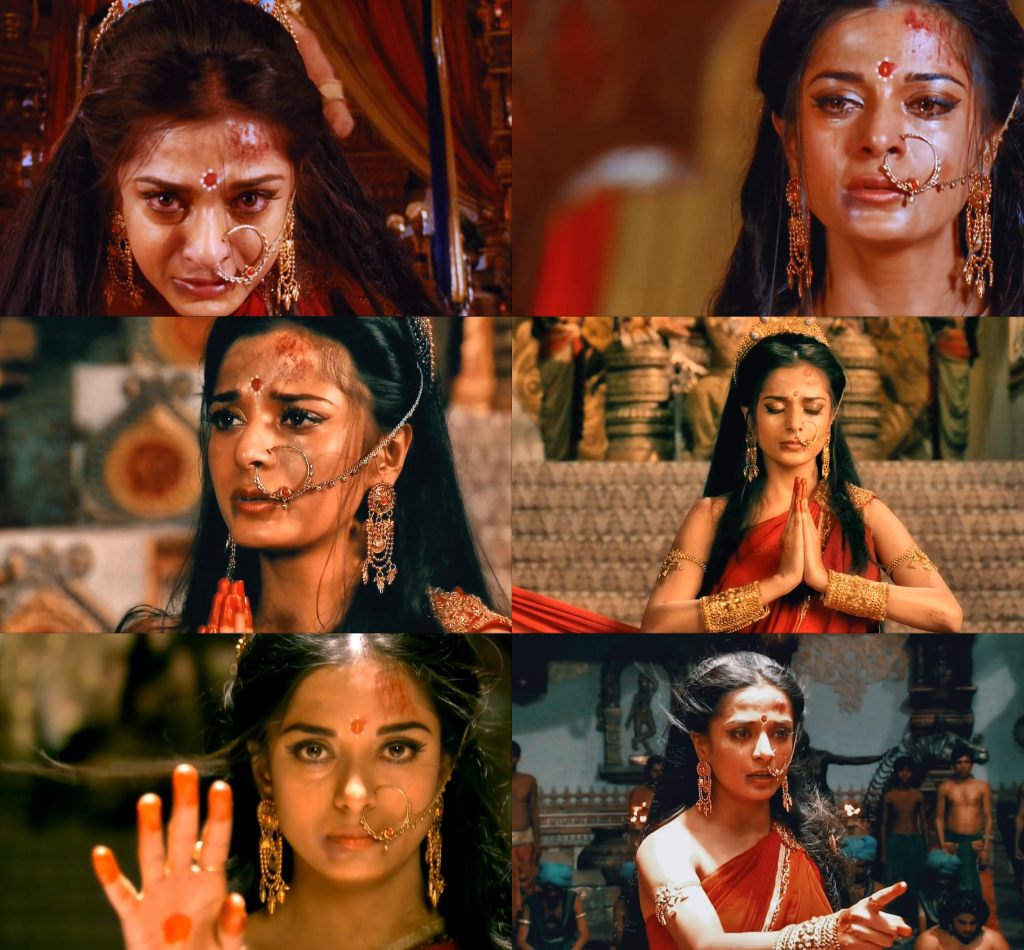
Collage I made of Pooja Sharma as Draupadī in the 2013 Mahābhārat. Although the TV series presents many distortions, her brilliant, fiery performance makes viewing it a joy for me.
♥️ happy to be graduating with a distinction in my first master’s degree!
♥️ what a transformative journey this MA has been – i would not lightly call my last year at lancaster university life-changing! my studies in Indian philosophy and literature, with an emphasis on the exquisite Mahābhāratam, combined with my wondrous immersion in oral practice traditions at Śabda Institute, have radically challenged and changed my perception of both myself and the world, and introduced me to so much beauty, wisdom and wonder.
the pressing longing to * know * that had been hounding me since my teens, it was for * this *. i often joke that it feels as if i wasn’t living before – only dreaming!
grateful to my supervisor, Dr. Brian Black, who guided me in my research and introduced me to the Mahābhārata and its complexities, and incredibly grateful to my beloved teacher, Dr. Kavitha Chinnaiyan, whose teachings are the foundation of all that i do; i am so fortunate that my studies at Śabda Institute enrich my academic writing with the insights, delight and fervour that are only accessible to practitioners.
lifetimes of refinement to go!
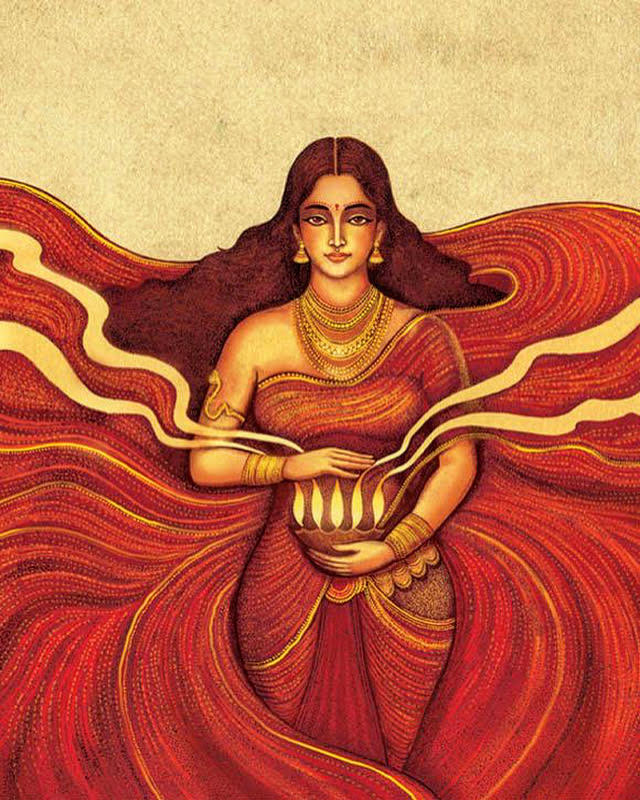
🌺 with the occasion of graduating from my master’s, taking a trip down memory lane to revisit the dearest pieces i worked on during my MA, namely “Feminine Dimensions of ‘God’: The Deification of Mahābhāratam’s Tragic Heroine”, “The Western Revival of Goddess Worship” & “The Question of Religious Violence in the Mahābhārata“. 🌺 my first paper explored the richness of the non-dual concept of ‘God’ by addressing the intricate worship of Draupadī, the Mahābhārata’s enigmatic female character – whose tragic and distinct storyline establishes her as a multifaceted heroine: a devoted wife; a caring mother; an abused and vindictive woman; a polyandrous empress; an avatāra of the Goddess; the Supreme Parāśakti, the all-pervading absolute reality herself; the celestial Śrī. i argued that, through the worship of an abused & vengeful woman, her devotees are deifying the entirety of the human experience. this piece has been my heart and soul, as my love for the fireborn Yājñasenī Draupadī knows no bounds. ♥️ 🌺 my second essay employed a discourse rooted in psychoanalysis, and was centred on the therapeutic values Goddess archetypes hold for the traumatised female psyche + commented on the ramifications of the phenomenon of religious revival in a secular age. 🌺 my third paper deconstructed the hypothesis of the existence of instigation to religious violence in the Mahābhārata – but this perhaps deserves a post of its own, so some other time. ♥️ current situation is incessant editing, and i am hopeful that in 2022 they will feel ready for publication. cannot wait to share my findings. image: “The Flaming Tresses of Draupadī” by Onkar Fondekar, for the illustration of the cover of the book of the same name written by Veerappa Moily, Rupa Publications. ♥️
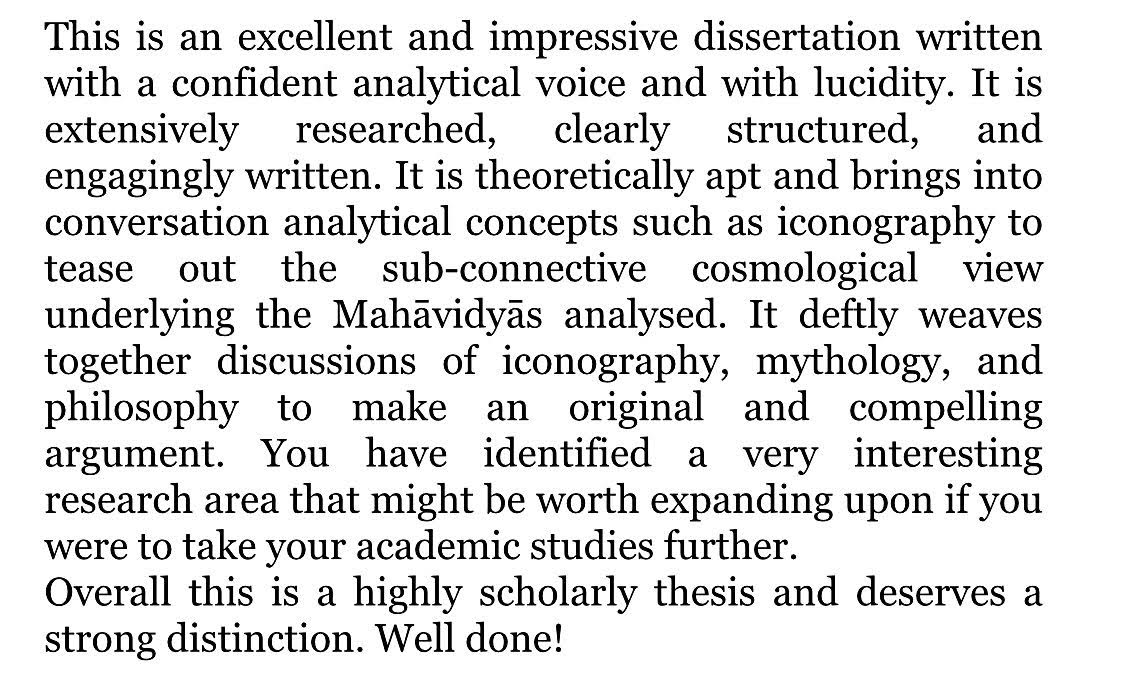
finally, attaching below the praise i received for my MA dissertation, which i plan to publish one day:
“This is an excellent and impressive dissertation written with a confident analytical voice and with lucidity. It is extensively researched, clearly structured, and engagingly written. It is theoretically apt and brings into conversation analytical concepts such as iconography to tease out the sub-connective cosmological view underlying the Mahāvidyās analysed. It deftly weaves together discussions of iconography, mythology, and philosophy to make an original and compelling argument. You have identified a very interesting research area that might be worth expanding upon if you were to take your academic studies further.
Overall this is a highly scholarly thesis and deserves a strong distinction. Well done!”
my christmas gift from dad has been the final draft of my MA dissertation, bound and printed on the glossiest paper (my favourite!). couldn’t take my eyes off how glorious the images of the Mahāvidyā Devīs looked. ♥️ the most precious christmas gift of all time for me. ♥️ cover-image: Mātaṅgī by Kailash Raj | Lalitā by Ekabhumi Ellik, Colouring Shakti. (2015) | the creations of the two artists are mesmerising and would recommend all to check them out! ♥️
and, journal-musing: this term has been so fruitful, despite working completely from home! i haven’t spent so much time at home since high school and, to an extent, i’ve felt like i was transported back to that time – minus the insecurities !
anyway, Mahābhārata’s been living in my head rent-free, and i’ve dedicated my time & research to writing about violence & religious conflict as they transpire in my beloved Kṛṣṇa’s actions and speech in the Kurukṣetra war & in the Bhagavad-gītā. additionally, i’m excited to be completing my first independent study, an exploration of issues of purity & impurity in non-dual philosophy, and to be undertaking a small research project into consumer spirituality and the relentless commodification that comes with it.
all in all, i am deeply grateful to be offered the opportunity to explore the marvellous Mahābhārata once more. its poetic teachings and ample cosmological symbolism have permeated through me and i often wish its universe would swallow me whole nonetheless, i’m certain that one needs to dedicate ten lifetimes to one parva, and i am not exaggerating ! as Vyāsa himself states in Ādi Parva: ~ what is found here, may be found elsewhere. what is not found here, will not be found elsewhere ~
i’ve never had so much workload crammed into such a short timespan, but i’ve been trying to savour the flavour of busyness. it’s alien to be doing all of this in my childhood home. it’s a fun parallel, though – whilst musing on the Bhagavad-gītā (by the way, we are exploring the B-g in our monthly satsaṅgs at #sabdainstitute with our beloved teacher Dr. Kavitha Chinnaiyan!), it dawned on me that i was so hungry for this knowledge in my teens, but i didn’t know where or how to look. it came to me in the end, and what a great joy it is ~ to sip the honey of “the stainless lotus of the Mahābhārata, born on the waters of the words of Vyāsa, fully blossomed through the grace of Hari…” ~ {my vague attempt at translating a śloka}
so thrilled to share that i finished the two papers i’ve been working on these past months: “Feminine Dimensions of ‘God’: The Deification of Mahābhārata’s Tragic Heroine” & “The Western Revival of Goddess Worship”.
my first essay explored the richness of the non-dual concept of ‘God’ by addressing the intricate worship of Draupadī, Mahābhārata’s enigmatic female character – whose tragic and distinct storyline establishes her as a multifaceted heroine: a devoted wife; a caring mother; an abused and vindicative woman; a polyandrous empress; an avatar of the Goddess; the Supreme Parāśakti, the all-pervading absolute reality herself; the celestial Śrī. i argued that, through the worship of an abused & vengeful woman, her devotees are deifying the entirety of the human experience. my second essay employed a discourse rooted in psychoanalysis, and was centred on the therapeutic values Goddess archetypes hold for the traumatised female psyche + commented on the ramifications of the phenomenon of religious revival in a secular age.
i have adored writing both, no matter how frustrating the writing inevitably got at times. i had so much fun with the two topics, which i’m very passionate about, but i especially enjoyed delving into Mahābhārata – three months in, and i still am absolutely fascinated by it and in awe of the beautiful Draupadī, who i’m sure will be the subject of much of my future research.
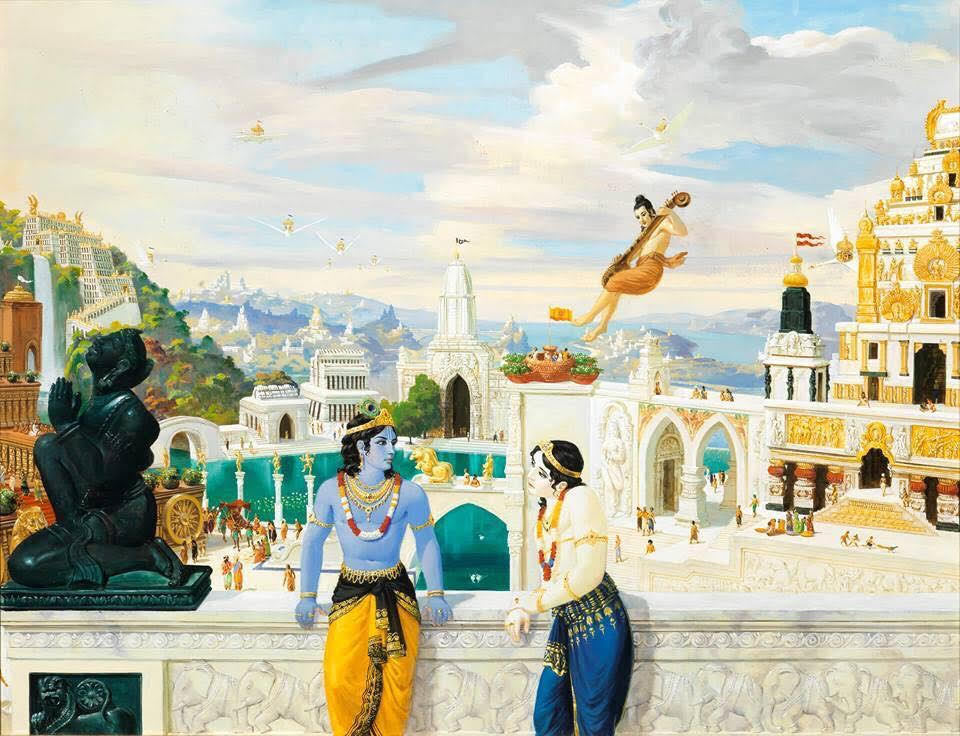
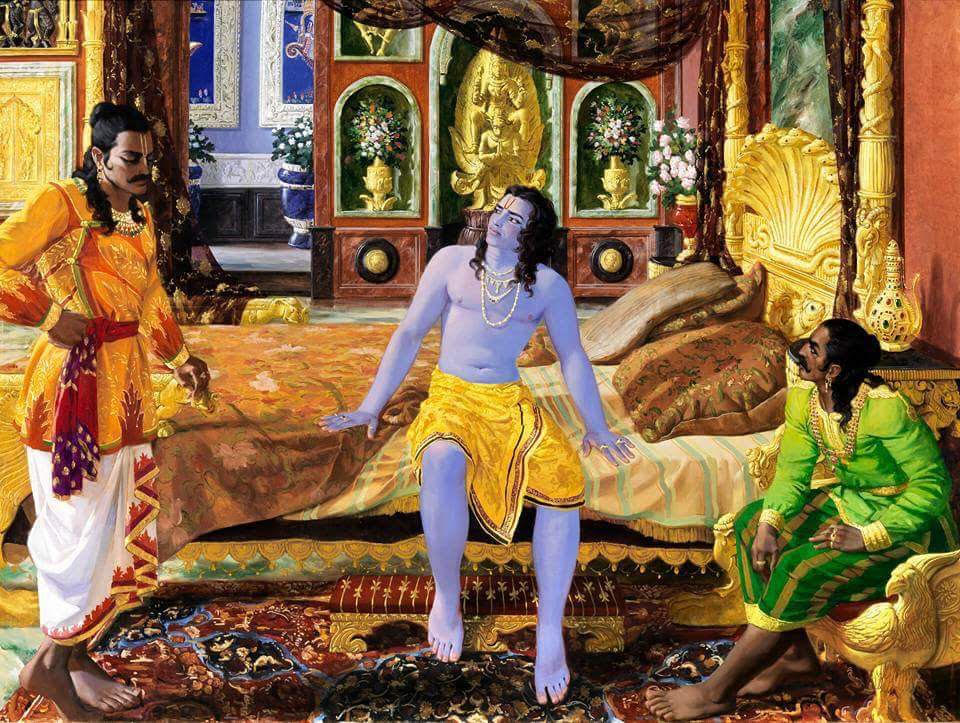
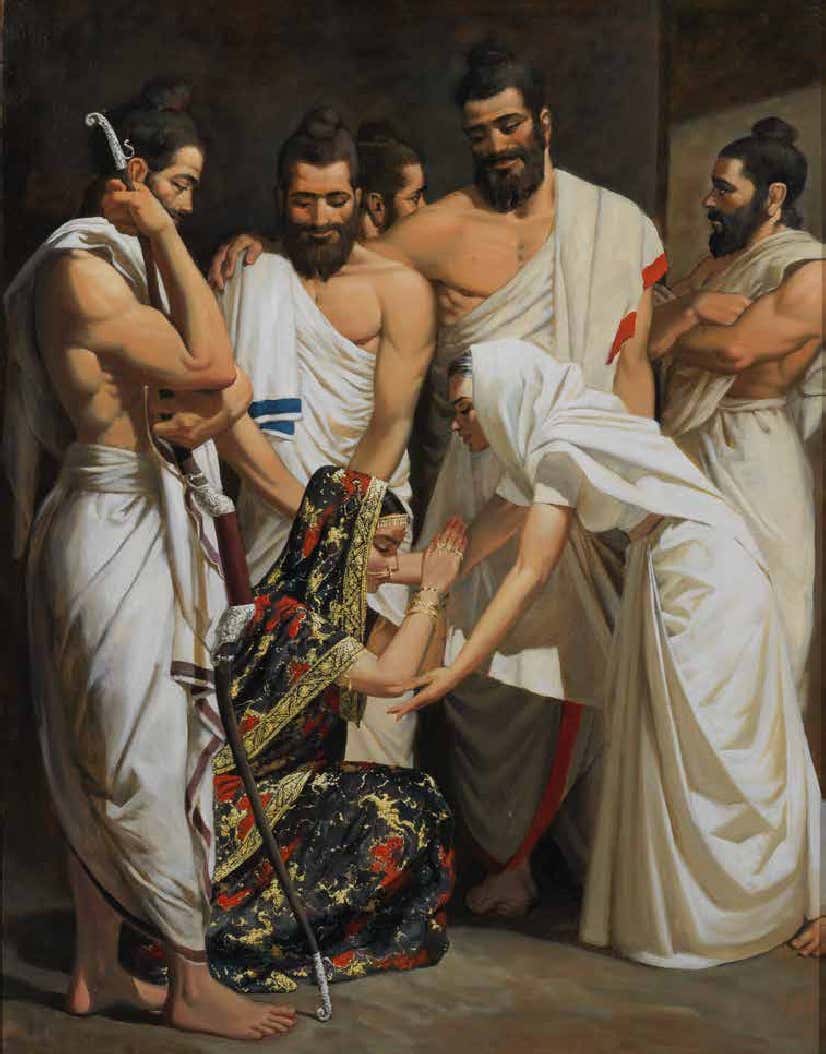
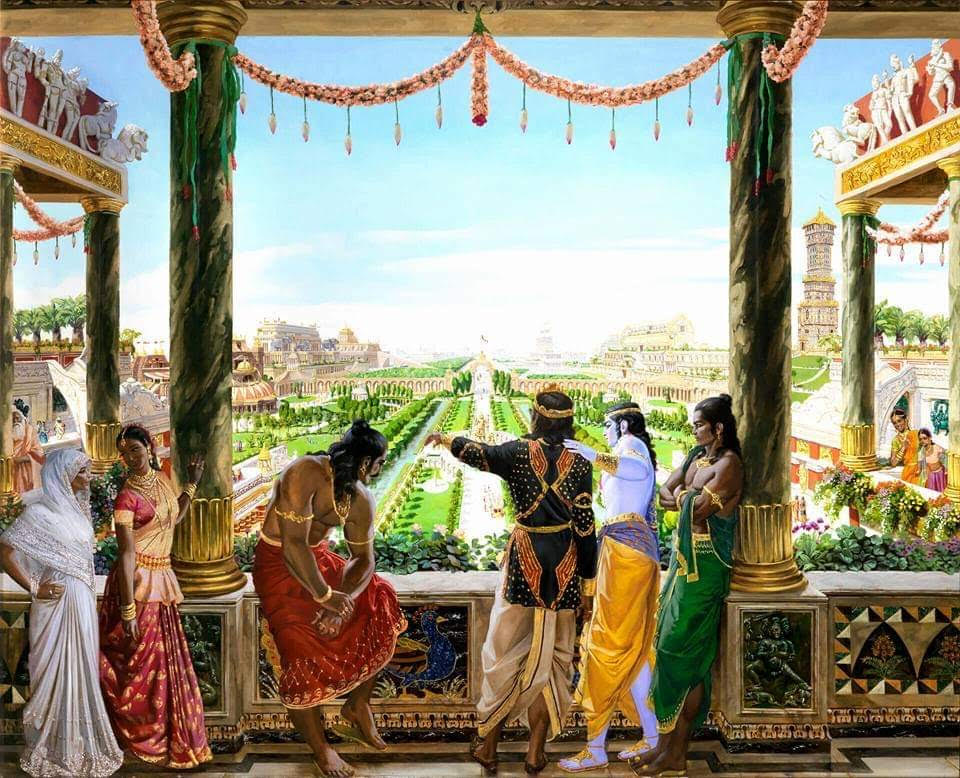
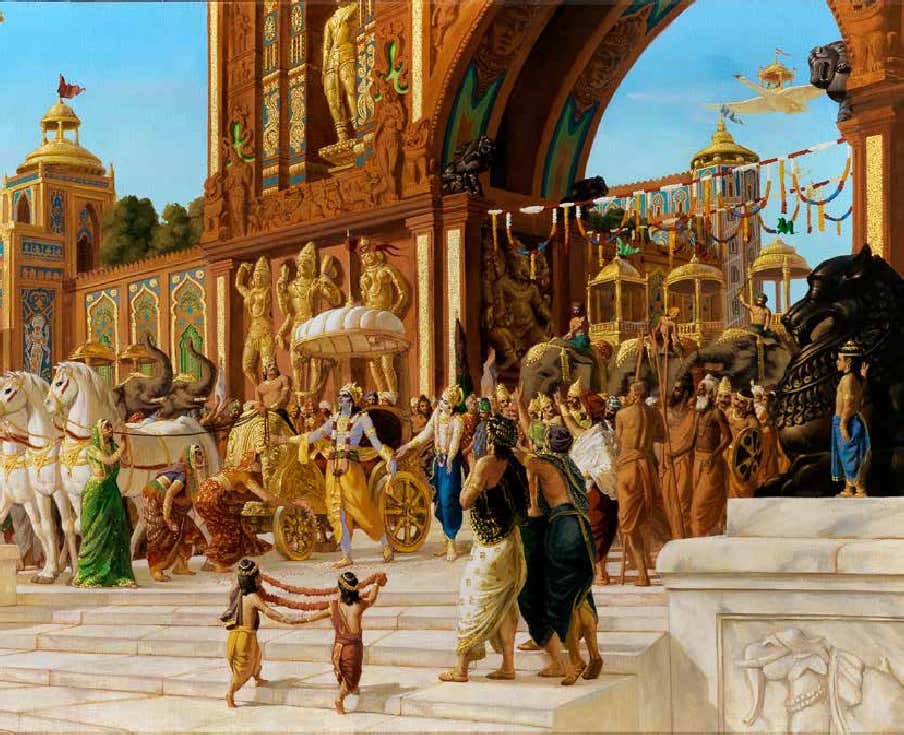
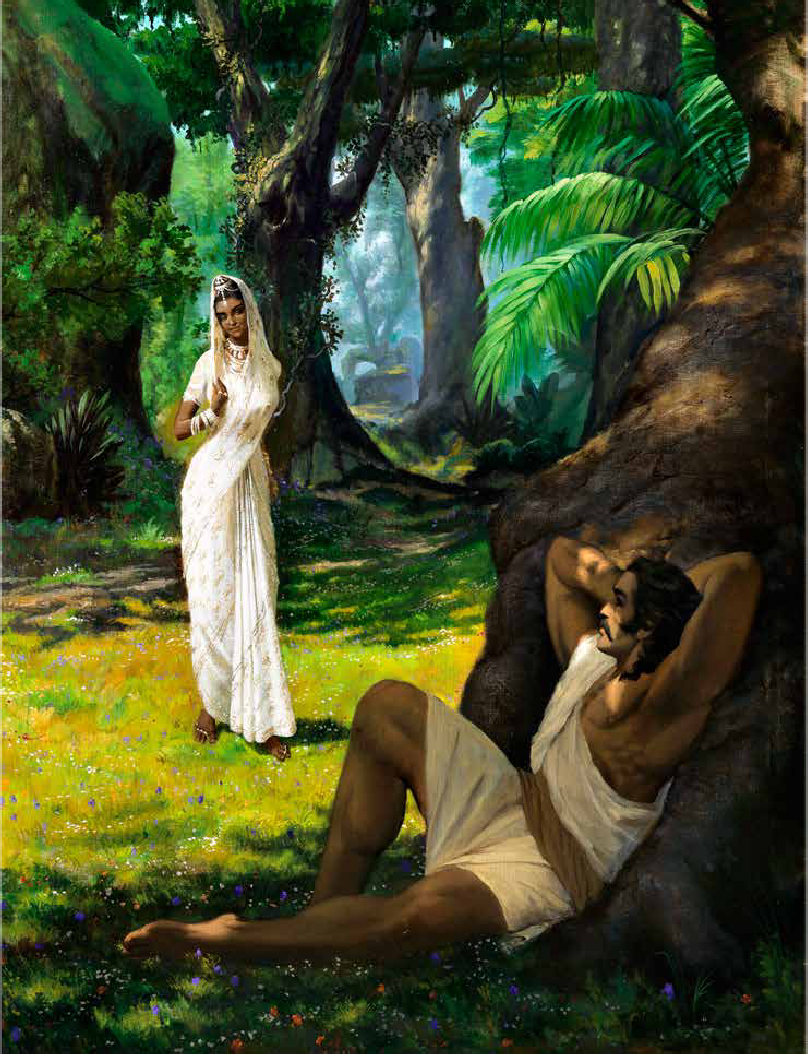
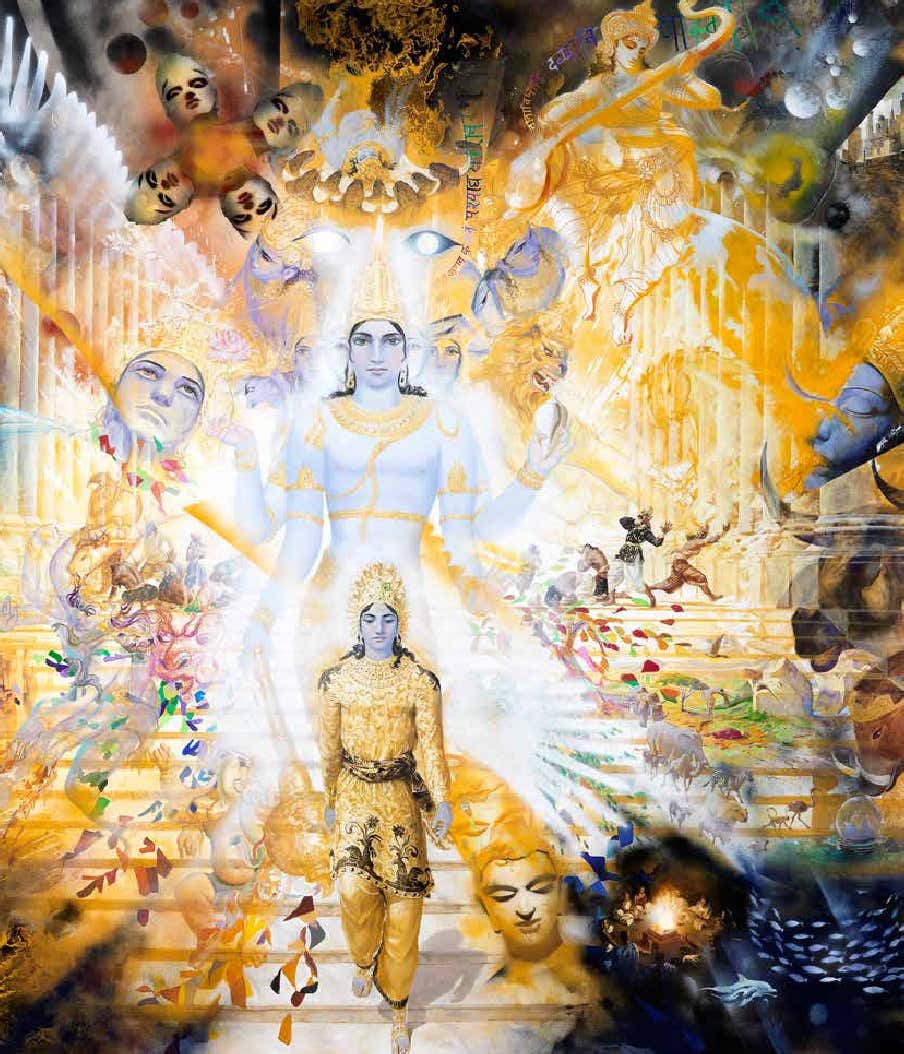
on this occasion, attaching here the marvellous paintings of Giampaolo Tomassetti, who dedicated 17 years of his life to studying & painting the Mahābhārata pictured:
Kṛṣṇa & Balarāma in Dvārakā (my favourite )
Kṛṣṇa advising the Pāṇḍavas
Draupadī meets Kuntī
Kuntī & Karṇa
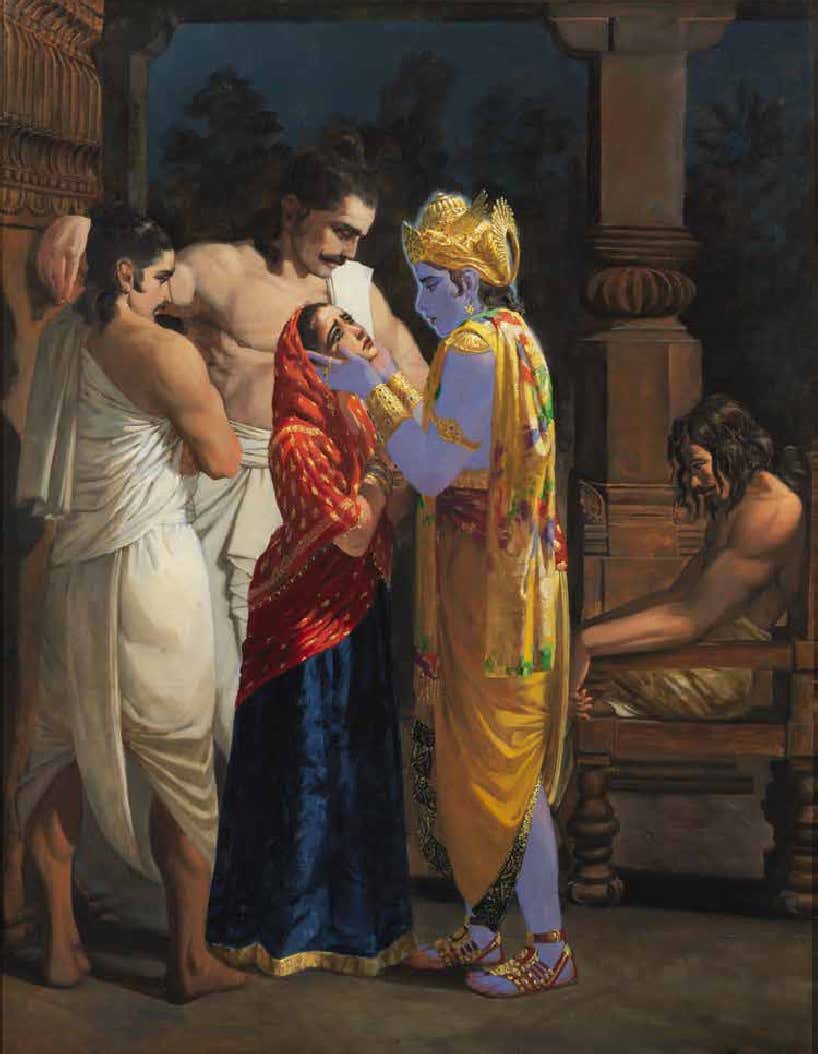
Kṛṣṇa comforting Draupadī after ~ dice match & disrobing ~
Kṛṣṇa reveals his universal form (Govindarūpiṇī)
Kuntī & Sūrya
Kṛṣṇa, the Pāṇḍavas, Draupadī & Kuntī in Indraprastha




 !
! additionally, i’m excited to be completing my first independent study, an exploration of issues of purity & impurity in non-dual philosophy, and to be undertaking a small research project into consumer spirituality and the relentless commodification that comes with it.






 amaryllis