Draupadī and the Dharma of Women

“Strī” translates from Sanskrit as “woman”, while “dharma” is a complex principle with manifold meanings, in this context bearing the significance of “duty”; in simple terms, it refers to an individual conduct that contributes to harmony in a greater framework, be it societal or cosmological.

Draupadī is lauded in the Critical Edition of the Mbh several times as being the epitome of strī-dharma, of the dharma of women. (2.62.20; 2.63.25-30; 2.64). Interestingly, she is most intensely praised as such after she angrily (yet elegantly!) questions the men of the royal court and demands justice, being anything but meek and demure. I would argue that this showcases that in the Mahābhārata voicing oneself and standing up for oneself are considered responsibilities belonging to the dharma of women.

To nuance this even more, Eknath Easwaran, an eminent translator of the Bhagavadgītā, highlights that, etymologically, the term “dharma” can be traced back to the root ‘dhri’, which means ‘to support, hold up, or bear’; “dharma” therefore translates as “that which supports”, and Draupadī’s conduct therefore supports both society and cosmology.

In the Sanskrit Mbh, Kṛṣṇa does not appear in the sabhā (royal hall) at the time of Draupadī’s attempted disrobing, and no direct mention of him is made during this episode. In a conversation with Dr. Brian Black, a Mbh researcher whom I had the honour to have as my MA supervisor, we talked about the implication of this, which is that Draupadī’s adherence to strī-dharma appears to be that which shields her. A question that could arise here could be whether there is a contradiction between the Critical Edition and modern renderings of the Mahābhārata, with Draupadī being shielded by her dharma as opposed to by Kṛṣṇa.

For me there is no contradiction.

Kṛṣṇa in the Bhagavadgītā establishes himself as ‘the eternal dharma’ (14.27); and so, Kṛṣṇa is all dharmas, including strī-dharma. We tend to associate Kṛṣṇa with a fully-fledged incarnation; but he is beyond that. I would maintain that, as the divine principle, he exists in Draupadī’s consciousness and in her actions as dharma (and not only!). The latter renditions, for me, in which he is physically there, only bring forth in tangible projections the internal process extending Draupadī’s consciousness.

I will write more about strī-dharma as it appears in the Mbh. ❤️‍🔥

You can find me on IG: @musingsonthemahabharata

and on Tumblr: https://www.tumblr.com/musingsonthemahabharata

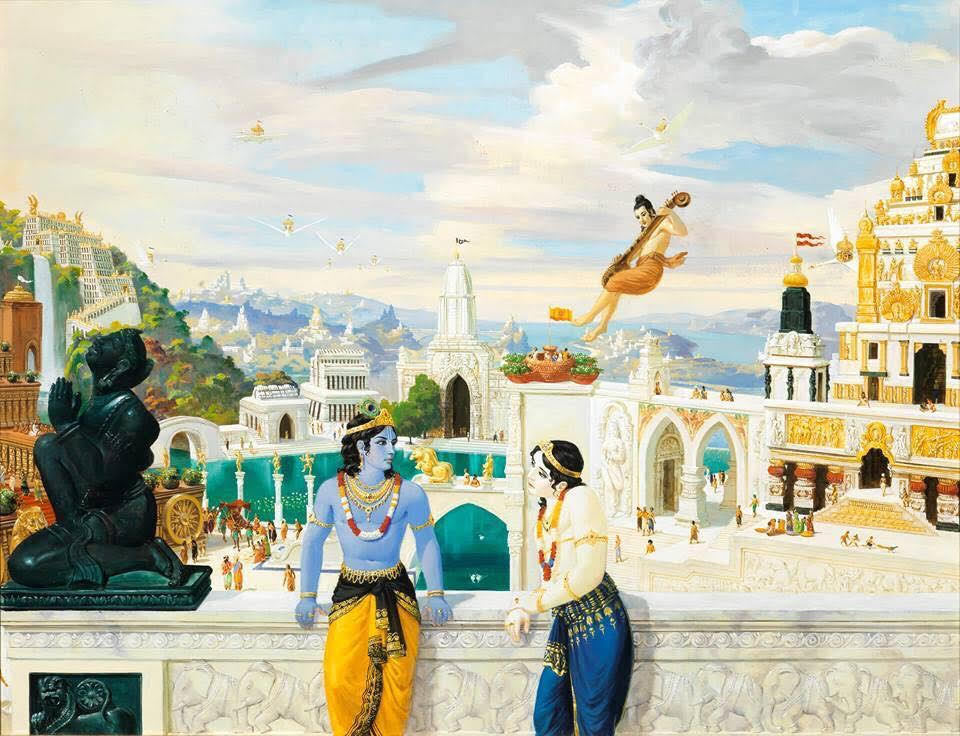
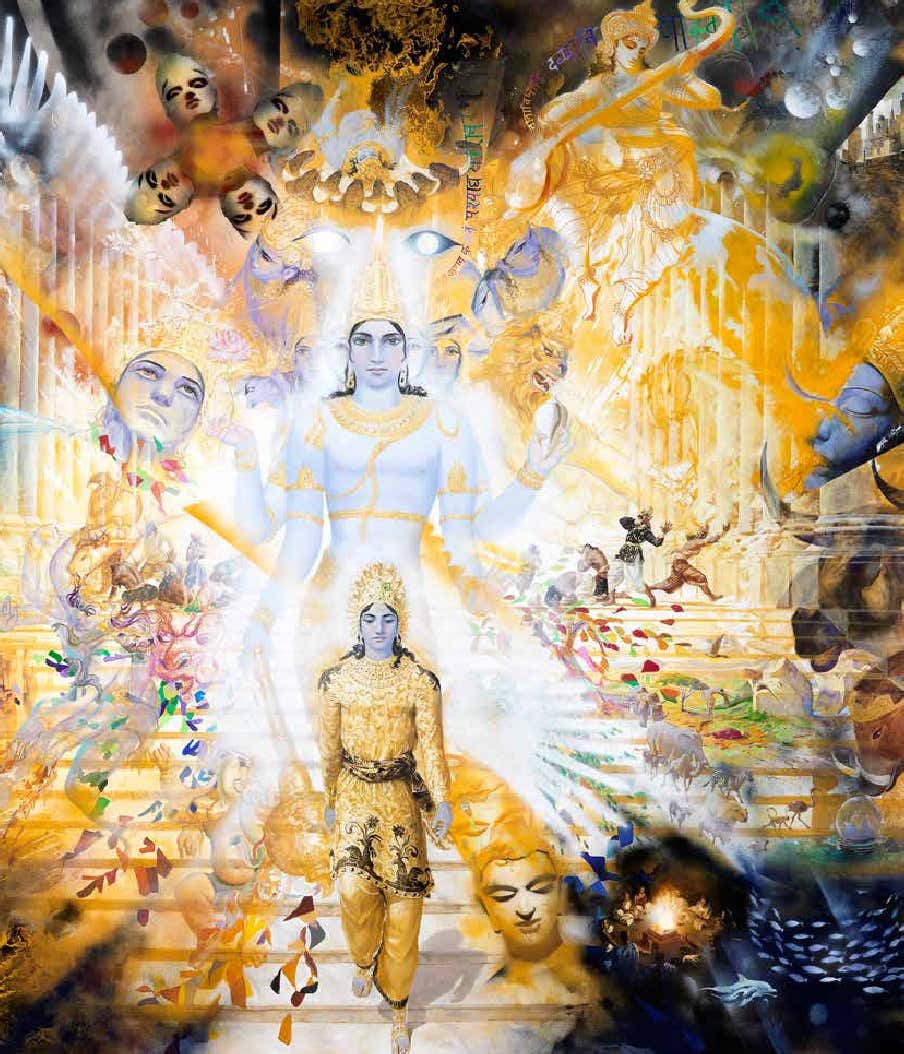
Painting: Jadurani Dasi, 1986.

Yajñasenī by Téa Nicolae

she who was born of fire

she whose beauty enticed even the sun

i garland thee

she whose blood spilled on royal floors of marble

she whose woe scorched the Kurus

i weep with thee

she who was touched yet remained stainless

she whose dishevelled hair holds the griefs of woman

i pray with thee

Draupadī,

she who cried the tears of the women who walked this earth

i am thee.

*poem published in Śabda Magazine, vol. II.

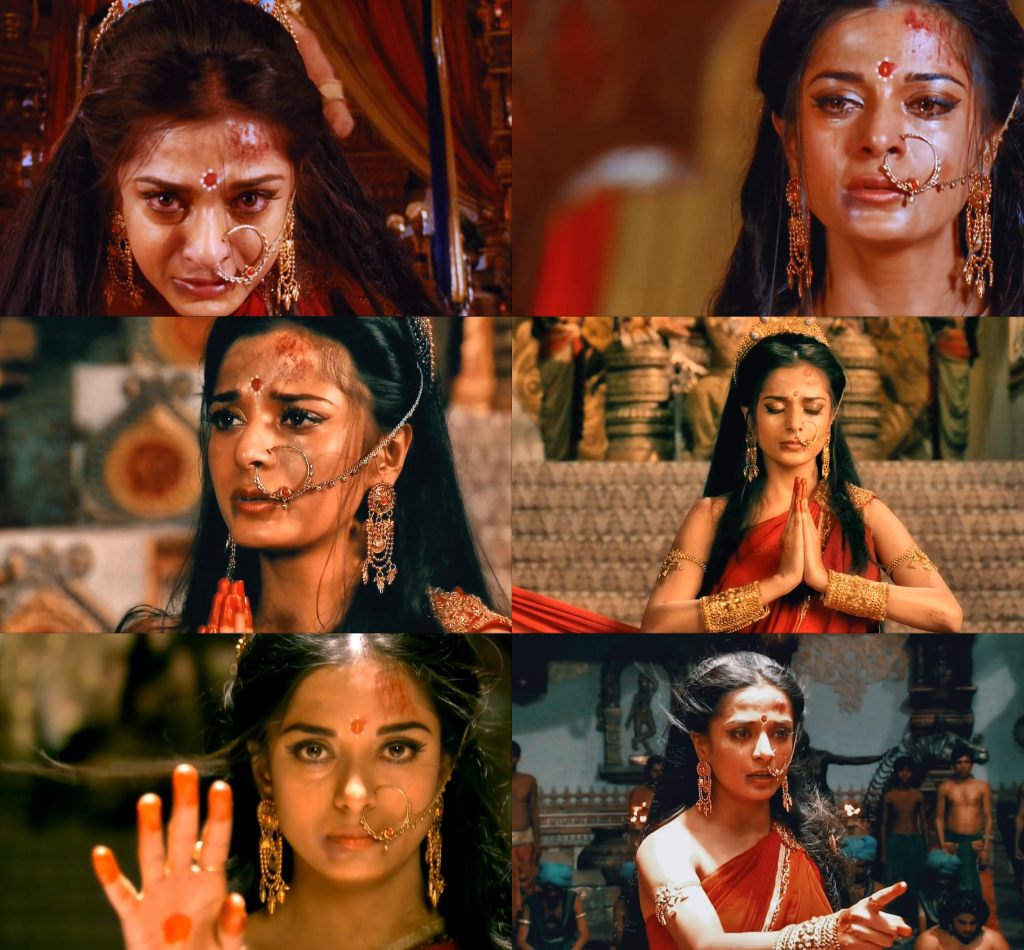
collage i made of pooja sharma as the beloved empress. her performance is etched to my heart!

The Internal Freedom of the Mahābhārata’s Fire-born Heroine

Perhaps one of the most jarring episodes of the Mahābhārata, the disrobing of Draupadī has been etched to my mind since my first introduction to the epic. The story of the Mahābhārata’s fire-born heroine goes as follows: the empress Draupadī, an incarnation of the celestial Śrī, is violently dragged to the royal court after her husbands, the Pāṇḍavas, are enslaved through deceit. Draupadī is tearful, menstruating, and the Pāṇḍavas’ offenders, the Kauravas, attempt to enslave her. However, she fiercely debates them and proclaims her freedom. Enraged by her rebuttal, the Kauravas decide to disrobe her. When they mercilessly begin to pull her clothing, Draupadī’s garment endlessly unfolds, and she remains clothed — by what is presumed to be the grace of Lord Kṛṣṇa.
My fascination with Draupadī first began as awe of the female endurance she embodies. As a woman myself, I deeply identified with her pains, and found our sufferings to mirror each other. In my reflections, my being melded with her character, whom I felt connected to through the thread of shared female experience. I found comfort in her triumph. As I continued mulling over her story, I became inexplicably moved by the imposing testament of devotion that is showcased in her tale; in most renditions of the Mahābhārata, Draupadī, while being abused, earnestly prays to her dearest friend, confidant, and God, Kṛṣṇa, who, out of boundless compassion, answers to her calls and envelops her in his grace. It is a touching picture: as the men of the court hang their heads in shame, bound in silence and inaction by their royal vows, Draupadī, deserted by all, is shielded by her devotion to Kṛṣṇa — and her devotion is enough.
However, my greatest personal and transformational shift has occurred when, with my beloved guru’s guidance, I was able to deconstruct the tale of Draupadī’s anguish in order to delve deeper into the teaching encased in it. Before doing so, there was slight anxiousness in my heart: there was self-doubt, and there were questions; Draupadī had been ‘saved’ through her devotion, but would I be? Would I be saveable or worthy?
Indeed, my mistake had been not delving deeper into the teaching encased in Draupadī’s anguish by remaining stuck at the level of storytelling. The liberating conclusion I have reached is that, in truth, whether the empress’s garment endlessly expanded or not is irrelevant. The teaching veiled in Draupadī’s disrobing is that she was untouchable because she was internally free. The horror she was subjected to did not shake her internal freedom, nor did it dismantle her devotion. Throughout it all, she was rooted in her love for Kṛṣṇa, and immersed in her independent power. As she says in a recent rendition: “You cannot make me your slave because I do not allow it. Independence lies within me; it is not a piece of clothing you can snatch.” All along, the question was not whether I would have been saved; it was whether I could unearth Draupadī’s fearlessness in myself.
The Mahābhārata’s fire-born heroine has taught me that freedom lies within me. It is not given to me by others, and it cannot be taken from me. My freedom is married to my devotion, and my heart holds the keys to both.


This article has been published in the second volume of Śabda Magazine.

Collage I made of Pooja Sharma as Draupadī in the 2013 Mahābhārat. Although the TV series presents many distortions, her brilliant, fiery performance makes viewing it a joy for me.

my papers + Mahābhārata as seen by Giampaolo Tomassetti

so thrilled to share that i finished the two papers i’ve been working on these past months: “Feminine Dimensions of ‘God’: The Deification of Mahābhārata’s Tragic Heroine” & “The Western Revival of Goddess Worship”. 🤍

my first essay explored the richness of the non-dual concept of ‘God’ by addressing the intricate worship of Draupadī, Mahābhārata’s enigmatic female character – whose tragic and distinct storyline establishes her as a multifaceted heroine: a devoted wife; a caring mother; an abused and vindicative woman; a polyandrous empress; an avatar of the Goddess; the Supreme Parāśakti, the all-pervading absolute reality herself; the celestial Śrī. i argued that, through the worship of an abused & vengeful woman, her devotees are deifying the entirety of the human experience. 🤍my second essay employed a discourse rooted in psychoanalysis, and was centred on the therapeutic values Goddess archetypes hold for the traumatised female psyche + commented on the ramifications of the phenomenon of religious revival in a secular age.

🕊i have adored writing both, no matter how frustrating the writing inevitably got at times. i had so much fun with the two topics, which i’m very passionate about, but i especially enjoyed delving into Mahābhārata – three months in, and i still am absolutely fascinated by it and in awe of the beautiful Draupadī, who i’m sure will be the subject of much of my future research. 🌹

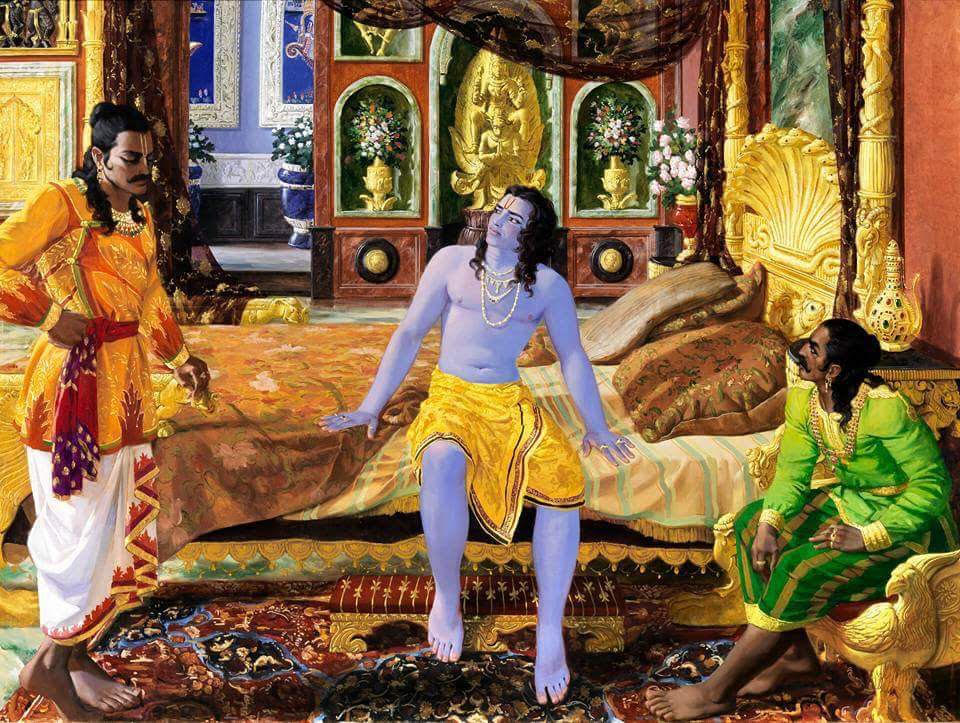
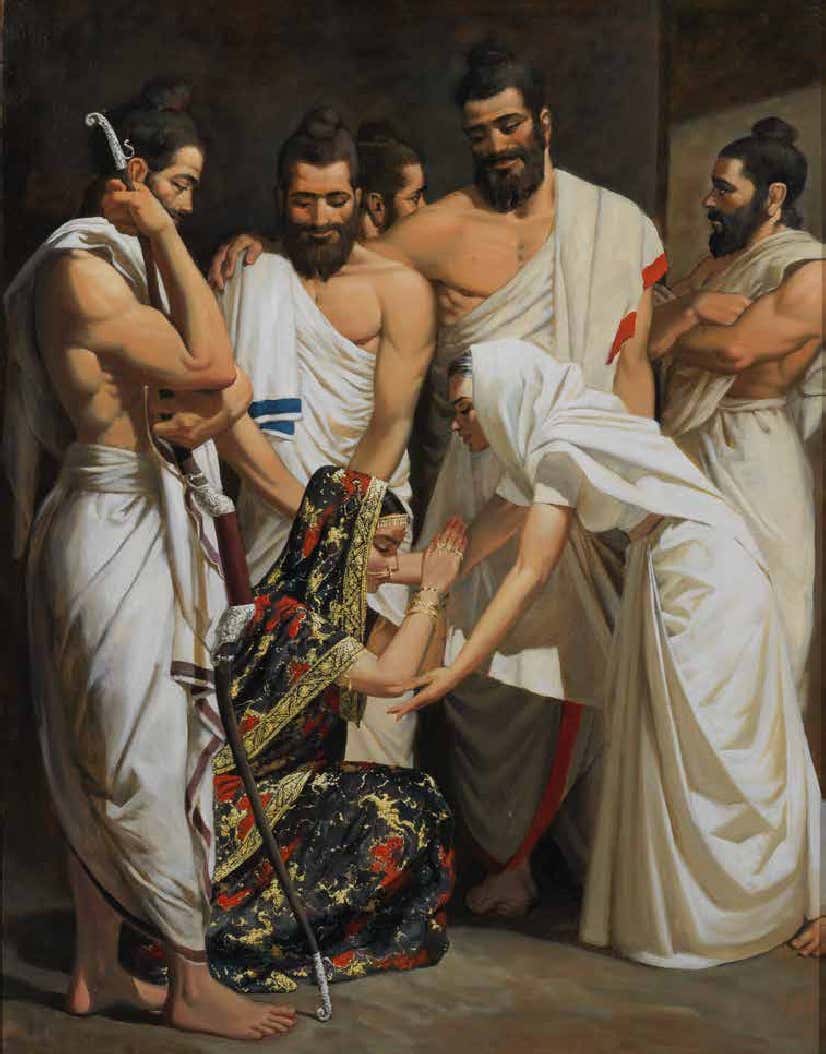
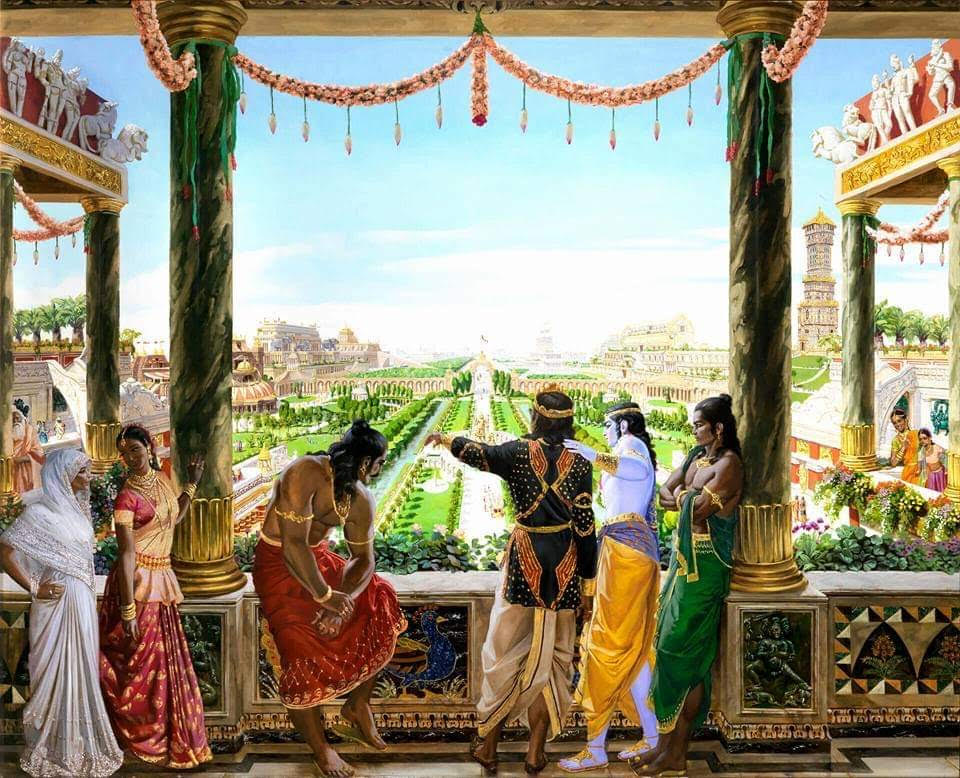
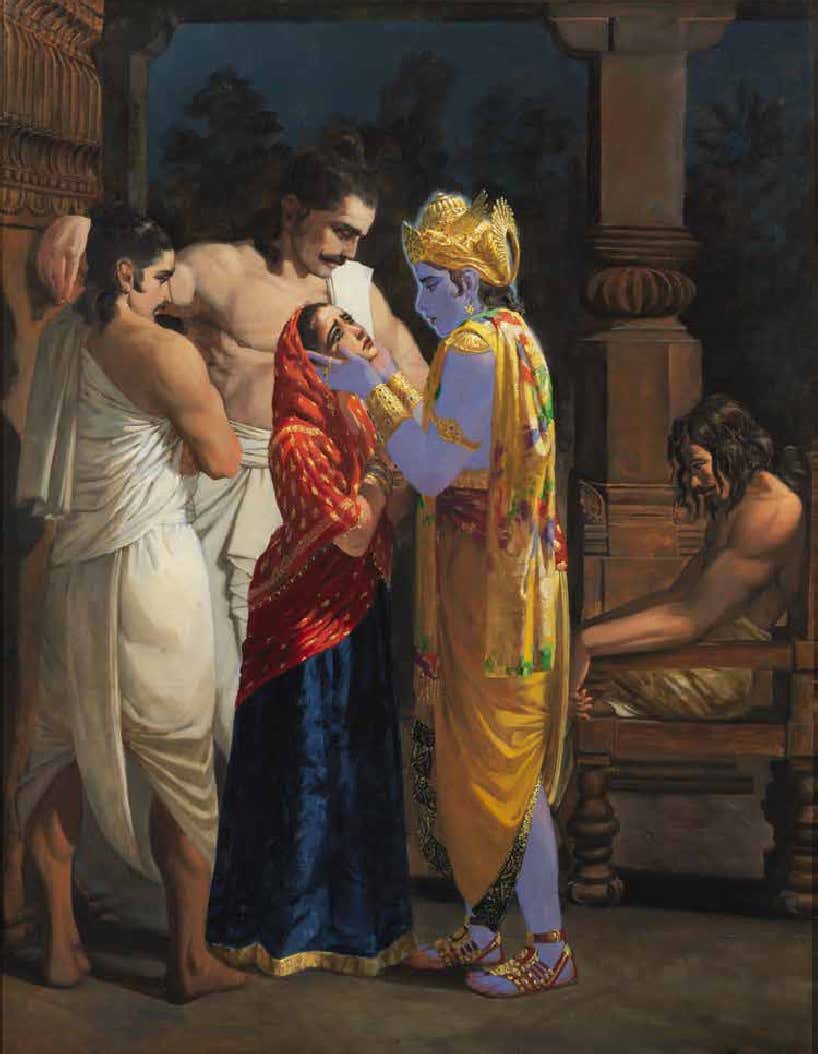
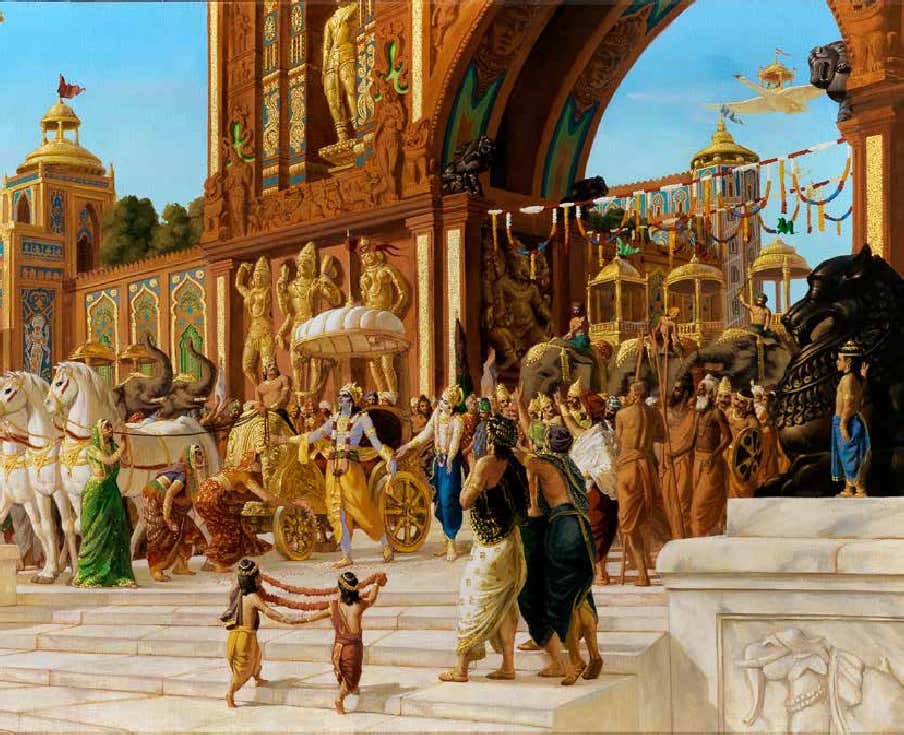
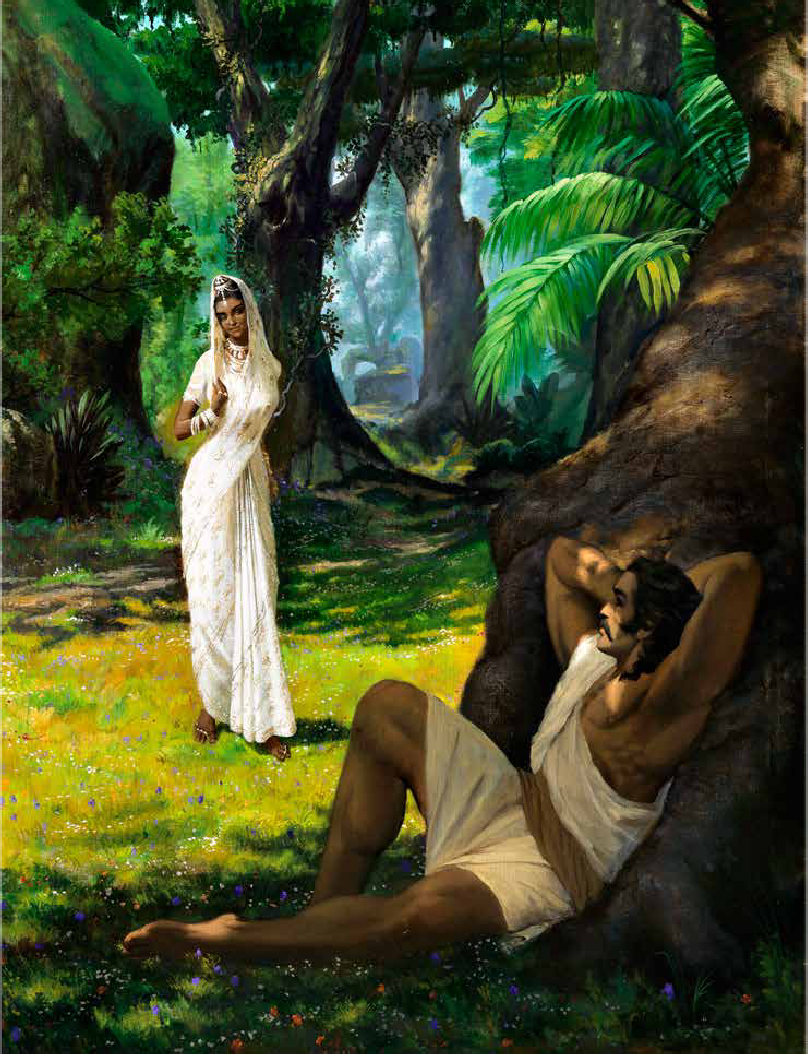
on this occasion, attaching here the marvellous paintings of Giampaolo Tomassetti, who dedicated 17 years of his life to studying & painting the Mahābhārata 🤍pictured:

Kṛṣṇa & Balarāma in Dvārakā (my favourite 🕊)

Kṛṣṇa advising the Pāṇḍavas

Draupadī meets Kuntī

Kuntī & Karṇa

Kṛṣṇa comforting Draupadī after ~ dice match & disrobing ~

Kṛṣṇa reveals his universal form (Govindarūpiṇī)

Kuntī & Sūrya

Kṛṣṇa, the Pāṇḍavas, Draupadī & Kuntī in Indraprastha

Bhīma & Hiḍimbī

Dvārakā