amaryllis (/ˌæməˈrɪlɪs/[1]) – bears the name of the shepherdess in virgil's pastoral eclogues. it stems from the greek ἀμαρύσσω (amarysso), meaning "to sparkle", and it is rooted in "amarella" for the bitterness of the bulb. the common name, "naked lady", comes from the plant's pattern of flowering that blooms when the foliage dies. in the victorian language of flowers, it means "radiant beauty".
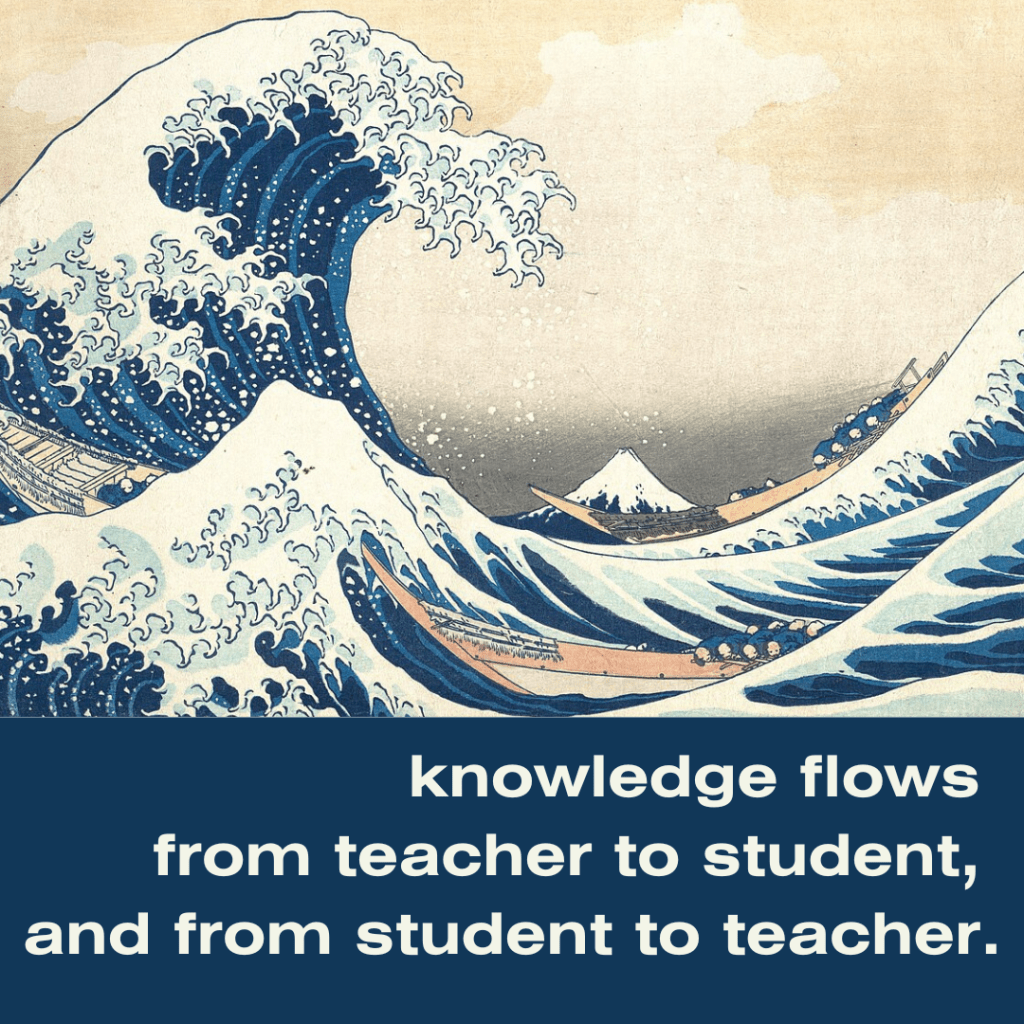
knowledge flows from teacher to student, and from student to teacher.
at the beginning of my academic journey, i was continuously surprised by the way the majority of our professors engaged with me and my colleagues; not only did they genuinely express interest in our opinions, but they also valued our input, ensured the openness of dialogue between us, and consistently encouraged us to become independent in thought and in writing. the learning environment i had been exposed to until then, namely secondary education in my home country, had been completely different: it had been one of strict hierarchy, in which plurality of thought was not existent, and in which the minds and experiences of students were not valued. it took me awhile to become used to – well, being valued, and to valuing my input myself.
i remember one particular exchange i had with a professor of mine, in which i expressed my understanding of one subject and proceeded to reflexively dismiss it by cloaking it in the “i am just a student, and who am i to say anything about this” garb. my professor stopped me and said something along the lines of: “yes, we are just people. but that doesn’t mean our contributions can’t be meaningful.”
the first week of my Ph.D. was similar: professors consistently reminded me and my colleagues that we are more than students, and they see us as valuable members of a research community that works together. they encouraged us to renounce our inhibitions, and to think, write and act as such.
it has become exceedingly important for me in my journey to be in such learning environments in which, past the roles of students and teachers that we play, there is an understanding of the flow of knowledge, which, in my view, would be limiting to think of as flowing rigidly in only one direction. knowledge flows from teacher to student, but also from student to teacher, and from student to student. i believe that to cut oneself off from receiving the flow from any source because of preconceived ideas of how it flows, and who to learn from, is a great loss.
sometime ago, i had a great conversation with my dear friend Avi Sato about how these same principles of knowledge flow apply in the area of spirituality as well, nuance which had long eluded me.
my second Master’s Degree is officially COMPLETE!! these past two years at Warwick University were a rich immersion in the art of poetry & in the practice of literary translation. milestones achieved have been:
completing my dissertation, entitled “Rendering Sacred Texts: Ethics and the Question of Untranslatability”, in which i explored the practice of translating sacred texts and the intricate issues it presents in the field of translation studies, mainly posed by the dilemma that is the hypothesis of an intrinsically sacred quality to languages such as Sanskrit or Latin. i argued that in the case of non-dual traditions, the subsequent question, of whether translation would defile the text, is incongruent with the philosophy & cosmology the text is rooted in. i used the Lalitāsahasranāma, a central hymn of Śrīvidyā, as a case-study.
conducting my poetic research centred on bhakti or devotional poetry, a genre of Indian poetry which worships the Divine as the Beloved. i worked on two bhakti collections: “odes to the Monsoon One” and “the Monsoon One and the pilgrim”, which explore a woman’s mystical journey. written as a response to the lingering legacy of female exclusion from spirituality that is present literature, the poetry rebels against misogynistic religious texts thematically, through female-centred imagery deifying the demonised body, through the subversion of elements of oppression such as motifs of marriage. the Divine is worshipped in my poems as a lover. i argued that for as long as remnants of a religious culture exclusive of women persist in South Asian literature and practice, for so long will bhakti poetry be needed for devotional rebuttal.
more on this soon! i am hoping for these to be published in 2024 or 2025.
i extend my gratitude to my extraordinary professors: my supervisors Dr. Jodie Kim & Rosalind Harvey; Professor David Morley, as well as Dr. Chantal Wright, who generously & expertly encouraged and guided me, as well as expressed genuine interest in my work – interest which i especially appreciated when my work took unconventional routes!
as this chapter ends, a new one at Edinburgh begins! onward!
In response to the article about Draupadī’s disrobing that I shared yesterday, Jim beautifully questioned whether the act of violence spurred from limited views around nudity and if it would have been avoided if nudity was perceived differently in that society (if it was common, seen as sacred or normal). This was a very rich ground of contemplation for me, and the reflections I have had are the following:
First, I would like to establish that Draupadī was not wearing a sari when her attempted disrobing took place. She was wearing a single cloth which covered her body through which she was menstruating, which was the custom at the time. It can be deduced through various references toward her appearance found throughout the Mbh that, outside of the timeframe of her menses period, she did not customarily wear an upper garment, so her breasts were uncovered. At the time of her attempted disrobing, she was wearing more clothes that she usually was. The men had already seen part of her body which they wanted to disrobe. There are scholars who argue that she was not wearing a single cloth at the time of her disrobing and she was instead wearing both an upper garment and a lower garment. I would argue that this is irrelevant, as the point still remains that her breasts were covered, and they usually were not.
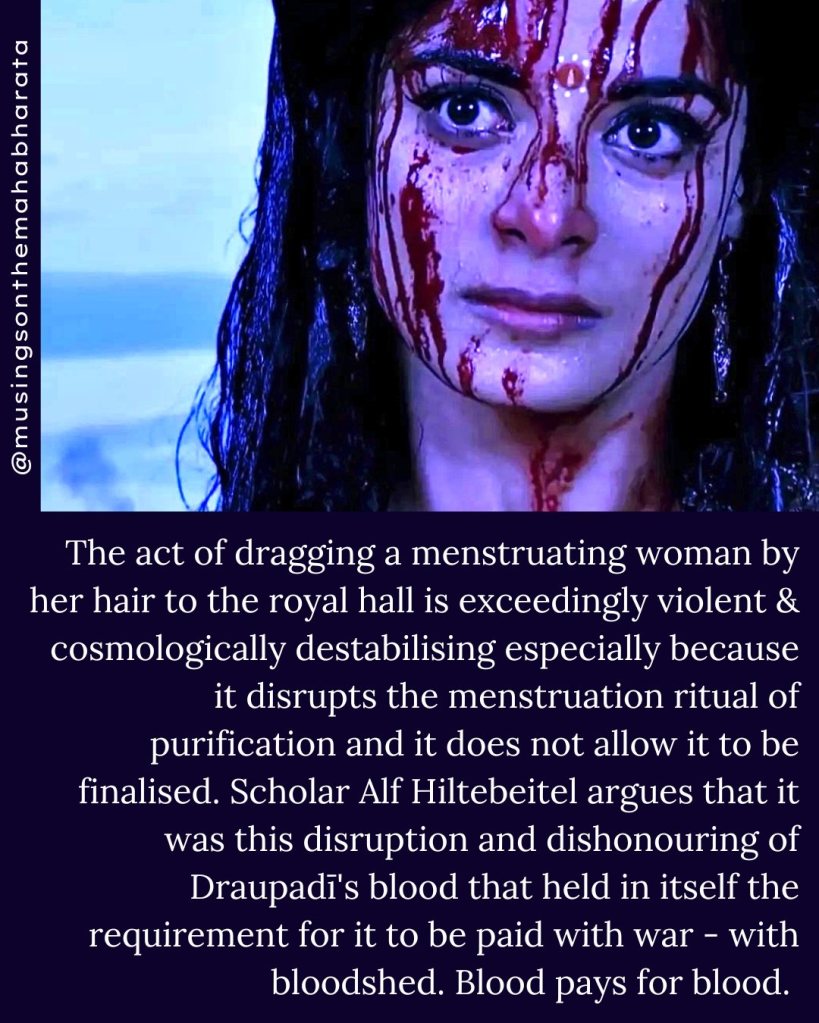
Second, I would maintain that, the disrobing episode, as most acts of sexual violence, was more about power than about sex or nudity, and that the key factor here, lost in so many adaptations, was not the attempted disrobing & possible nudity, it was the fact that Draupadī was menstruating, and she was brought to the royal hall in a stained garment through which she was free-bleeding. Menses was / is considered a period of purification. The act of dragging a menstruating woman by her hair to the royal hall – who, as I priorly mentioned, was wearing more clothes than usually – is exceedingly violent & cosmologically destabilising especially because it disrupts the menstruation ritual of purification and it does not allow it to be finalised. Further, hair in itself is a symbol of sexual power for a woman. Duśāsana grabbing Draupadī’s hair is an attempt to curb her sexual power and own her sexuality.
Draupadī bleeds in the hall and leaves Hastinapura bleeding through her clothes. Scholar Alf Hiltebeitel argues that it was the dishonouring of her blood that held in itself the requirement for it to be paid with war; with bloodshed. In the cosmological cycle, blood pays for blood.
The Kauravas wanted to humiliate, own and disempower Draupadī; nudity was one of the means to get there, along with disturbing her purification rituals, not the end goal. However, one could argue that in a society in which nudity was seen as sacred the intention to humiliate wouldn’t have arisen in that openness or expansion of consciousness – but maybe it would have just taken a different form and found different means.
Photo: Pooja Sharma as Draupadī, bathed in the blood of her principal offender. The cosmological cycle is finalised.
I am incredibly honoured and moved to share that I am being awarded the Edinburgh Doctoral College scholarship of the School of Divinity and will be commencing my Ph.D. at Edinburgh University in September with full funding for my research, and with a thesis entitled (as of now!) “The Goddess’s Descent to Earth: In Dialogue with the Reimaginations of the Mahābhārata’s Draupadī”. I am extremely grateful to Professors Mark Harris, Alison Jack and to the board of the School of Divinity for believing in my work. There were times when I was close to not believing in it myself, but the love for the work has pulled me to keep moving forward even in the greatest moments of doubt. More exactly, the love has grown to be greater – and, to be honest, more interesting – than my doubt or uncertainties about myself, which are less exciting to follow than the mysteries that are to be uncovered.
Once, a teacher of mine shared that, if you quiet the mind and listen to your depths, you will be able to feel a thread, a glimmer – pulling you to where and how life wants to move through you. Where that is, as well as getting there, could seem unattainable by way of reason or logic, but the thread will pull you through in ways unimaginable to your perception, with its current limitations and insecurities. This has been my experience, as well.
Follow the thread. Let the love for your work guide you and pave your path.
recommendations for abridged and unabridged translations of the Mahābhārata, as well as reading and referencing tips 🤍.
to reiterate the last point i made in my video first, i would like to accentuate that those of us who rely on translations and are inhibited by the language barrier are already working with a diluted version of the Mbh; it is for this reason that it is exceptionally important to work with the best and most authentic translation that is accessible for us, especially if we are scholars. in this, we can ensure that we are not perpetuating any misunderstanding or false information in the world. 🤍
🔱 unabridged translations:
🔱 for the first five parvas – J. A. B. van Buitenen | for the remaining books of war – Clay Sanskrit Library | these are exquisite, elegant, all-encompassing, and delicious works of translation.
additionally, i use the abridged translation created by John D. Smith and published by Penguin Classics as a handbook or manual to find my way through the unabridged versions when i write papers. this is extremely efficient for referencing – a compass or map to guide you through the verses. i expand on this in the video, and will additionally create a separate video about how to reference the Mbh.
🔱 the recommendations i have shared have been given to me by my amazing MA supervisor from Lancaster University, Dr. Brian Black, who instilled within me the love for the Mahābhārata in academia, and supported me through my research and my PhD application process. in my opinion, he is one of the most dedicated and passionate contemporary researchers of the Mbh, and i am most grateful to him. his book, ‘In Dialogue with the Mahābhārata’, is a fantastic work of research. read more here: https://www.routledge.com/In…/Black/p/book/9780367547271
🔱 TIPS: for those unfamiliar with this epic, i would recommend they begin with an abridged retelling. note: a retelling, and not a translation (John D. Smith’s abridged work would be considered a translation as it follows the epic poem verse by verse). retellings are easier to digest! the Mbh is vast and can be overwhelming, so use the retellings to
familiarise yourself with the characters and with their narrative arcs, and, when you feel familiar enough with the Mbh’s universe, move onto the unabridged versions.
please be aware that, due to the nature of reproducing an epic poem in prose, most retellings include errors, omissions or interpolations. hold these lightly while you read through and also hold in your awareness that the author might have taken many liberties. use the unabridged versions to correct and reorientate yourself within the universe. this is how i started my own journey with it 😊
demonstrating how to reference the Mbh
a thorough Mahābhārata reference consists of three parts: the number of the parva in which the event in question takes place in, the number of its corresponding verse, and the number of the secondary verse. in have created a video in which i am demonstrating how to most efficiently reference the Mbh by utilising the abridged and unabridged translations with the example of Draupadī’s birth from fire (1.155.45).
note the difference in detailed expansion between the two versions, and the importance of continuously referring to the unabridged translations:
abridged: “A beautiful, dark girl emerged from the altar, and the voice proclaimed that she was destined to accomplish the purpose of the Gods by annihilating the Kṣatriyas. [She was] named Kṛṣṇā (Draupadī).”
*Kṛṣṇā means She of Dark Complexion.
unabridged: “Thereupon a young maiden arose from the center of the altar, the well-favored and beautiful Daughter of the Pañcālas, heart-fetching, with a waist shaped like an altar. She was dark, with eyes like lotus petals, her hair glossy black and curling – a lovely Goddess who had chosen a human form. The fragrance of blue lotuses waited from her to the distance of a league, the shape she bore was magnificent, and no one was her peer on earth. And over the full-hipped maiden as soon as she was born the disembodied voice spoke: ‘Superb among women, the Dark Woman shall lead the Kṣatriyas to their doom. The fair-waisted maiden shall in time accomplish the purpose of the Gods, and because of her, great danger shall arise for the Kṣatriyas.’ Hearing this, all the Pañcālas roared like a pride of lions and earth was unable to hold them so full of joy”.
this might seem as an over-scholarly topic, but much of the written material you are going to encounter on the Mbh will include this, and i find it relevant to have a framework for it. 🤍

 these past two years at Warwick University were a rich immersion in the art of poetry & in the practice of literary translation. milestones achieved have been:
 completing my dissertation, entitled “Rendering Sacred Texts: Ethics and the Question of Untranslatability”, in which i explored the practice of translating sacred texts and the intricate issues it presents in the field of translation studies, mainly posed by the dilemma that is the hypothesis of an intrinsically sacred quality to languages such as Sanskrit or Latin. i argued that in the case of non-dual traditions, the subsequent question, of whether translation would defile the text, is incongruent with the philosophy & cosmology the text is rooted in. i used the Lalitāsahasranāma, a central hymn of Śrīvidyā, as a case-study.

 onward!




 amaryllis