amaryllis (/ˌæməˈrɪlɪs/[1]) – bears the name of the shepherdess in virgil's pastoral eclogues. it stems from the greek ἀμαρύσσω (amarysso), meaning "to sparkle", and it is rooted in "amarella" for the bitterness of the bulb. the common name, "naked lady", comes from the plant's pattern of flowering that blooms when the foliage dies. in the victorian language of flowers, it means "radiant beauty".
at the beginning of my internal journey, i was desperate to find “the real thing”. my thought process was the following: the legacy of colonialism fuelled appropriation in the multicultural spiritual landscape and stripped traditions such as Yoga & Tantra off their complex nuances, which in turn became oversimplified replications of the streams in question, with Tantra bearing the brunt of postcolonial fetishisation and extreme oversexualisation. i was fascinated by the profound non-dual philosophy of Tantra, but i was worried that if i dived into it, i wouldn’t find “the real thing” in terms of practices, teacher and community. and so i read the books, the papers, the testimonies, and made myself lists with boxes to tick off. a list looked like: a well-defined lineage of practices and gurus, classical elements such as rituals, a grounding in an academic background etc… i ensured myself that if the boxes were ticked, i would find the “real thing”. the real Tantra. i would be set. i would find certainty.
yet i’m finding that the only certainty in life is uncertainty. ticking all the boxes i myself have created (in all areas of my life, this does not just apply to spirituality) ensures only the illusion of security. i can never be sure what the real stuff is, and ultimately the only “real thing” i can ever know is my experience. myself.
etymologically, tan-tra (तन्त्र) translates as “expansion-device”. where i’m at in my process is that i’ve stopped asking myself what the “real thing” is outside of me. the real thing is my experience. i don’t need to make sure if the place and the people i choose to be with are the “real thing” as long as i am expanding within. to be completely honest, i don’t care anymore. i am “here”. and i’m having an experience. and if the platform changes and the people go, i am still “here”, within myself, in my experience.
similarly, if i do not expand, i don’t need to stay where i think “the real thing” is just because i have convinced myself or logically reasoned through deductions that it was * it * – or was told was it.
so is there a real Tantra? a fake Tantra? perhaps. perhaps not. i don’t know. perhaps that’s the wrong question to ask. perhaps there is no answer – or if it is, it won’t come through logic or ticking appearance boxes.
perhaps when experience prevails, there is no need to ask this question or to differentiate between what could be real or what could be fake.
one certain thing is, i know i’m tired of doing anything else but be in my own experience. and… you’ll know if you are expanding.
In the recent months, I have been deeply reflecting on independence and personal power, and the reflections that I am sharing in this article are emergent from interactions with friends, from browsing social media trends, as well as from contemplations on my own journey.
What I’ve become familiar with, within and without, is recognising fear: the fear to stand on one’s own, in full autonomy and independence, which, I find, stems from deeper, more rooted fears of our own incompetence; fears of something just not being quite right with us.
I have observed, within and without, how, controlled by fears, we shy away from paving our path by ourselves, and fall into wanting it to be paved for us by an external agent. Insecurity leads us to wanting to be told how to think; how to act; how to be treated; what to aspire for. We desperately want to feel okay within ourselves, so we seek comfort and security in dependence — be it on a person or on a thought process. We conceal our gifts, infantilize ourselves and make ourselves small in exchange for what we think is love.
And, in a desperate quest to, very simply put, not feel awful about ourselves, we seek help: in the work of great thinkers, philosophers, spiritual leaders and mental health coaches. However, what I’m noticing is that, in such fear-based seeking, we don’t even trust ourselves to absorb these thought processes on our own. We rely on others to interpret them, and, in this, we remain even more stuck; dependent on someone, or something, for information, knowledge, comfort; dependent on someone to offer us an experience.
In a paradigm of co-dependency and fear, self-help and coaching businesses, as well as pop-psychology thrive. I want to underline that I find nothing wrong with either, and consider them to be essential in the great design, as well as helpful on an individual to individual basis. However, in my view, there is a worrisome element to the structure of these businesses as they prevail on social media, and it is this very element that enables much of our mental dependence: which is that, in an effort to appeal to the masses (which, again, is a logical and natural goal to have in the context of sustaining business), pop psychologists, health coaches distil the knowledge of great thinkers in consumable bites: rephrasing, extracting, simplifying, sometimes even appropriating without reference. So much is lost in this; we end up engaging with pruned versions of philosophies and pruned truths which only give a taste of the encompassing worldview we want to grasp and embody; we don’t enter that door of perception, we only hang at the frame. Our fears and mistrust in ourselves, combined with a modern short attention span and desire for quick fixes, provide the perfect context for us to fall before the illusion of knowledge, and not before the knowledge itself, as well as facilitate our dependency on surface-level content for relief, comfort, and insight. We remain alienated from ourselves and cling to external sources (coaches, teachers) in the absence of connection to ourselves and to direct sources of knowledge (which, ultimately, I am learning are our internalisations of our own experience). We end up extolling people and not knowledge, and, in impaired autonomy, remain perpetually unsatisfied, powerless, and stuck in one-dimensional echo-chambers, believing truth is held or experienced outside of ourselves, and can be offered to us by an external force; instead of attained within through our own power — yes, supported, and, yes, with guidance, but not as a passive, powerless actor, but as an active, free agent.
What I personally want to tackle within is dependence, and not trusting myself to pave my own path. After years of remaining stuck in personal mistrust, perpetual insecurity and in the fear of losing myself to myself, what I am coming to see is that it is only by having my own experience of the teachings that I want to follow that I can both understand them and break from my patterns of churn; so, for instance, if I resonate with Marcus Aurelius decreeing ‘no one can keep you from living as your nature requires’ (6.58), what I want to do is, after satisfying my intellectual curiosity by reading and inquiring into this precept, is to followingly FEEL, experience and embody what my nature is;to FEEL what it is to live as is; understand how I cannot be kept from living it; then decide if it’s a precept that I want to live by based on whether it brings most growth to me at this particular point in time. And, revisit, recheck if this remains valid as I move through life — as Aurelius says himself, your nature is of continuous change. Contrarily, what I have done until now is to read and either stop there by assimilating others’ takes without forming my own, or by relying on the experience of an external source / individual to teach me what it is for them to live as nature requires, and build my worldview, mould myself on that. Both approaches have left me powerless, insecure, and ultimately in pain.
I am learning that no intermediary is needed between me and knowledge — between me and understanding myself.
Of course, this does not mean that teachers, mentors, friends and guides are not needed; for me, this understanding, however, implies self-reliance and steadiness in my own knowledge and experience. Why is this important? Because, when these arrive, you will choose to stay at, or to leave a place you are learning in, or to stay with or leave a person you learn from, from a fearless place of autonomy, in which your discernment is not clouded by the fear of being alone. By the fear of being wrong.
I am learning that it is in the absence of fear, hierarchy, and personal gain that knowledge flows most abundantly, a place in which individuals can join each other in complete freedom of being, in mutual respect and openness, with the purpose to enrich each other’s understanding of their own self. A place where you enter and walk away as a captain of your own soul, steering the ship toward yourself.
Concluding this article by reminding myself that it is not enough to peer through the doors of perception, expression so beautifully coined by Aldous Huxley; we must enter.
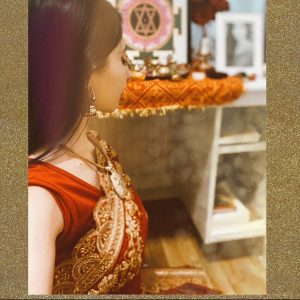

 amaryllis