Musings on the Mahābhārata: Part II

so, did Draupadī laugh at Duryodhana in the Palace of Illusions and did she insult Karṇa at her svayaṃvara? no. neither of these events appear in the critical edition of the Mahābhārata, and they are considered interpolations coming from uncertain sources.

how do we relate to these, however – considering that they are now completely imbued in the South Asian collective consciousness?

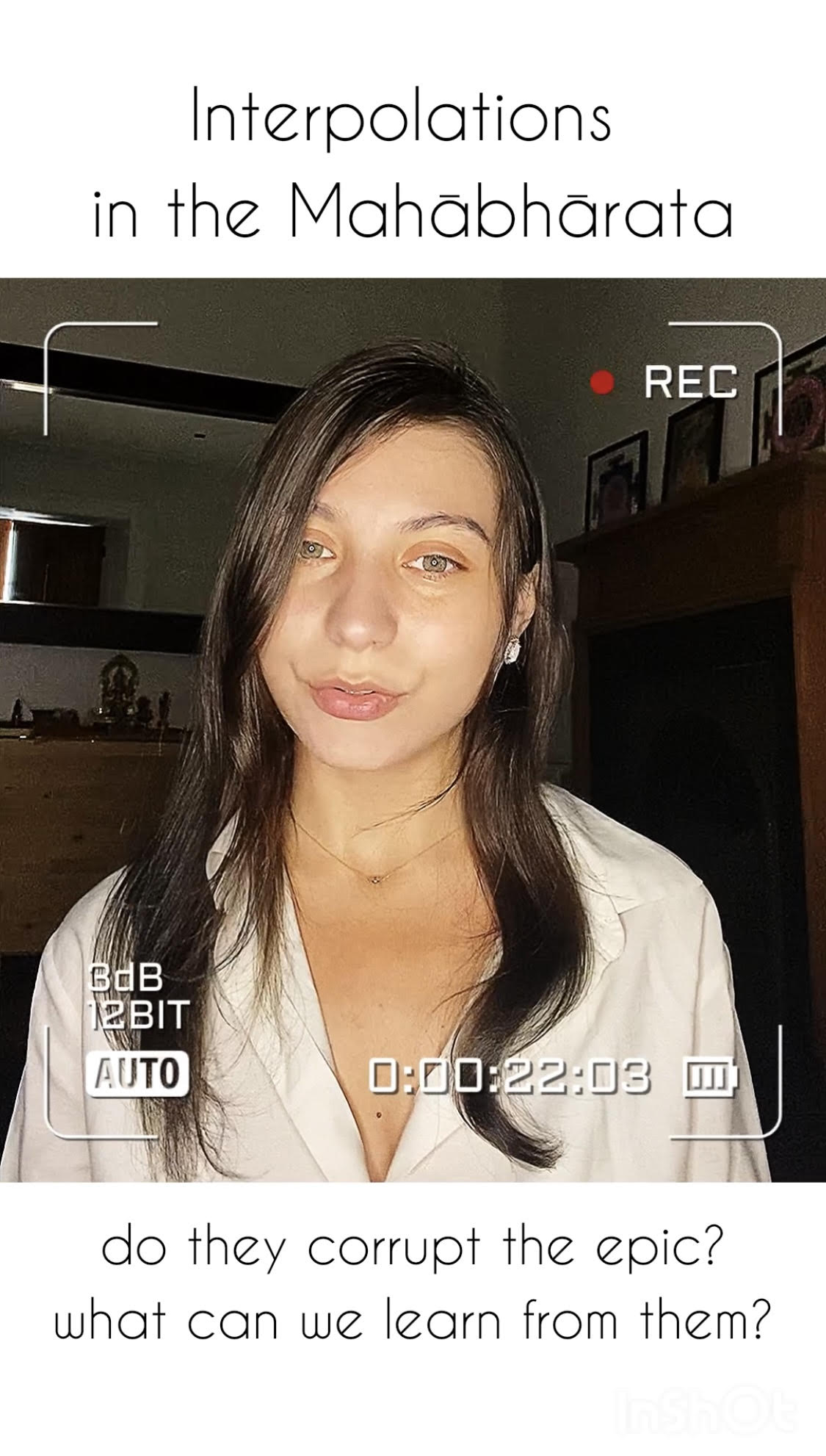
devoid of frustration! we relate to them in a way that is devoid of frustration. 😁 this is my first answer because i used to be very frustrated with interpolations, especially with those that, in my view, vilified Draupadī in any way. inquiring into my intense reactivity triggered by these led me on a rich introspective process, in which, first, i questioned the depths of my identification as a woman to Draupadī’s character (will write more on this in the future!). second, i began questioning how important it is for the Mahābhārata to remain intact in popular culture and in retellings, and if these interpolations corrupt the epic. one of the conclusions that i have reached, which i will expand on in my PhD thesis, is that these interpolations and retellings can teach us about how society has progressed through time, and can teach us about what moves us as humans, and about the ways we continuously try to make meaning and to find reflections of ourselves in the external world. for instance, interpolations that might vilify Draupadī’s character, in my view, can pinpoint to blind spots in society which can uncover latent misogyny, whereas interpolations which glorify Karṇa can pinpoint to people’s identification with his particular character, which to many represents a symbol of class struggle. in this, i believe there is much to uncover; as scholars, and i have been guilty of this, we usually tend to dismiss interpolations, and i would maintain that we lose a lot by doing so. because everything is valid, and i would argue that every single retelling can teach us more about the ways in which this epic is actually lived, and comes alive for people. 🖤

did Draupadī’s disrobing ‘really’ happen?

yes, as in, it appears in the critical edition, and it is not considered an interpolation. there have been scholars who have argued for Draupadī’s disrobing to be recognised as an interpolation (one scholar in particular) but their claims have been rebuked.

however, i do not want to talk about the validity or invalidity of these arguments, but, as a follow-up to my previous video, i want to briefly discuss what i find most fascinating about these debates on interpolations, which is that i think they mirror back to us our own possible blind spots and our biases as researchers. this is a great generalisation, but i have noticed that people who are more drawn to argue for Draupadī’s disrobing being recognised as an interpolation might be more dismissive of the female experience as a whole in academia or in various strands of literature, whereas, for those of us belonging on the other side of the spectrum, our blind spots might be being too entrenched in validating the female experience or in being overfocused on it, and i count myself in this category. i believe there is worth to blind spots, though – i think they can be important or can work to our advantage in relative terms, in the same way overattachment to our own research can – in the sense that, both can provide fuel for our work as well as solidify belief in it – so, nothing is good or bad, no binary thinking here! 😁 but, i do think that this can be a very fruitful area for contemplation for each of us, in which we could question our overattachment to a particular argumentative thread. what can be mirrored back to us through it? for instance, i find that a lot of my attachment to certain narrative threads can mirror back to me my attachment to my female identity; which, again, if channelled properly, can be great fuel, but i do find it important for me to hold it in my awareness and deconstruct it internally if not externally through the means of, for example, an academic paper.

how everything can be great fuel for inner work – even academic research! 🤍

Referencing the Mahābhārata

you can watch the videos i have created on this topic here: https://www.instagram.com/musingsonthemahabharata/

recommendations for abridged and unabridged translations of the Mahābhārata, as well as reading and referencing tips 🤍.

to reiterate the last point i made in my video first, i would like to accentuate that those of us who rely on translations and are inhibited by the language barrier are already working with a diluted version of the Mbh; it is for this reason that it is exceptionally important to work with the best and most authentic translation that is accessible for us, especially if we are scholars. in this, we can ensure that we are not perpetuating any misunderstanding or false information in the world. 🤍

🔱 unabridged translations:

🔱 for the first five parvas – J. A. B. van Buitenen | for the remaining books of war – Clay Sanskrit Library | these are exquisite, elegant, all-encompassing, and delicious works of translation.

additionally, i use the abridged translation created by John D. Smith and published by Penguin Classics as a handbook or manual to find my way through the unabridged versions when i write papers. this is extremely efficient for referencing – a compass or map to guide you through the verses. i expand on this in the video, and will additionally create a separate video about how to reference the Mbh.

🔱 the recommendations i have shared have been given to me by my amazing MA supervisor from Lancaster University, Dr. Brian Black, who instilled within me the love for the Mahābhārata in academia, and supported me through my research and my PhD application process. in my opinion, he is one of the most dedicated and passionate contemporary researchers of the Mbh, and i am most grateful to him. his book, ‘In Dialogue with the Mahābhārata’, is a fantastic work of research. read more here: https://www.routledge.com/In…/Black/p/book/9780367547271

🔱 TIPS:
for those unfamiliar with this epic, i would recommend they begin with an abridged retelling. note: a retelling, and not a translation (John D. Smith’s abridged work would be considered a translation as it follows the epic poem verse by verse). retellings are easier to digest! the Mbh is vast and can be overwhelming, so use the retellings to

familiarise yourself with the characters and with their narrative arcs, and, when you feel familiar enough with the Mbh’s universe, move onto the unabridged versions.

please be aware that, due to the nature of reproducing an epic poem in prose, most retellings include errors, omissions or interpolations. hold these lightly while you read through and also hold in your awareness that the author might have taken many liberties. use the unabridged versions to correct and reorientate yourself within the universe. this is how i started my own journey with it 😊

demonstrating how to reference the Mbh

a thorough Mahābhārata reference consists of three parts: the number of the parva in which the event in question takes place in, the number of its corresponding verse, and the number of the secondary verse. in have created a video in which i am demonstrating how to most efficiently reference the Mbh by utilising the abridged and unabridged translations with the example of Draupadī’s birth from fire (1.155.45).

note the difference in detailed expansion between the two versions, and the importance of continuously referring to the unabridged translations:

abridged: “A beautiful, dark girl emerged from the altar, and the voice proclaimed that she was destined to accomplish the purpose of the Gods by annihilating the Kṣatriyas. [She was] named Kṛṣṇā (Draupadī).”

*Kṛṣṇā means She of Dark Complexion.

unabridged: “Thereupon a young maiden arose from the center of the altar, the well-favored and beautiful Daughter of the Pañcālas, heart-fetching, with a waist shaped like an altar. She was dark, with eyes like lotus petals, her hair glossy black and curling – a lovely Goddess who had chosen a human form. The fragrance of blue lotuses waited from her to the distance of a league, the shape she bore was magnificent, and no one was her peer on earth. And over the full-hipped maiden as soon as she was born the disembodied voice spoke: ‘Superb among women, the Dark Woman shall lead the Kṣatriyas to their doom. The fair-waisted maiden shall in time accomplish the purpose of the Gods, and because of her, great danger shall arise for the Kṣatriyas.’ Hearing this, all the Pañcālas roared like a pride of lions and earth was unable to hold them so full of joy”.

this might seem as an over-scholarly topic, but much of the written material you are going to encounter on the Mbh will include this, and i find it relevant to have a framework for it. 🤍

my papers + Mahābhārata as seen by Giampaolo Tomassetti

so thrilled to share that i finished the two papers i’ve been working on these past months: “Feminine Dimensions of ‘God’: The Deification of Mahābhārata’s Tragic Heroine” & “The Western Revival of Goddess Worship”. 🤍

my first essay explored the richness of the non-dual concept of ‘God’ by addressing the intricate worship of Draupadī, Mahābhārata’s enigmatic female character – whose tragic and distinct storyline establishes her as a multifaceted heroine: a devoted wife; a caring mother; an abused and vindicative woman; a polyandrous empress; an avatar of the Goddess; the Supreme Parāśakti, the all-pervading absolute reality herself; the celestial Śrī. i argued that, through the worship of an abused & vengeful woman, her devotees are deifying the entirety of the human experience. 🤍my second essay employed a discourse rooted in psychoanalysis, and was centred on the therapeutic values Goddess archetypes hold for the traumatised female psyche + commented on the ramifications of the phenomenon of religious revival in a secular age.

🕊i have adored writing both, no matter how frustrating the writing inevitably got at times. i had so much fun with the two topics, which i’m very passionate about, but i especially enjoyed delving into Mahābhārata – three months in, and i still am absolutely fascinated by it and in awe of the beautiful Draupadī, who i’m sure will be the subject of much of my future research. 🌹

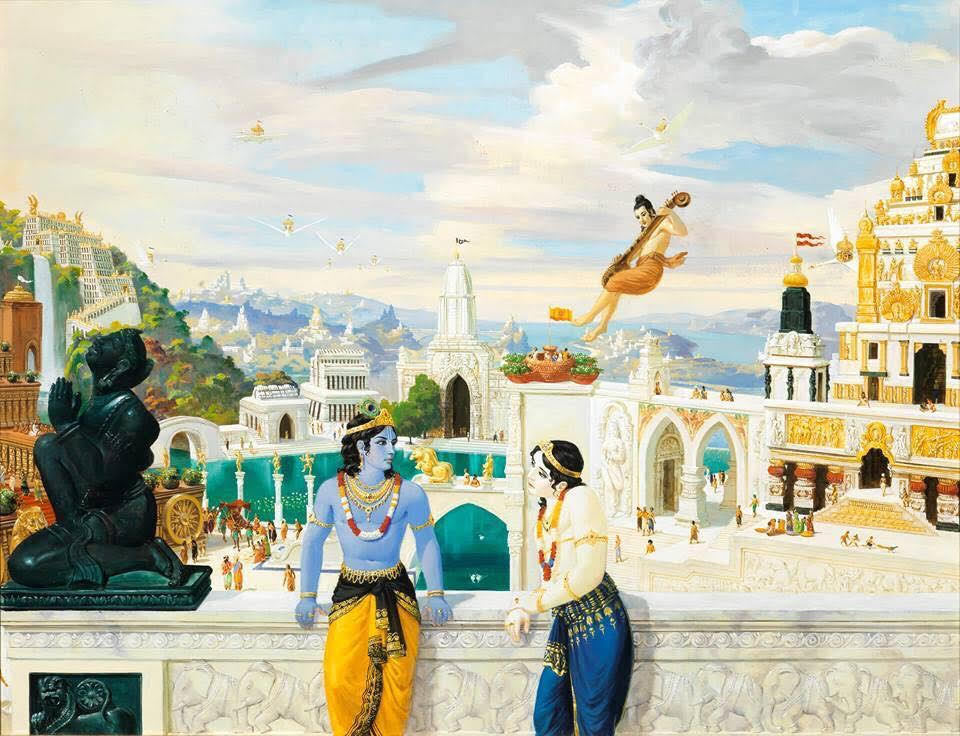
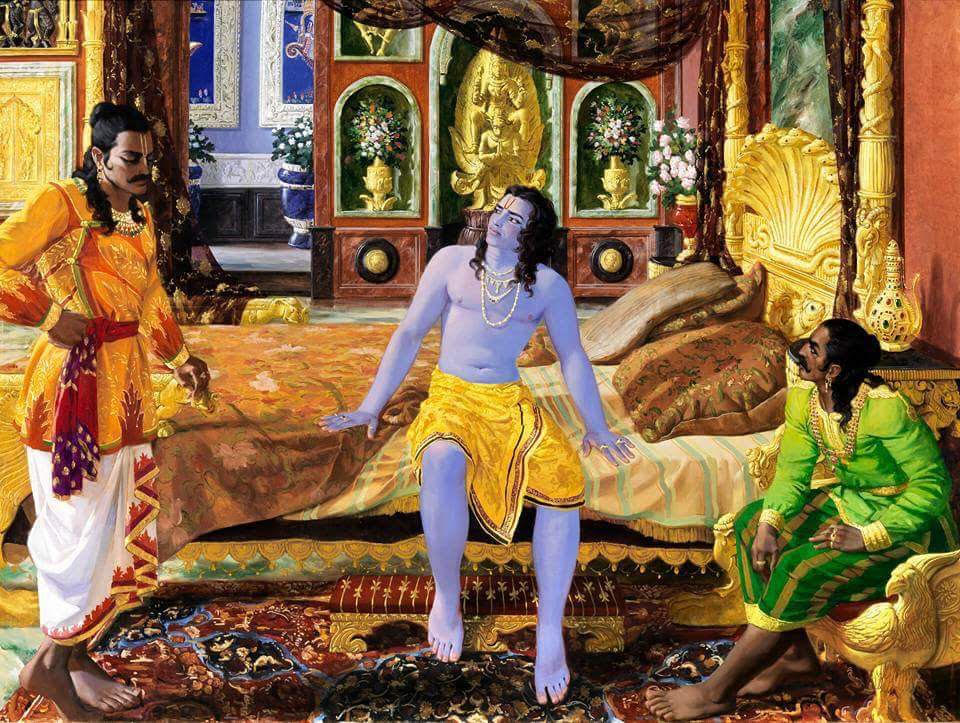
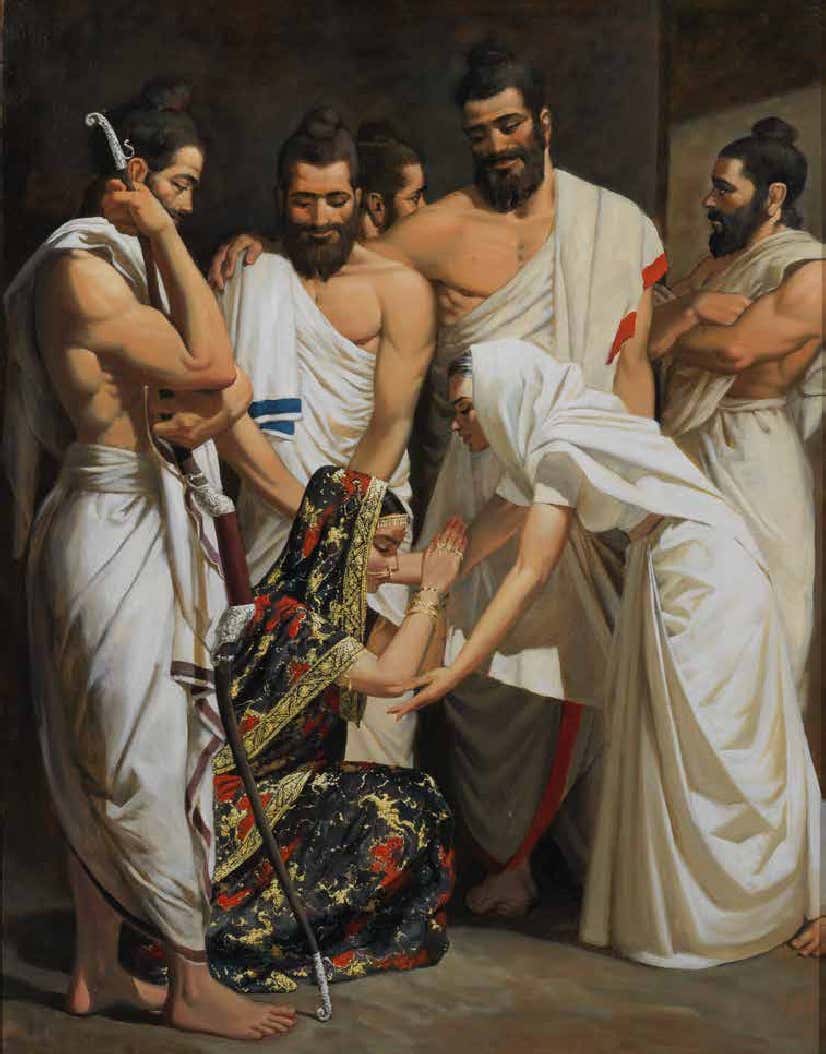
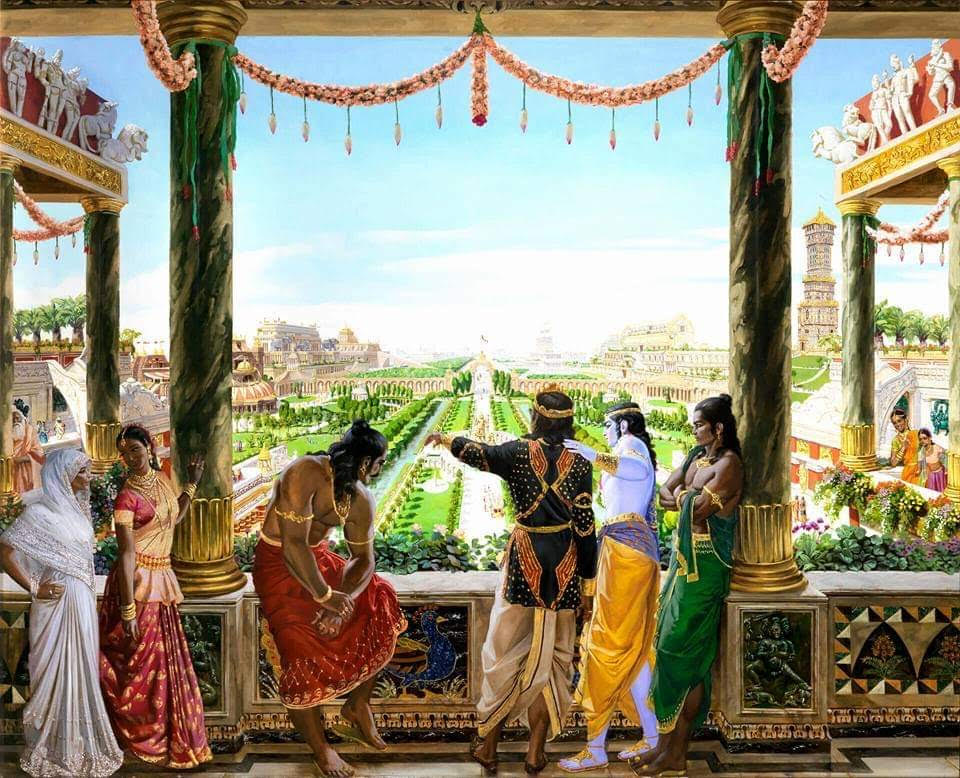
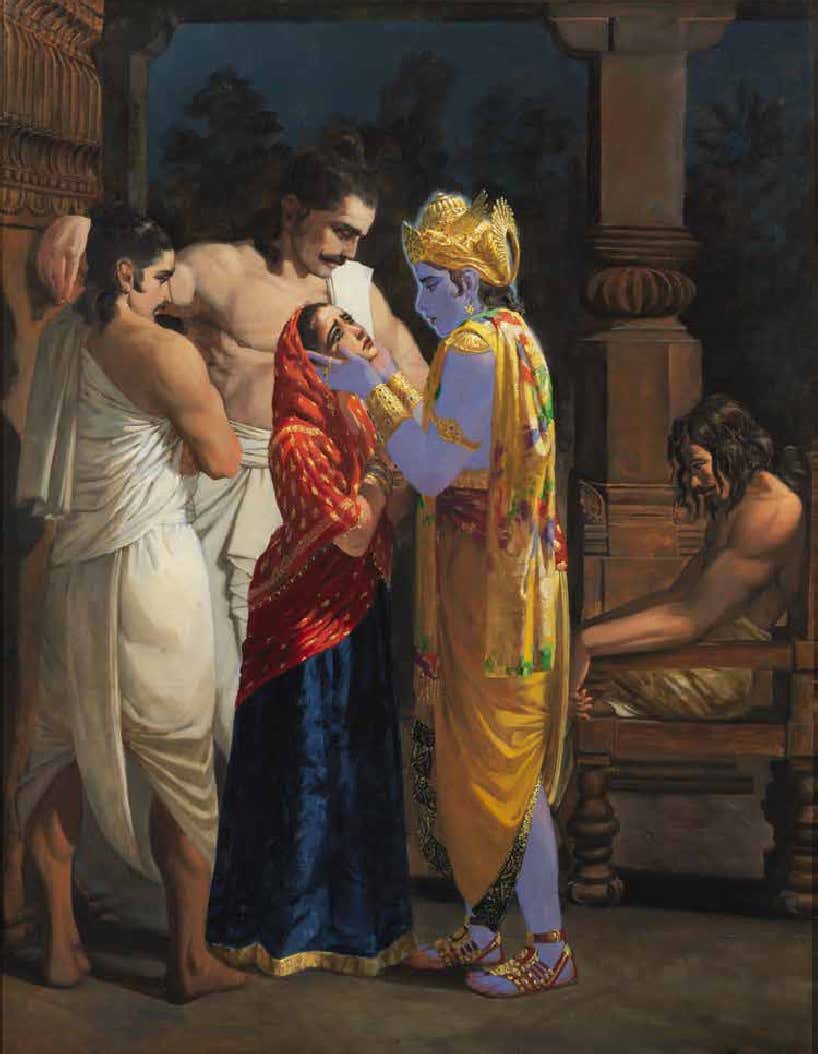
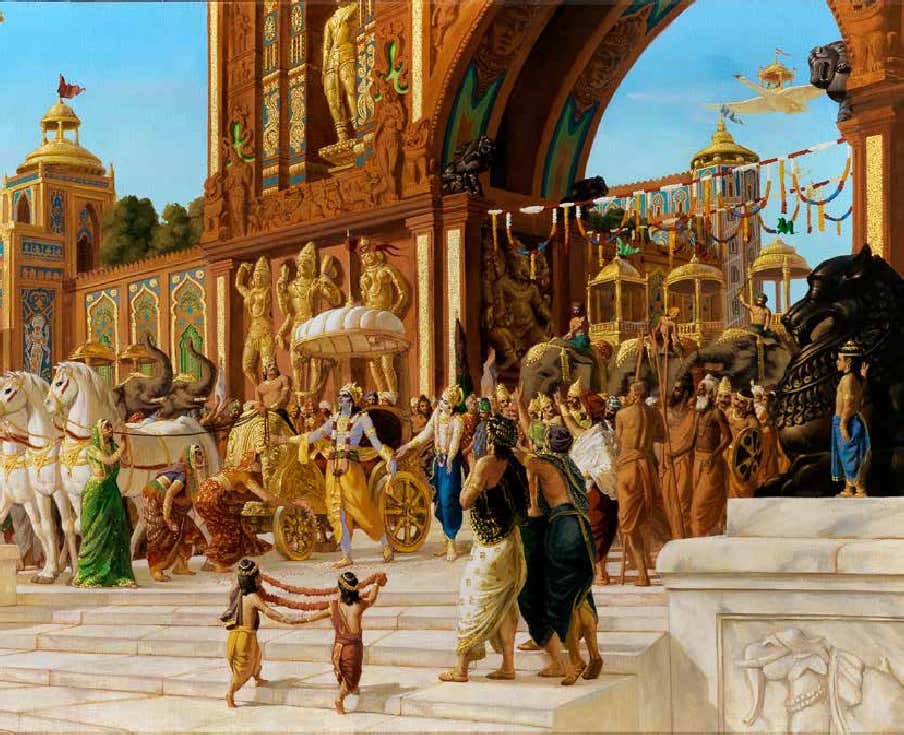
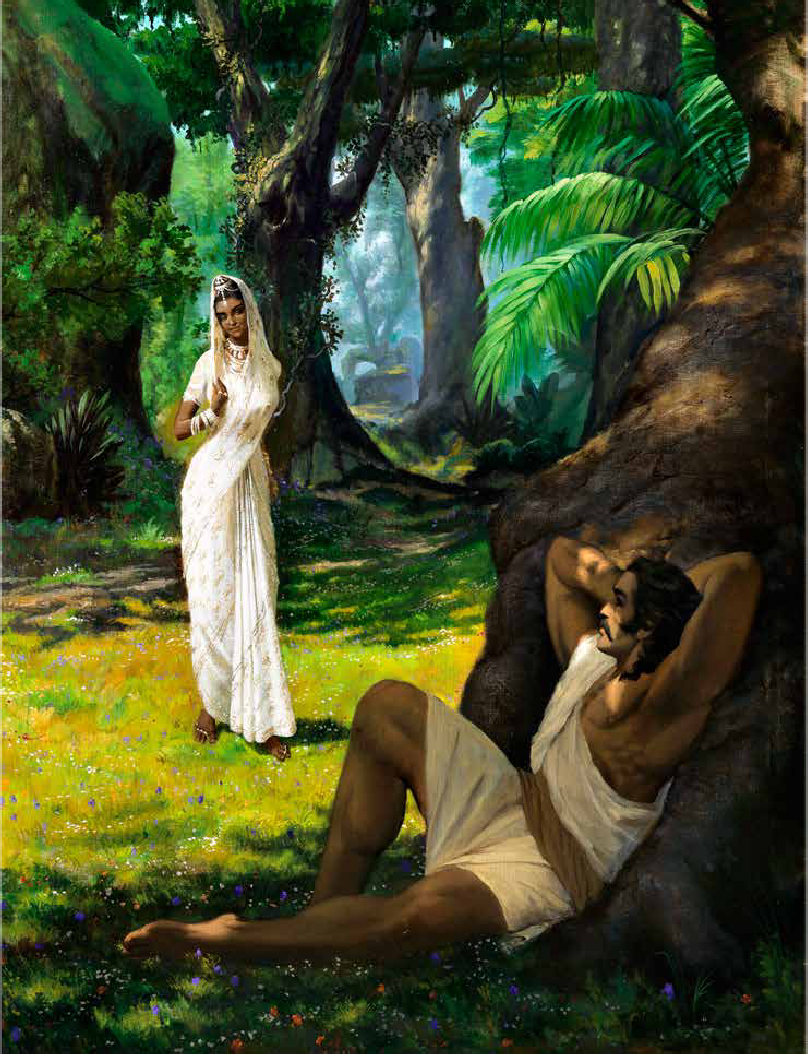
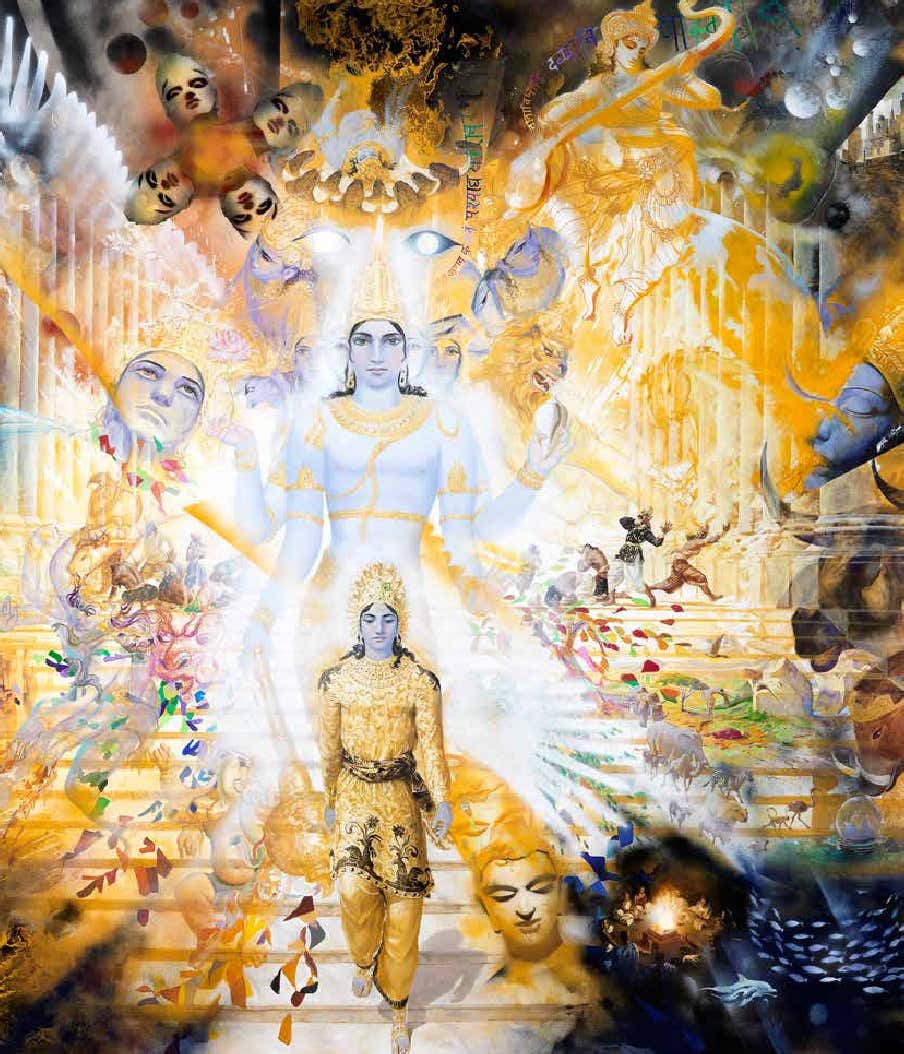
on this occasion, attaching here the marvellous paintings of Giampaolo Tomassetti, who dedicated 17 years of his life to studying & painting the Mahābhārata 🤍pictured:

Kṛṣṇa & Balarāma in Dvārakā (my favourite 🕊)

Kṛṣṇa advising the Pāṇḍavas

Draupadī meets Kuntī

Kuntī & Karṇa

Kṛṣṇa comforting Draupadī after ~ dice match & disrobing ~

Kṛṣṇa reveals his universal form (Govindarūpiṇī)

Kuntī & Sūrya

Kṛṣṇa, the Pāṇḍavas, Draupadī & Kuntī in Indraprastha

Bhīma & Hiḍimbī

Dvārakā