Draupadī and the Dharma of Women

“Strī” translates from Sanskrit as “woman”, while “dharma” is a complex principle with manifold meanings, in this context bearing the significance of “duty”; in simple terms, it refers to an individual conduct that contributes to harmony in a greater framework, be it societal or cosmological.

Draupadī is lauded in the Critical Edition of the Mbh several times as being the epitome of strī-dharma, of the dharma of women. (2.62.20; 2.63.25-30; 2.64). Interestingly, she is most intensely praised as such after she angrily (yet elegantly!) questions the men of the royal court and demands justice, being anything but meek and demure. I would argue that this showcases that in the Mahābhārata voicing oneself and standing up for oneself are considered responsibilities belonging to the dharma of women.

To nuance this even more, Eknath Easwaran, an eminent translator of the Bhagavadgītā, highlights that, etymologically, the term “dharma” can be traced back to the root ‘dhri’, which means ‘to support, hold up, or bear’; “dharma” therefore translates as “that which supports”, and Draupadī’s conduct therefore supports both society and cosmology.

In the Sanskrit Mbh, Kṛṣṇa does not appear in the sabhā (royal hall) at the time of Draupadī’s attempted disrobing, and no direct mention of him is made during this episode. In a conversation with Dr. Brian Black, a Mbh researcher whom I had the honour to have as my MA supervisor, we talked about the implication of this, which is that Draupadī’s adherence to strī-dharma appears to be that which shields her. A question that could arise here could be whether there is a contradiction between the Critical Edition and modern renderings of the Mahābhārata, with Draupadī being shielded by her dharma as opposed to by Kṛṣṇa.

For me there is no contradiction.

Kṛṣṇa in the Bhagavadgītā establishes himself as ‘the eternal dharma’ (14.27); and so, Kṛṣṇa is all dharmas, including strī-dharma. We tend to associate Kṛṣṇa with a fully-fledged incarnation; but he is beyond that. I would maintain that, as the divine principle, he exists in Draupadī’s consciousness and in her actions as dharma (and not only!). The latter renditions, for me, in which he is physically there, only bring forth in tangible projections the internal process extending Draupadī’s consciousness.

I will write more about strī-dharma as it appears in the Mbh. ❤️‍🔥

You can find me on IG: @musingsonthemahabharata

and on Tumblr: https://www.tumblr.com/musingsonthemahabharata

Painting: Jadurani Dasi, 1986.

Kṛṣṇa and Draupadī Discuss Karma

One of my favourite interpolations from modern tellings of the Mahābhārata is a conversation between Draupadī and Kṛṣṇa that occurs after Draupadī’s sexual assault and attempted disrobing by the Kauravas.

Clutching his feet, Draupadī sobs: “Govind, why? Why did this happen to me? What sins did I commit? I am reaping the fruit of which actions of mine?”

Picking her up and caressing her hair, Arya tells her: “What happened was neither because of your ‘bad’ karma, nor did you reap the fruit of your past actions. It was the Kauravas who reaped the fruit of their past actions by engaging in such a grave misdeed. Sakhī, this is the meaning of karma.”

“But I am the one experiencing agony, Govind.”

“Then relinquish it, Sakhī. Although what happened was not the result of your ‘bad’ karma, the way you transform following these events will be your karma.”

This is such a beautiful and profound exchange which offers rich nuances to the teaching of karma. Oftentimes, when events we perceive as terrible happen to us, we create a story of unworthiness around them; we wonder if we are being punished, if the root cause is our evilness, if God or the universe are rejecting or dooming us. A question that rests on these lines that is often asked would be the common: “why do bad things happen to good people”. A first layer to this, in my view, is a deconstruction of ‘bad’ and ‘good’ as solid concepts. The second layer is the understanding that any event ‘just’ happens aleatorily, rises and falls, and karma is not a simplistic cause-effect reaction.

Karma encapsulates, in my understanding, the ingrained patterns held within us through which we act, react, and process the world around us and the events that occur in our lives. There is freedom from karma in finding new ways of reacting, engaging, processing.

Finally, a significant teaching encased in this interpolation is that the way someone treats us, ultimately, is a reflection of their karma (ingrained patterns), and not a reflection of our ingrained patterns. We cannot control another’s patterns, but we can aim to understand and rewire ours accordingly.

The magnificent art: @beauty_of_art_aditi 💙

My musings on the Mbh – IG: https://www.instagram.com/musingsonthemahabharata/
Tumblr: https://www.tumblr.com/musingsonthemahabharata

Draupadī’s Disrobing: Menstruation as Purification and the Price of Blood

In response to the article about Draupadī’s disrobing that I shared yesterday, Jim beautifully questioned whether the act of violence spurred from limited views around nudity and if it would have been avoided if nudity was perceived differently in that society (if it was common, seen as sacred or normal). This was a very rich ground of contemplation for me, and the reflections I have had are the following:

First, I would like to establish that Draupadī was not wearing a sari when her attempted disrobing took place. She was wearing a single cloth which covered her body through which she was menstruating, which was the custom at the time. It can be deduced through various references toward her appearance found throughout the Mbh that, outside of the timeframe of her menses period, she did not customarily wear an upper garment, so her breasts were uncovered. At the time of her attempted disrobing, she was wearing more clothes that she usually was. The men had already seen part of her body which they wanted to disrobe. There are scholars who argue that she was not wearing a single cloth at the time of her disrobing and she was instead wearing both an upper garment and a lower garment. I would argue that this is irrelevant, as the point still remains that her breasts were covered, and they usually were not.

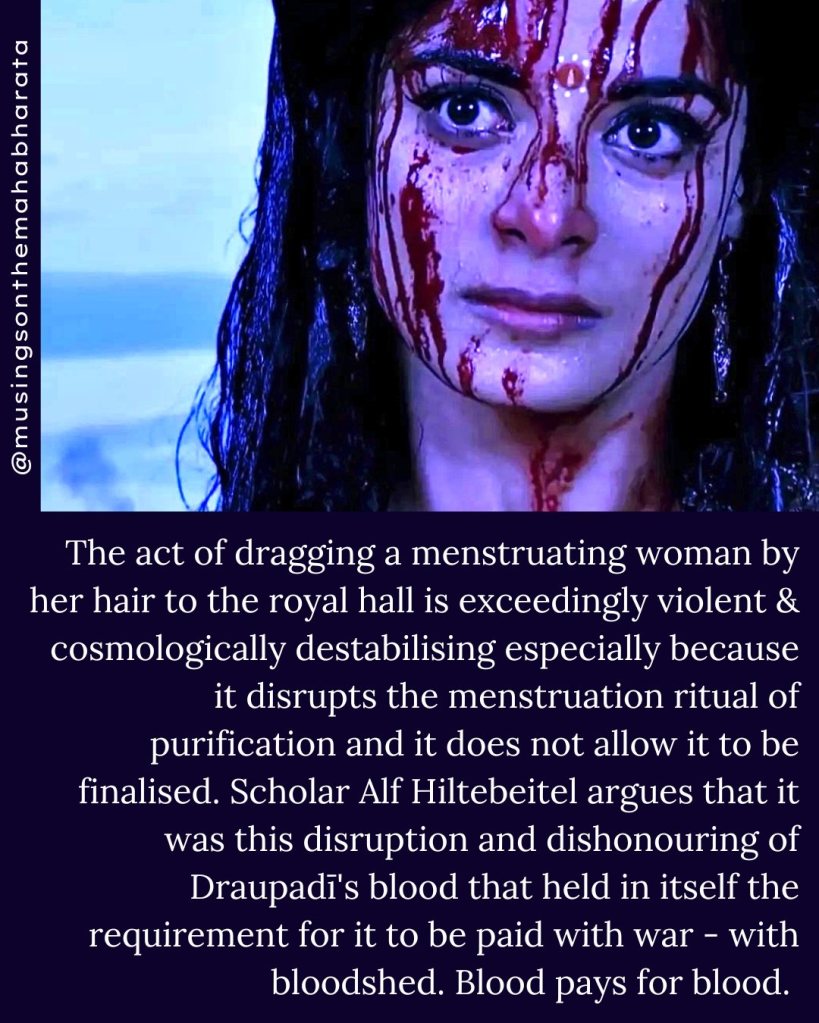
Second, I would maintain that, the disrobing episode, as most acts of sexual violence, was more about power than about sex or nudity, and that the key factor here, lost in so many adaptations, was not the attempted disrobing & possible nudity, it was the fact that Draupadī was menstruating, and she was brought to the royal hall in a stained garment through which she was free-bleeding. Menses was / is considered a period of purification. The act of dragging a menstruating woman by her hair to the royal hall – who, as I priorly mentioned, was wearing more clothes than usually – is exceedingly violent & cosmologically destabilising especially because it disrupts the menstruation ritual of purification and it does not allow it to be finalised. Further, hair in itself is a symbol of sexual power for a woman. Duśāsana grabbing Draupadī’s hair is an attempt to curb her sexual power and own her sexuality.

Draupadī bleeds in the hall and leaves Hastinapura bleeding through her clothes. Scholar Alf Hiltebeitel argues that it was the dishonouring of her blood that held in itself the requirement for it to be paid with war; with bloodshed. In the cosmological cycle, blood pays for blood.

The Kauravas wanted to humiliate, own and disempower Draupadī; nudity was one of the means to get there, along with disturbing her purification rituals, not the end goal. However, one could argue that in a society in which nudity was seen as sacred the intention to humiliate wouldn’t have arisen in that openness or expansion of consciousness – but maybe it would have just taken a different form and found different means.

Photo: Pooja Sharma as Draupadī, bathed in the blood of her principal offender. The cosmological cycle is finalised. 

references on Draupadī, the symbols of menstruation as purification and hair as female sexual power: https://press.uchicago.edu/…/book/chicago/C/bo3626877.html

Draupadī’s Speech, Vastrāharaṇa: A Collaborative and Experimental Audio-translation

Fragment of a collaborative and experimental audio-translation of Draupadī’s speech following Vastrāharaṇa (The Attempted Disrobing of the Empress) in modern retellings of the epic. This excerpt follows the 2013 rendition of the Mahābhārat. It was created in the module ‘The Practice of Literary Translation’ of the Warwick Writing Programme with Sumithreyi Sivapalan. 🙂

Draupadī:

Touch me not, Queen Mother Kuntī.

I will get besmirched.

I am no longer your daughter-in-law.

I am no longer your sons’ wife.

I am no longer the bride of the Kuru dynasty.

Now I am without husband, without name, without dynasty.

I am the fire that burns in the furnace. I am purity itself,

yet I feed on what is impure.

Today, in this sabhā, I have cried the tears of the women who walked this Earth.

Queen Mother Kuntī, Great Queen Gandharī, if you wish to save yourselves, renounce this sabhā and leave. Because this palace hall will break today.

I am no longer a human being. I am death, only death. I am the death of all the vile men present in this unjust sabhā today.

My curse is that, at this very moment…

Gandharī:

No, Draupadī. Do not curse. Do not curse! Forgive them. Forgive us. I beg you, forgive us!

Draupadī:

My curse is forgiveness in itself, Great Queen. If I have to punish, let it be in this lifetime. Every moment, they will suffer the agony of hell. Their pain will know no end.

Gandharī:

No, my daughter. The woman who gives life cannot give death.

In taking one’s own life, one annihilates the body. In taking another’s life, one destroys the soul.

Destroying the soul is self-annihilation.

In your anger, do not act like these men!

Draupadī:

It is a woman’s duty to cleanse the house, and it is a woman’s duty to purify it. It is a woman’s duty, as well, to cleanse this world.

Indeed,

only a woman can purify the Earth. I curse (that)…

still and edit i created of Pooja Sharma as Draupadī. the most fantastic performance of the fireborn heroine!

Yajñasenī by Téa Nicolae

she who was born of fire

she whose beauty enticed even the sun

i garland thee

she whose blood spilled on royal floors of marble

she whose woe scorched the Kurus

i weep with thee

she who was touched yet remained stainless

she whose dishevelled hair holds the griefs of woman

i pray with thee

Draupadī,

she who cried the tears of the women who walked this earth

i am thee.

*poem published in Śabda Magazine, vol. II.

collage i made of pooja sharma as the beloved empress. her performance is etched to my heart!