Draupadī’s Question

The order of the stakes of the dice game in the Mahābhārata goes as follows:

1) Yudhiṣṭhira stakes and loses the Pāṇḍavas’ wealth, army, empire, throne, weapons
2) Yudhiṣṭhira stakes and loses the autonomy of his four younger brothers, and they are enslaved on the spot (and they submit to it)
3) Yudhiṣṭhira stakes and loses his own autonomy, rendering himself enslaved (and submitting to it himself)
4) lastly, Yudhiṣṭhira stakes and loses Draupadī’s autonomy. The Kauravas roar in excitement, and they send a servant to fetch Draupadī to the sabhā (the royal hall) so she can be enslaved publicly.

Draupadī is absent from the sabhā at the time the dice game unfolds, as she is in her private chambers, menstruating. The servant comes to her and announces the outcome of the dice game. She is told that she has been ordered to present herself as a servant before the Kuru dynasty. She refuses to go, and says she wants one question to be asked to Yudhiṣṭhira:

“Did you first lose yourself, or me?” (2.60.9)

The servant returns to the sabhā and asks Draupadī’s question to Yudhiṣṭhira, who remains silent. The Kauravas become enraged by what they perceive to be Draupadī’s defiance, and one of them, Duḥśāsana, goes to fetch her himself. When she still refuses to come, he grabs her by her hair, drags her to the court and molests her publicly.

However, Draupadī is unbent: she delivers an incredibly powerful speech in which she continuously asserts her independence, challenges and rejects the men’s claims to her freedom, questions and denies the validity of the dice game, and, ultimately, overturns its verdict. In this speech, she presents a series of arguments, and I will analyse each in a series of upcoming posts.

Her first argument is her first question, which infers that, even if Yudhiṣṭhira did have any authority over her status (which she later challenges and denies as well), he lost all authority which could have been argued that he exerted over her the moment he renounced his independence. One who is not their own master cannot be the master of someone else, and one who is dependent cannot impair another’s independence.

My Mahābhārata blog: https://www.tumblr.com/musingsonthemahabharata

IG: @musingsonthemahabharata. ❤️‍🔥

Draupadī and the Dharma of Women

“Strī” translates from Sanskrit as “woman”, while “dharma” is a complex principle with manifold meanings, in this context bearing the significance of “duty”; in simple terms, it refers to an individual conduct that contributes to harmony in a greater framework, be it societal or cosmological.

Draupadī is lauded in the Critical Edition of the Mbh several times as being the epitome of strī-dharma, of the dharma of women. (2.62.20; 2.63.25-30; 2.64). Interestingly, she is most intensely praised as such after she angrily (yet elegantly!) questions the men of the royal court and demands justice, being anything but meek and demure. I would argue that this showcases that in the Mahābhārata voicing oneself and standing up for oneself are considered responsibilities belonging to the dharma of women.

To nuance this even more, Eknath Easwaran, an eminent translator of the Bhagavadgītā, highlights that, etymologically, the term “dharma” can be traced back to the root ‘dhri’, which means ‘to support, hold up, or bear’; “dharma” therefore translates as “that which supports”, and Draupadī’s conduct therefore supports both society and cosmology.

In the Sanskrit Mbh, Kṛṣṇa does not appear in the sabhā (royal hall) at the time of Draupadī’s attempted disrobing, and no direct mention of him is made during this episode. In a conversation with Dr. Brian Black, a Mbh researcher whom I had the honour to have as my MA supervisor, we talked about the implication of this, which is that Draupadī’s adherence to strī-dharma appears to be that which shields her. A question that could arise here could be whether there is a contradiction between the Critical Edition and modern renderings of the Mahābhārata, with Draupadī being shielded by her dharma as opposed to by Kṛṣṇa.

For me there is no contradiction.

Kṛṣṇa in the Bhagavadgītā establishes himself as ‘the eternal dharma’ (14.27); and so, Kṛṣṇa is all dharmas, including strī-dharma. We tend to associate Kṛṣṇa with a fully-fledged incarnation; but he is beyond that. I would maintain that, as the divine principle, he exists in Draupadī’s consciousness and in her actions as dharma (and not only!). The latter renditions, for me, in which he is physically there, only bring forth in tangible projections the internal process extending Draupadī’s consciousness.

I will write more about strī-dharma as it appears in the Mbh. ❤️‍🔥

You can find me on IG: @musingsonthemahabharata

and on Tumblr: https://www.tumblr.com/musingsonthemahabharata

Painting: Jadurani Dasi, 1986.

Draupadī’s Disrobing: Menstruation as Purification and the Price of Blood

In response to the article about Draupadī’s disrobing that I shared yesterday, Jim beautifully questioned whether the act of violence spurred from limited views around nudity and if it would have been avoided if nudity was perceived differently in that society (if it was common, seen as sacred or normal). This was a very rich ground of contemplation for me, and the reflections I have had are the following:

First, I would like to establish that Draupadī was not wearing a sari when her attempted disrobing took place. She was wearing a single cloth which covered her body through which she was menstruating, which was the custom at the time. It can be deduced through various references toward her appearance found throughout the Mbh that, outside of the timeframe of her menses period, she did not customarily wear an upper garment, so her breasts were uncovered. At the time of her attempted disrobing, she was wearing more clothes that she usually was. The men had already seen part of her body which they wanted to disrobe. There are scholars who argue that she was not wearing a single cloth at the time of her disrobing and she was instead wearing both an upper garment and a lower garment. I would argue that this is irrelevant, as the point still remains that her breasts were covered, and they usually were not.

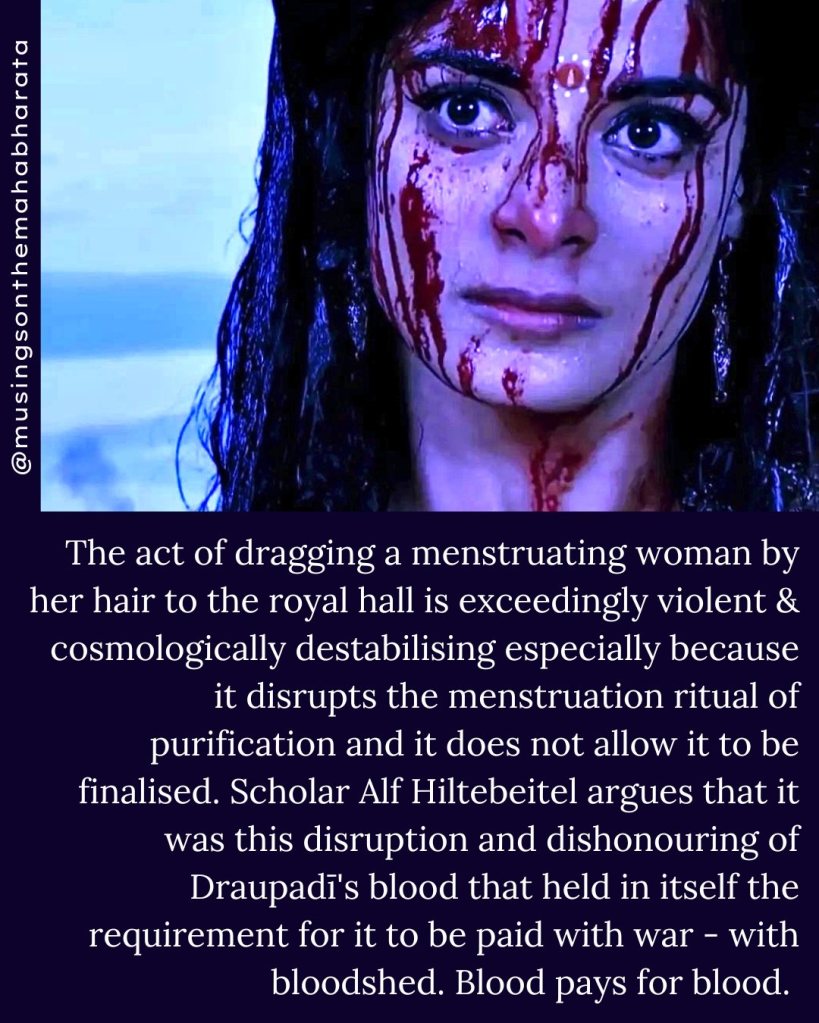
Second, I would maintain that, the disrobing episode, as most acts of sexual violence, was more about power than about sex or nudity, and that the key factor here, lost in so many adaptations, was not the attempted disrobing & possible nudity, it was the fact that Draupadī was menstruating, and she was brought to the royal hall in a stained garment through which she was free-bleeding. Menses was / is considered a period of purification. The act of dragging a menstruating woman by her hair to the royal hall – who, as I priorly mentioned, was wearing more clothes than usually – is exceedingly violent & cosmologically destabilising especially because it disrupts the menstruation ritual of purification and it does not allow it to be finalised. Further, hair in itself is a symbol of sexual power for a woman. Duśāsana grabbing Draupadī’s hair is an attempt to curb her sexual power and own her sexuality.

Draupadī bleeds in the hall and leaves Hastinapura bleeding through her clothes. Scholar Alf Hiltebeitel argues that it was the dishonouring of her blood that held in itself the requirement for it to be paid with war; with bloodshed. In the cosmological cycle, blood pays for blood.

The Kauravas wanted to humiliate, own and disempower Draupadī; nudity was one of the means to get there, along with disturbing her purification rituals, not the end goal. However, one could argue that in a society in which nudity was seen as sacred the intention to humiliate wouldn’t have arisen in that openness or expansion of consciousness – but maybe it would have just taken a different form and found different means.

Photo: Pooja Sharma as Draupadī, bathed in the blood of her principal offender. The cosmological cycle is finalised. 

references on Draupadī, the symbols of menstruation as purification and hair as female sexual power: https://press.uchicago.edu/…/book/chicago/C/bo3626877.html

Musings on the Mahābhārata: Part II

so, did Draupadī laugh at Duryodhana in the Palace of Illusions and did she insult Karṇa at her svayaṃvara? no. neither of these events appear in the critical edition of the Mahābhārata, and they are considered interpolations coming from uncertain sources.

how do we relate to these, however – considering that they are now completely imbued in the South Asian collective consciousness?

devoid of frustration! we relate to them in a way that is devoid of frustration. 😁 this is my first answer because i used to be very frustrated with interpolations, especially with those that, in my view, vilified Draupadī in any way. inquiring into my intense reactivity triggered by these led me on a rich introspective process, in which, first, i questioned the depths of my identification as a woman to Draupadī’s character (will write more on this in the future!). second, i began questioning how important it is for the Mahābhārata to remain intact in popular culture and in retellings, and if these interpolations corrupt the epic. one of the conclusions that i have reached, which i will expand on in my PhD thesis, is that these interpolations and retellings can teach us about how society has progressed through time, and can teach us about what moves us as humans, and about the ways we continuously try to make meaning and to find reflections of ourselves in the external world. for instance, interpolations that might vilify Draupadī’s character, in my view, can pinpoint to blind spots in society which can uncover latent misogyny, whereas interpolations which glorify Karṇa can pinpoint to people’s identification with his particular character, which to many represents a symbol of class struggle. in this, i believe there is much to uncover; as scholars, and i have been guilty of this, we usually tend to dismiss interpolations, and i would maintain that we lose a lot by doing so. because everything is valid, and i would argue that every single retelling can teach us more about the ways in which this epic is actually lived, and comes alive for people. 🖤

did Draupadī’s disrobing ‘really’ happen?

yes, as in, it appears in the critical edition, and it is not considered an interpolation. there have been scholars who have argued for Draupadī’s disrobing to be recognised as an interpolation (one scholar in particular) but their claims have been rebuked.

however, i do not want to talk about the validity or invalidity of these arguments, but, as a follow-up to my previous video, i want to briefly discuss what i find most fascinating about these debates on interpolations, which is that i think they mirror back to us our own possible blind spots and our biases as researchers. this is a great generalisation, but i have noticed that people who are more drawn to argue for Draupadī’s disrobing being recognised as an interpolation might be more dismissive of the female experience as a whole in academia or in various strands of literature, whereas, for those of us belonging on the other side of the spectrum, our blind spots might be being too entrenched in validating the female experience or in being overfocused on it, and i count myself in this category. i believe there is worth to blind spots, though – i think they can be important or can work to our advantage in relative terms, in the same way overattachment to our own research can – in the sense that, both can provide fuel for our work as well as solidify belief in it – so, nothing is good or bad, no binary thinking here! 😁 but, i do think that this can be a very fruitful area for contemplation for each of us, in which we could question our overattachment to a particular argumentative thread. what can be mirrored back to us through it? for instance, i find that a lot of my attachment to certain narrative threads can mirror back to me my attachment to my female identity; which, again, if channelled properly, can be great fuel, but i do find it important for me to hold it in my awareness and deconstruct it internally if not externally through the means of, for example, an academic paper.

how everything can be great fuel for inner work – even academic research! 🤍