Draupadī’s Question

The order of the stakes of the dice game in the Mahābhārata goes as follows:

1) Yudhiṣṭhira stakes and loses the Pāṇḍavas’ wealth, army, empire, throne, weapons
2) Yudhiṣṭhira stakes and loses the autonomy of his four younger brothers, and they are enslaved on the spot (and they submit to it)
3) Yudhiṣṭhira stakes and loses his own autonomy, rendering himself enslaved (and submitting to it himself)
4) lastly, Yudhiṣṭhira stakes and loses Draupadī’s autonomy. The Kauravas roar in excitement, and they send a servant to fetch Draupadī to the sabhā (the royal hall) so she can be enslaved publicly.

Draupadī is absent from the sabhā at the time the dice game unfolds, as she is in her private chambers, menstruating. The servant comes to her and announces the outcome of the dice game. She is told that she has been ordered to present herself as a servant before the Kuru dynasty. She refuses to go, and says she wants one question to be asked to Yudhiṣṭhira:

“Did you first lose yourself, or me?” (2.60.9)

The servant returns to the sabhā and asks Draupadī’s question to Yudhiṣṭhira, who remains silent. The Kauravas become enraged by what they perceive to be Draupadī’s defiance, and one of them, Duḥśāsana, goes to fetch her himself. When she still refuses to come, he grabs her by her hair, drags her to the court and molests her publicly.

However, Draupadī is unbent: she delivers an incredibly powerful speech in which she continuously asserts her independence, challenges and rejects the men’s claims to her freedom, questions and denies the validity of the dice game, and, ultimately, overturns its verdict. In this speech, she presents a series of arguments, and I will analyse each in a series of upcoming posts.

Her first argument is her first question, which infers that, even if Yudhiṣṭhira did have any authority over her status (which she later challenges and denies as well), he lost all authority which could have been argued that he exerted over her the moment he renounced his independence. One who is not their own master cannot be the master of someone else, and one who is dependent cannot impair another’s independence.

My Mahābhārata blog: https://www.tumblr.com/musingsonthemahabharata

IG: @musingsonthemahabharata. ❤️‍🔥

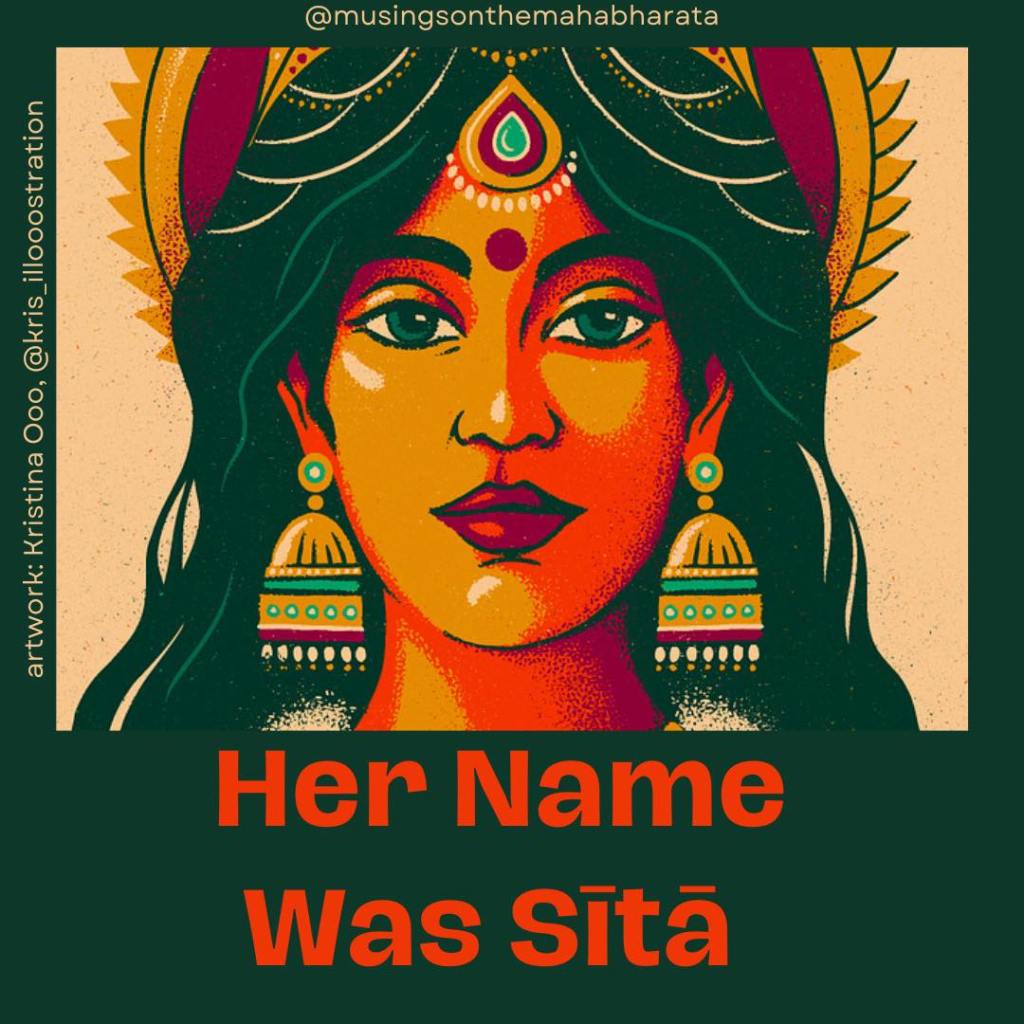
Her Name Was Sītā

I attended a screening of “Her Name Was Sītā” at Edinburgh University’s Centre for South Asian Studies last month, an incredible film by Heshani Sothiraj Eddleston that explores shame and the concept of female virtue, and how these can drive women to suicide through religious discourse and socio-cultural castigation.

Sītā, as a character, Goddess or symbol, is not addressed directly in the film except for in the title, but I would maintain that this initial evocation builds a framework to process the film in. Sītā, as a key figure of itihāsa (Sanskrit for “so it was”, a body of work that accounts past events / the history of the Hindu streams or Hindu universe, of which the Mahābhārata and the Rāmāyaṇa are central components), holds an emblematic position in the South Asian collective consciousness as an archetype of female virtue, sacrifice, female suffering and tragedy. Notably, I would maintain that this is a limiting association and that Sītā, as with any element of itihāsa, can be decoded in expansive ways that subsume and transcend those connotations.

Regardless, the associations are there, and there is power in that, as well as in a name; symbols and names such as Sītā and Draupadī hold in themselves potential to be approached as mediums through which we can understand gender programming, socio-cultural gender relations and the moral biases related to that. They therefore offer us the opportunity to deconstruct gendered conditioning; however, unfortunately, we generally do not take the leap to do so, and instead become further embroiled in contractions such as our identification with gender through the very tools that could free us.

Final note — the film shook me in many ways, would recommend watching it!

The stunning artwork credit: Kristina Ooo.

Barbie Mini-Review: Sweet yet an Encapsulation of the Deficiencies of Pop-Feminism

Sweet, energetic, and entertaining, Greta Gerwig’s Barbie is a delightfully camp blockbuster that I thoroughly enjoyed. The cinematography is excellent, the colour palette is perfect, and the actors are a treat. However, I did find its feminist thesis to be lacking. Although I acknowledge that the film is in itself a comedy which does not aim to solve social justice and functions primarily as entertainment, it still does construct a social, feminist commentary, which is why I found it fitting to utilise as a stimulus for analysing the deficiencies of pop-feminism culturally, as well as within myself.

Barbie offers its female characters the space and opportunity to muse on their condition and on the pains of being a woman, such as the contradictions of having to be extraordinary (attractive, successful, loving, kind, assertive) and yet contained, the ideal being achieving or conforming to a personal excellence that concomitantly is appeasing, controllable and tameable; yet never too much — not too powerful, nor too intimidating or destabilising.
A message of: Shine, but do not shine too much.

In my personal journey, I have recently been reflecting on my self-punishing tendencies and on my self-images of having to always be kind, never angered or envious, and, while watching Barbie, I was moved listening to the monologues of the female characters, and saw more clearly how much of my own ruptures in my identity are the legacy of having been conditioned and socialised as female growing up.

“I’m just so tired of watching myself and every single other woman tie ourselves into knots so that people will like us.” America Ferrera as Gloria in Barbie.

Indeed, I have found that men are less likely to have intense hang-ups around emotions such as anger, as it is viewed as more acceptable for them to express it. However, this binary contracts all gendered expressions, as male conditioning stereotypically also rejects its own emotional range of vulnerability and openness.

The human condition is such that we all are continuously split and stretched within between who we think we should be and who we truly are. We perpetually hide, repress, contort, and harm ourselves to mould into ideals and images which we innocently construct by absorbing various messages from society, culture, history. The Barbies are given the chance to see through the mirage of constriction, the Kens are not (which, in part, saddened me), however, neither fully glimpse through into the ultimate bondage: that of the gendered self.

To successfully break through the suffering caused by female conditioning, a deconstruction of the very concept of femaleness as a rigid reality must ultimately occur — along with a deep dive into gender as a construct, both which are unfortunately glossed over in Barbie, and, on a greater scale, in pop-feminism. In my understanding, complete liberation cannot be achieved while still operating in the gender binary, which is to be dismantled within in order to open to freedom from all self-images, internal conflicts and constrictions.

Barbie both delighted me with its vibrancy, playfulness and beauty, and also reminded me that, as a woman myself, I must push through myself more for my liberation.

My arguments are based on the work of feminist philosophers such as Simone de Beauvoir (see: The Second Sex), as well as on the precepts of non-dual ‘Eastern’ philosophy.