Draupadī’s Question

The order of the stakes of the dice game in the Mahābhārata goes as follows:

1) Yudhiṣṭhira stakes and loses the Pāṇḍavas’ wealth, army, empire, throne, weapons
2) Yudhiṣṭhira stakes and loses the autonomy of his four younger brothers, and they are enslaved on the spot (and they submit to it)
3) Yudhiṣṭhira stakes and loses his own autonomy, rendering himself enslaved (and submitting to it himself)
4) lastly, Yudhiṣṭhira stakes and loses Draupadī’s autonomy. The Kauravas roar in excitement, and they send a servant to fetch Draupadī to the sabhā (the royal hall) so she can be enslaved publicly.

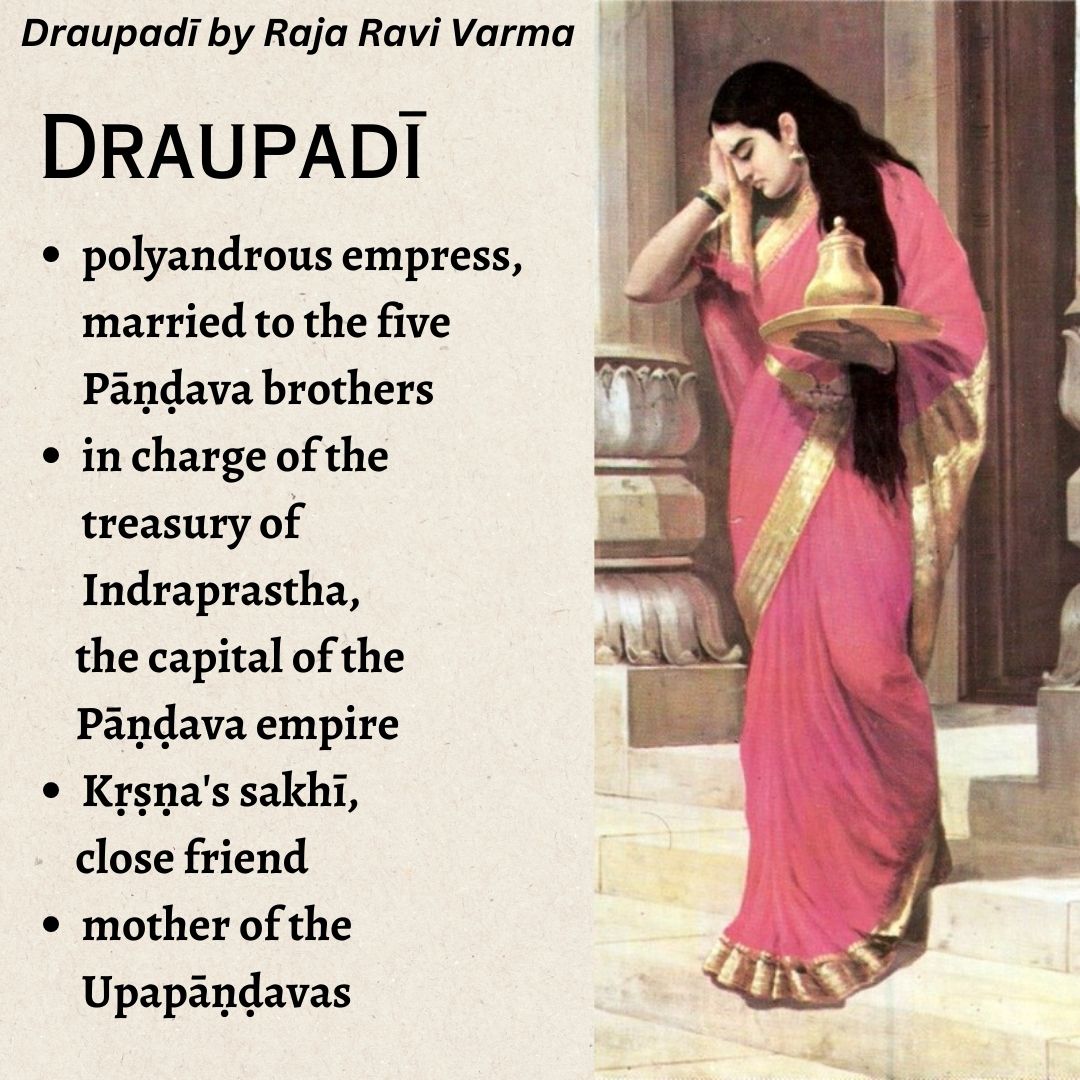
Draupadī is absent from the sabhā at the time the dice game unfolds, as she is in her private chambers, menstruating. The servant comes to her and announces the outcome of the dice game. She is told that she has been ordered to present herself as a servant before the Kuru dynasty. She refuses to go, and says she wants one question to be asked to Yudhiṣṭhira:

“Did you first lose yourself, or me?” (2.60.9)

The servant returns to the sabhā and asks Draupadī’s question to Yudhiṣṭhira, who remains silent. The Kauravas become enraged by what they perceive to be Draupadī’s defiance, and one of them, Duḥśāsana, goes to fetch her himself. When she still refuses to come, he grabs her by her hair, drags her to the court and molests her publicly.

However, Draupadī is unbent: she delivers an incredibly powerful speech in which she continuously asserts her independence, challenges and rejects the men’s claims to her freedom, questions and denies the validity of the dice game, and, ultimately, overturns its verdict. In this speech, she presents a series of arguments, and I will analyse each in a series of upcoming posts.

Her first argument is her first question, which infers that, even if Yudhiṣṭhira did have any authority over her status (which she later challenges and denies as well), he lost all authority which could have been argued that he exerted over her the moment he renounced his independence. One who is not their own master cannot be the master of someone else, and one who is dependent cannot impair another’s independence.

My Mahābhārata blog: https://www.tumblr.com/musingsonthemahabharata

IG: @musingsonthemahabharata. ❤️‍🔥

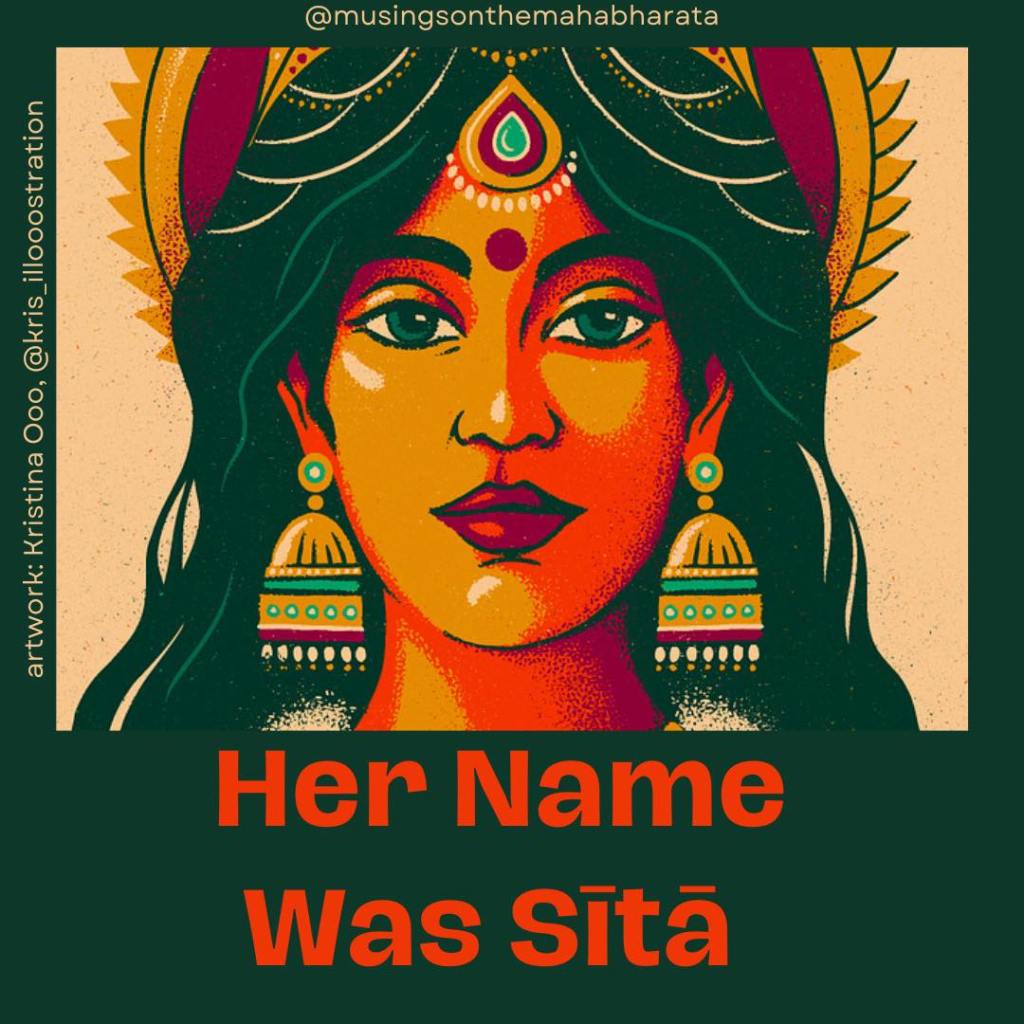
Her Name Was Sītā

I attended a screening of “Her Name Was Sītā” at Edinburgh University’s Centre for South Asian Studies last month, an incredible film by Heshani Sothiraj Eddleston that explores shame and the concept of female virtue, and how these can drive women to suicide through religious discourse and socio-cultural castigation.

Sītā, as a character, Goddess or symbol, is not addressed directly in the film except for in the title, but I would maintain that this initial evocation builds a framework to process the film in. Sītā, as a key figure of itihāsa (Sanskrit for “so it was”, a body of work that accounts past events / the history of the Hindu streams or Hindu universe, of which the Mahābhārata and the Rāmāyaṇa are central components), holds an emblematic position in the South Asian collective consciousness as an archetype of female virtue, sacrifice, female suffering and tragedy. Notably, I would maintain that this is a limiting association and that Sītā, as with any element of itihāsa, can be decoded in expansive ways that subsume and transcend those connotations.

Regardless, the associations are there, and there is power in that, as well as in a name; symbols and names such as Sītā and Draupadī hold in themselves potential to be approached as mediums through which we can understand gender programming, socio-cultural gender relations and the moral biases related to that. They therefore offer us the opportunity to deconstruct gendered conditioning; however, unfortunately, we generally do not take the leap to do so, and instead become further embroiled in contractions such as our identification with gender through the very tools that could free us.

Final note — the film shook me in many ways, would recommend watching it!

The stunning artwork credit: Kristina Ooo.

on writing as an act of transcendence

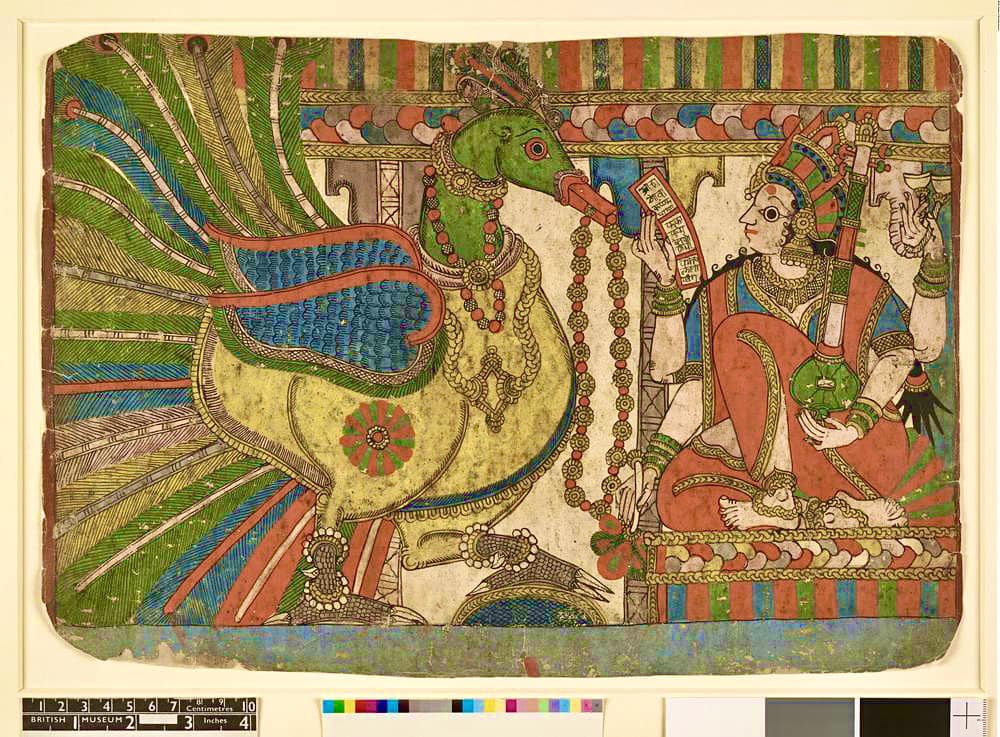
the beautiful image is a painting of Sarasvatī that belongs to a set of sixty which chronologically depict a tale told in the Mahābhārata (as well as in the Mārkaṇḍeya Purāṇa and in the Śrīmad Devībhāgavata), that of King Hariścandra. this painting is one of two beginning the set, and it depicts the invocation of Sarasvatī, the Goddess of knowledge, speech and poetry, who is invoked as the flow of (and to flow the) words and wisdom of the telling. Gaṇeśa is invoked, as well.

in a seminar i recently went to, we discussed sacred texts, and the invocation of Gods & Goddesses in their openings – the muse in the Iliad, the deities in the Sanskrit texts etc. it made me reflect on writing as an inherently transcendental act. as in, it is not you who writes (or creates etc). it is being written through you, and it is therefore futile to take ownership for it.

as a ‘writer’, i oftentimes read my work and feel as if it was written by someone else. of course, my biases seep in (in editing, especially), but if i fully connect, the experience is that of it being written through me, and not by me.

i understand the invocation of the muses and Goddesses to reflect, in part, this understanding: that the act of creation subsumes and transcends the self or ego, even if only momentarily. that in creating, we tap into and open pathways within that we usually do not access customarily, when we are so entrenched in our sense of self that the energy can only flow in one way (that of sustaining our identity and the patterns which construct it). in creating, the energy can be freed to flow in new or in more ways. this is how i understand the surrendering to the muse or to one’s art that is so lauded by poets. 🦢