amaryllis (/ˌæməˈrɪlɪs/[1]) – bears the name of the shepherdess in virgil's pastoral eclogues. it stems from the greek ἀμαρύσσω (amarysso), meaning "to sparkle", and it is rooted in "amarella" for the bitterness of the bulb. the common name, "naked lady", comes from the plant's pattern of flowering that blooms when the foliage dies. in the victorian language of flowers, it means "radiant beauty".
I have been asked on Tumblr how the Mahābhārata answers to the question of suffering (is suffering important? why? how?). First, this is an amazing question which hadn’t occurred to me to ask myself in relation to the Mbh, so I’m grateful for this prompt.
Second, I wouldn’t say that the Mahābhārata distinguishes suffering as important, but it does establish that it exists. All its characters undergo extreme suffering: from sexual assault to losing and grieving children, beloveds, friends, subjects. No character is spared from grief, and, in this, suffering is established as an inevitable reality of the human experience.
However, as scholar Emily Hudson argues in her book “Disorienting Dharma: Ethics and the Aesthetics of Suffering in the Mahābhārata”, there is another dimension the epic offers to the question of suffering, which is that of confronting it. Confronting suffering “involves cultivating a clear sense of the factors that contribute to human misery” (p.33) which the epic, I join Hudson in maintaining, equates with “the quality of one’s mind (manas)” or “intelligence (buddhi)”.
In a significant scene that occurs in the aftermath of the war, Yudhiṣṭhira, crippled by guilt and loss, refuses to rule, and wishes to renounce the world and his responsibilities in an effort to both punish himself and escape his pain. Kṛṣṇa, Draupadī and the other four Pāṇḍavas each give individual speeches to Yudhiṣṭhira in which they attempt to convince him that he cannot do so, that he has a duty to uphold, and, most fascinatingly, that the intensity of his suffering is derived from a misunderstanding of reality.
Most beautifully, Yudhiṣṭhira is told by Kṛṣṇa and Bhīma that “the battle he now must wage is the one with his mind (manas)” and he is to accept the impermanence of existence (Hudson, p.33; Mbh; 12.16.21-25; 14.12.1-14).
My understanding of this exchange is that, suffering will come. However, the extent to which we suffer is dictated by the clarity of our perception. One will naturally grieve death and loss and experience sorrow; however, the narratives we create around these emotions or experiences will dictate whether we remain stuck in them, or whether we welcome them as transitory states that experience themselves through us.
Just as Yudhiṣṭhira falls to his grief, yet picks himself up and rules, so can we.
Many thanks again to the Tumblr user from London who asked this question – if anyone has any other question, please, all are welcome here! Receiving questions from different perspectives is helping me see the epic in new ways in which my mind might not take me on.
Painting: The Destruction of the Yādavas. Unknown artist – do let me know if you know the artist!
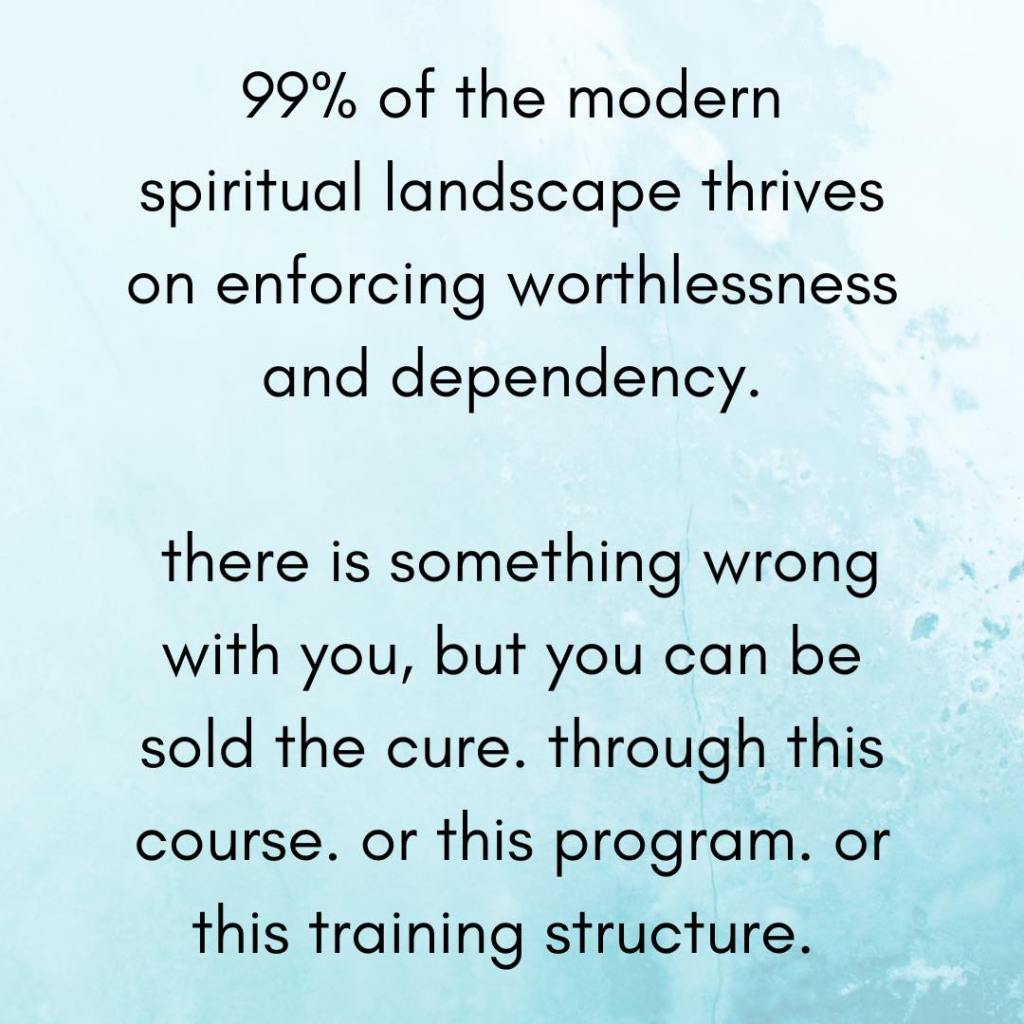
99% of the modern spiritual landscape thrives on enforcing worthlessness and dependency. there is something wrong with you, but you can be sold the cure. through this course. or this program. or this training structure.
this paradigm is packaged masterfully in esotericism and sanskrit terminology, with beacons of validatory hope offered that keep you hooked in a dopamine loop of hope: God loves you; you are God — which will mean nothing to you as long as your intrinsic experience of yourself continues to be one of absolute worthlessness.
once you are stuck in worthlessness while having access to no real tools to actually break through it, the reassuring promises of divine love or wholeness will act only as reinforcers of the one constant underlining message, which will continue to be, you are not worthy.
and because you are so excruciatingly insecure, you will believe it, and strive to become worthy. you will be cruel to yourself. you will give away your autonomy. you will beat yourself up for feeling anger or misalignment. for not being “surrendered”. for making what you fear are mistakes. you will compare yourself to others, you will become dependent on others. you will mistrust yourself. you will repress yourself.
you will think that the experience is anywhere but here, in you.
Sweet, energetic, and entertaining, Greta Gerwig’s Barbie is a delightfully camp blockbuster that I thoroughly enjoyed. The cinematography is excellent, the colour palette is perfect, and the actors are a treat. However, I did find its feminist thesis to be lacking. Although I acknowledge that the film is in itself a comedy which does not aim to solve social justice and functions primarily as entertainment, it still does construct a social, feminist commentary, which is why I found it fitting to utilise as a stimulus for analysing the deficiencies of pop-feminism culturally, as well as within myself.
Barbie offers its female characters the space and opportunity to muse on their condition and on the pains of being a woman, such as the contradictions of having to be extraordinary (attractive, successful, loving, kind, assertive) and yet contained, the ideal being achieving or conforming to a personal excellence that concomitantly is appeasing, controllable and tameable; yet never too much — not too powerful, nor too intimidating or destabilising. A message of: Shine, but do not shine too much.
In my personal journey, I have recently been reflecting on my self-punishing tendencies and on my self-images of having to always be kind, never angered or envious, and, while watching Barbie, I was moved listening to the monologues of the female characters, and saw more clearly how much of my own ruptures in my identity are the legacy of having been conditioned and socialised as female growing up.
“I’m just so tired of watching myself and every single other woman tie ourselves into knots so that people will like us.” America Ferrera as Gloria in Barbie.
Indeed, I have found that men are less likely to have intense hang-ups around emotions such as anger, as it is viewed as more acceptable for them to express it. However, this binary contracts all gendered expressions, as male conditioning stereotypically also rejects its own emotional range of vulnerability and openness.
The human condition is such that we all are continuously split and stretched within between who we think we should be and who we truly are. We perpetually hide, repress, contort, and harm ourselves to mould into ideals and images which we innocently construct by absorbing various messages from society, culture, history. The Barbies are given the chance to see through the mirage of constriction, the Kens are not (which, in part, saddened me), however, neither fully glimpse through into the ultimate bondage: that of the gendered self.
To successfully break through the suffering caused by female conditioning, a deconstruction of the very concept of femaleness as a rigid reality must ultimately occur — along with a deep dive into gender as a construct, both which are unfortunately glossed over in Barbie, and, on a greater scale, in pop-feminism. In my understanding, complete liberation cannot be achieved while still operating in the gender binary, which is to be dismantled within in order to open to freedom from all self-images, internal conflicts and constrictions.
Barbie both delighted me with its vibrancy, playfulness and beauty, and also reminded me that, as a woman myself, I must push through myself more for my liberation.
My arguments are based on the work of feminist philosophers such as Simone de Beauvoir (see: The Second Sex), as well as on the precepts of non-dual ‘Eastern’ philosophy.
today i discussed with a friend and fellow spiritual practitioner about our experiences with learning from people and receiving guidance on the internal journey. they shared with me about their moments of disagreement with their teacher, and about how such moments often end in comedic relief or deepened openness.
incidentally, i have recently experienced such a moment myself, in which i felt frustrated with the person i am learning from, and my first impulse was to suppress my frustration – which is the modus operandi i have internalised from past experiences, having come to associate disagreement or conflict with one you are learning from with lack of surrender or respect, with something being wrong with me as a ‘student’ – as myself. (*note: i don’t resonate with using ‘teacher’ – ‘student’ labels anymore, but for simplification sake).
i was set to suppress myself this time as well, only a pestering thought or feeling lingered and pulled at me.
the thought was: “i can’t do this to myself again”.
so i reached out, asked if i could share, expressed all of it as it came, as irrational and messy as it was – and breathed in relief. when the response came, it was most welcoming and kind. and i thought to myself, oh.
it can be like this. easeful. it can be like this; a non-judgmental container in which a full capacity for self-expression is allowed, in my niceness and in my ugliness, in which there is no fear of being wrong or of making an offence.
i sat with this for many hours later, for the first time in years seeing how heavy the burden of having curbed my self-expression had been – in and out of ‘spirituality’ (which, yes, encompasses all, but again for simplification sake).
followingly, questions that came to mind on this dynamic were:
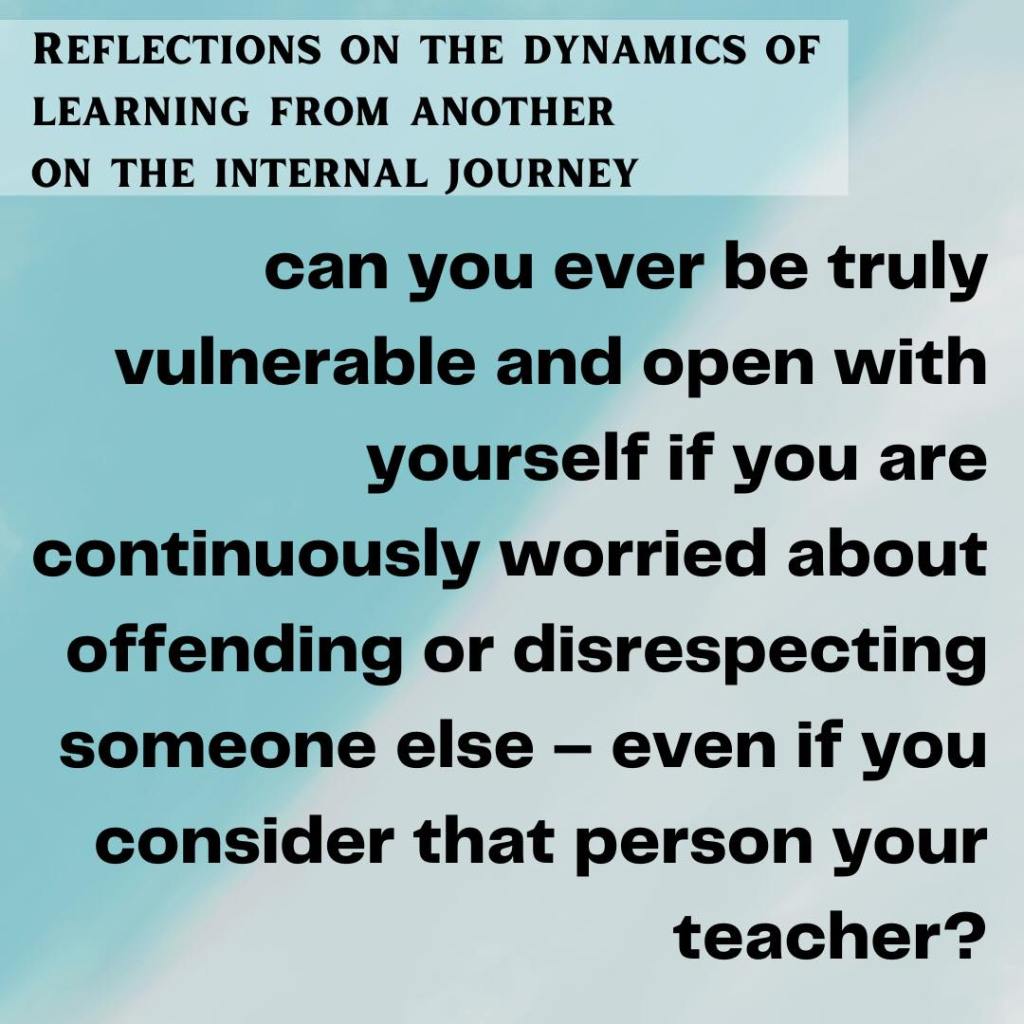
can you ever truly be vulnerable and open with someone if you are continuously worried about offending or disrespecting them? and, can you ever be truly vulnerable and open with yourself if you are continuously worried about offending or disrespecting someone else – even if you consider that person your teacher? (extrapolating this, i believe this applies to our relationship with God as well – how can we connect if we live in self-imposed fears of God?)
although i do think that there is no right or wrong ‘teacher’ (and, extending this to the playground of life, person, friend, whichever the role etc), or right or wrong place to be in, i personally have decided that i want to learn from someone i can speak freely to, and be freely with. if i spend more time being on edge than expanding, i’m out.
at the beginning of my internal journey, i was desperate to find “the real thing”. my thought process was the following: the legacy of colonialism fuelled appropriation in the multicultural spiritual landscape and stripped traditions such as Yoga & Tantra off their complex nuances, which in turn became oversimplified replications of the streams in question, with Tantra bearing the brunt of postcolonial fetishisation and extreme oversexualisation. i was fascinated by the profound non-dual philosophy of Tantra, but i was worried that if i dived into it, i wouldn’t find “the real thing” in terms of practices, teacher and community. and so i read the books, the papers, the testimonies, and made myself lists with boxes to tick off. a list looked like: a well-defined lineage of practices and gurus, classical elements such as rituals, a grounding in an academic background etc… i ensured myself that if the boxes were ticked, i would find the “real thing”. the real Tantra. i would be set. i would find certainty.
yet i’m finding that the only certainty in life is uncertainty. ticking all the boxes i myself have created (in all areas of my life, this does not just apply to spirituality) ensures only the illusion of security. i can never be sure what the real stuff is, and ultimately the only “real thing” i can ever know is my experience. myself.
etymologically, tan-tra (तन्त्र) translates as “expansion-device”. where i’m at in my process is that i’ve stopped asking myself what the “real thing” is outside of me. the real thing is my experience. i don’t need to make sure if the place and the people i choose to be with are the “real thing” as long as i am expanding within. to be completely honest, i don’t care anymore. i am “here”. and i’m having an experience. and if the platform changes and the people go, i am still “here”, within myself, in my experience.
similarly, if i do not expand, i don’t need to stay where i think “the real thing” is just because i have convinced myself or logically reasoned through deductions that it was * it * – or was told was it.
so is there a real Tantra? a fake Tantra? perhaps. perhaps not. i don’t know. perhaps that’s the wrong question to ask. perhaps there is no answer – or if it is, it won’t come through logic or ticking appearance boxes.
perhaps when experience prevails, there is no need to ask this question or to differentiate between what could be real or what could be fake.
one certain thing is, i know i’m tired of doing anything else but be in my own experience. and… you’ll know if you are expanding.
In the recent months, I have been deeply reflecting on independence and personal power, and the reflections that I am sharing in this article are emergent from interactions with friends, from browsing social media trends, as well as from contemplations on my own journey.
What I’ve become familiar with, within and without, is recognising fear: the fear to stand on one’s own, in full autonomy and independence, which, I find, stems from deeper, more rooted fears of our own incompetence; fears of something just not being quite right with us.
I have observed, within and without, how, controlled by fears, we shy away from paving our path by ourselves, and fall into wanting it to be paved for us by an external agent. Insecurity leads us to wanting to be told how to think; how to act; how to be treated; what to aspire for. We desperately want to feel okay within ourselves, so we seek comfort and security in dependence — be it on a person or on a thought process. We conceal our gifts, infantilize ourselves and make ourselves small in exchange for what we think is love.
And, in a desperate quest to, very simply put, not feel awful about ourselves, we seek help: in the work of great thinkers, philosophers, spiritual leaders and mental health coaches. However, what I’m noticing is that, in such fear-based seeking, we don’t even trust ourselves to absorb these thought processes on our own. We rely on others to interpret them, and, in this, we remain even more stuck; dependent on someone, or something, for information, knowledge, comfort; dependent on someone to offer us an experience.
In a paradigm of co-dependency and fear, self-help and coaching businesses, as well as pop-psychology thrive. I want to underline that I find nothing wrong with either, and consider them to be essential in the great design, as well as helpful on an individual to individual basis. However, in my view, there is a worrisome element to the structure of these businesses as they prevail on social media, and it is this very element that enables much of our mental dependence: which is that, in an effort to appeal to the masses (which, again, is a logical and natural goal to have in the context of sustaining business), pop psychologists, health coaches distil the knowledge of great thinkers in consumable bites: rephrasing, extracting, simplifying, sometimes even appropriating without reference. So much is lost in this; we end up engaging with pruned versions of philosophies and pruned truths which only give a taste of the encompassing worldview we want to grasp and embody; we don’t enter that door of perception, we only hang at the frame. Our fears and mistrust in ourselves, combined with a modern short attention span and desire for quick fixes, provide the perfect context for us to fall before the illusion of knowledge, and not before the knowledge itself, as well as facilitate our dependency on surface-level content for relief, comfort, and insight. We remain alienated from ourselves and cling to external sources (coaches, teachers) in the absence of connection to ourselves and to direct sources of knowledge (which, ultimately, I am learning are our internalisations of our own experience). We end up extolling people and not knowledge, and, in impaired autonomy, remain perpetually unsatisfied, powerless, and stuck in one-dimensional echo-chambers, believing truth is held or experienced outside of ourselves, and can be offered to us by an external force; instead of attained within through our own power — yes, supported, and, yes, with guidance, but not as a passive, powerless actor, but as an active, free agent.
What I personally want to tackle within is dependence, and not trusting myself to pave my own path. After years of remaining stuck in personal mistrust, perpetual insecurity and in the fear of losing myself to myself, what I am coming to see is that it is only by having my own experience of the teachings that I want to follow that I can both understand them and break from my patterns of churn; so, for instance, if I resonate with Marcus Aurelius decreeing ‘no one can keep you from living as your nature requires’ (6.58), what I want to do is, after satisfying my intellectual curiosity by reading and inquiring into this precept, is to followingly FEEL, experience and embody what my nature is;to FEEL what it is to live as is; understand how I cannot be kept from living it; then decide if it’s a precept that I want to live by based on whether it brings most growth to me at this particular point in time. And, revisit, recheck if this remains valid as I move through life — as Aurelius says himself, your nature is of continuous change. Contrarily, what I have done until now is to read and either stop there by assimilating others’ takes without forming my own, or by relying on the experience of an external source / individual to teach me what it is for them to live as nature requires, and build my worldview, mould myself on that. Both approaches have left me powerless, insecure, and ultimately in pain.
I am learning that no intermediary is needed between me and knowledge — between me and understanding myself.
Of course, this does not mean that teachers, mentors, friends and guides are not needed; for me, this understanding, however, implies self-reliance and steadiness in my own knowledge and experience. Why is this important? Because, when these arrive, you will choose to stay at, or to leave a place you are learning in, or to stay with or leave a person you learn from, from a fearless place of autonomy, in which your discernment is not clouded by the fear of being alone. By the fear of being wrong.
I am learning that it is in the absence of fear, hierarchy, and personal gain that knowledge flows most abundantly, a place in which individuals can join each other in complete freedom of being, in mutual respect and openness, with the purpose to enrich each other’s understanding of their own self. A place where you enter and walk away as a captain of your own soul, steering the ship toward yourself.
Concluding this article by reminding myself that it is not enough to peer through the doors of perception, expression so beautifully coined by Aldous Huxley; we must enter.





 amaryllis