amaryllis (/ˌæməˈrɪlɪs/[1]) – bears the name of the shepherdess in virgil's pastoral eclogues. it stems from the greek ἀμαρύσσω (amarysso), meaning "to sparkle", and it is rooted in "amarella" for the bitterness of the bulb. the common name, "naked lady", comes from the plant's pattern of flowering that blooms when the foliage dies. in the victorian language of flowers, it means "radiant beauty".
Something I find fascinating about the Critical Edition of the Mahābhārata is that the characters sporadically move from addressing Kṛṣṇa as an embodied mortal (as their friend, cousin, son-in-law etc) to addressing him as the Godhead; as Viṣṇu, as the Supreme Being, and as Īśvara. The succession of change between the modes of address can sometimes even happen on the same page, at a distance of a few lines. The veil is lifted, and the characters see through Kṛṣṇa’s illusion, and, through that, they become immersed in the nature of Reality; the veil promptly drops back, and God is lost.
An argument for this could be that the divine modes of address are interpolations, a theory being that Kṛṣṇa became identified with Viṣṇu only in later renditions of the Mahābhārata. While this could be true at the level of historical analysis of the epic, for me, there is a subtler teaching encased here: how all of us, without exception, glimpse into the nature of Reality as we move through life, yet we perpetually proceed to return to becoming engrossed in the superimpositions we project upon Reality; and the dance continues. From Truth to dream, from dream to Truth. It is quite endearing, really. What committed and imaginative dreamers we are!
Adyashanti once talked about how one inadvertently glimpses truth; it is, after all, inescapable as it is our nature; the trick is not forgetting / losing the glimpse.
so, did Draupadī laugh at Duryodhana in the Palace of Illusions and did she insult Karṇa at her svayaṃvara? no. neither of these events appear in the critical edition of the Mahābhārata, and they are considered interpolations coming from uncertain sources.
how do we relate to these, however – considering that they are now completely imbued in the South Asian collective consciousness?
devoid of frustration! we relate to them in a way that is devoid of frustration. 😁 this is my first answer because i used to be very frustrated with interpolations, especially with those that, in my view, vilified Draupadī in any way. inquiring into my intense reactivity triggered by these led me on a rich introspective process, in which, first, i questioned the depths of my identification as a woman to Draupadī’s character (will write more on this in the future!). second, i began questioning how important it is for the Mahābhārata to remain intact in popular culture and in retellings, and if these interpolations corrupt the epic. one of the conclusions that i have reached, which i will expand on in my PhD thesis, is that these interpolations and retellings can teach us about how society has progressed through time, and can teach us about what moves us as humans, and about the ways we continuously try to make meaning and to find reflections of ourselves in the external world. for instance, interpolations that might vilify Draupadī’s character, in my view, can pinpoint to blind spots in society which can uncover latent misogyny, whereas interpolations which glorify Karṇa can pinpoint to people’s identification with his particular character, which to many represents a symbol of class struggle. in this, i believe there is much to uncover; as scholars, and i have been guilty of this, we usually tend to dismiss interpolations, and i would maintain that we lose a lot by doing so. because everything is valid, and i would argue that every single retelling can teach us more about the ways in which this epic is actually lived, and comes alive for people. 🖤
did Draupadī’s disrobing ‘really’ happen?
yes, as in, it appears in the critical edition, and it is not considered an interpolation. there have been scholars who have argued for Draupadī’s disrobing to be recognised as an interpolation (one scholar in particular) but their claims have been rebuked.
however, i do not want to talk about the validity or invalidity of these arguments, but, as a follow-up to my previous video, i want to briefly discuss what i find most fascinating about these debates on interpolations, which is that i think they mirror back to us our own possible blind spots and our biases as researchers. this is a great generalisation, but i have noticed that people who are more drawn to argue for Draupadī’s disrobing being recognised as an interpolation might be more dismissive of the female experience as a whole in academia or in various strands of literature, whereas, for those of us belonging on the other side of the spectrum, our blind spots might be being too entrenched in validating the female experience or in being overfocused on it, and i count myself in this category. i believe there is worth to blind spots, though – i think they can be important or can work to our advantage in relative terms, in the same way overattachment to our own research can – in the sense that, both can provide fuel for our work as well as solidify belief in it – so, nothing is good or bad, no binary thinking here! 😁 but, i do think that this can be a very fruitful area for contemplation for each of us, in which we could question our overattachment to a particular argumentative thread. what can be mirrored back to us through it? for instance, i find that a lot of my attachment to certain narrative threads can mirror back to me my attachment to my female identity; which, again, if channelled properly, can be great fuel, but i do find it important for me to hold it in my awareness and deconstruct it internally if not externally through the means of, for example, an academic paper.
how everything can be great fuel for inner work – even academic research! 🤍
The Nāṭyaśāstra is a Sanskrit treatise on the performing arts, authored by sage Bharatamuni.
Most notably, it addresses the aesthetic theory of rasā, which translates from Sanskrit as ‘essence’, ‘taste’ or ‘nectar’. Herein, eight rasās are identified, which encapsulate the totality of human expression and experience:
śṛṅgāraḥ (शृङ्गारः) (loosely translated as love or eroticism)
hāsyam (हास्यं): (laughter)
raudram (रौद्रं): (rage)
kāruṇyam (कारुण्यं): (compassion)
bībhatsam (बीभत्सं): (disgust)
bhayānakam (भयानकं) (terror)
vīram (वीरं) (heroism)
adbhutam (अद्भु) (wonder, astonishment)
The Nāṭyaśāstra pinpoints the ultimate, supreme aim of any work of performance art to be titillating the interior landscape of the one in the audience to experience pure rasā.
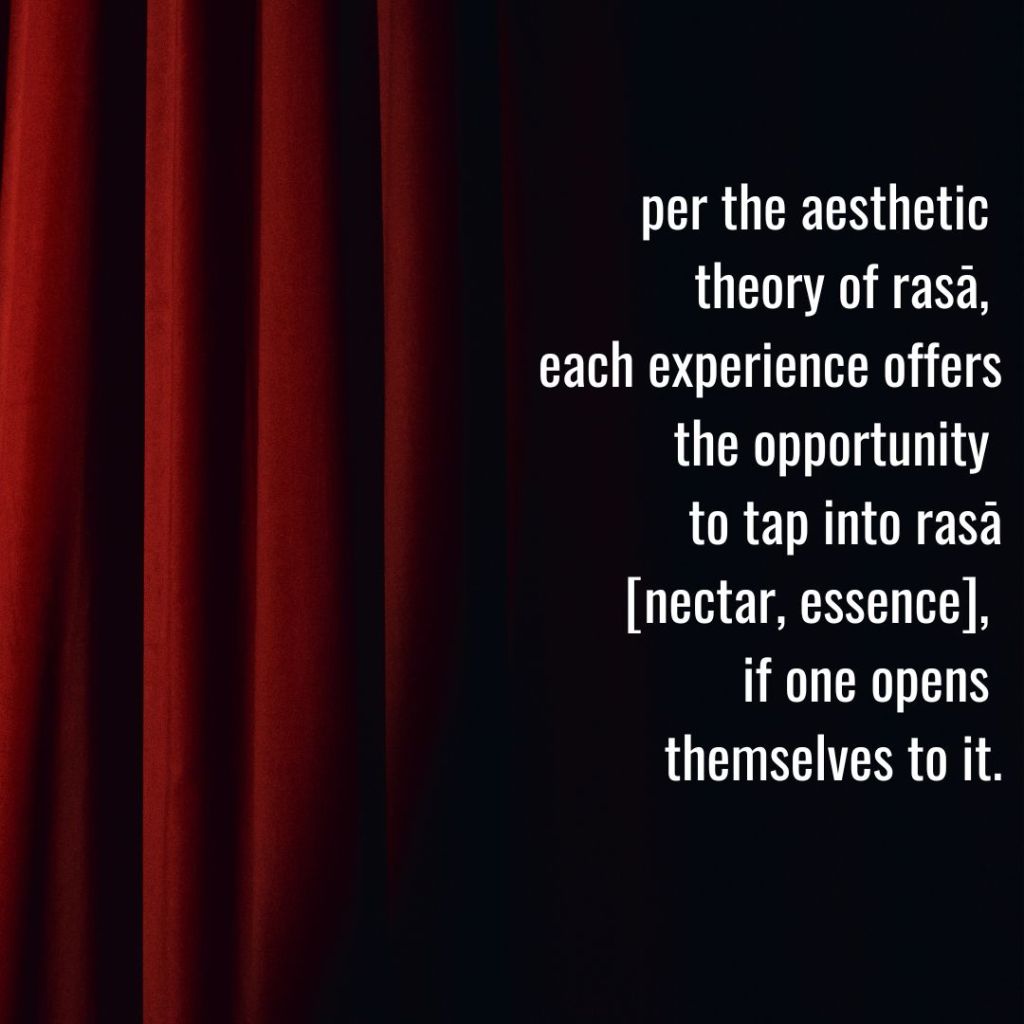
However, access to rasā in its purity is not limited to the performing arts medium; each experience offers the opportunity to tap into rasā, if one opens themselves to it.
Furthermore, rasās are given so much importance by Bharatamuni (and also by Abhinavagupta in his magnum opus Tantrāloka) because arguably it is by experiencing rasā in fullness that one can be offered a gateway to experiencing and understanding the essence of their being and consciousness.
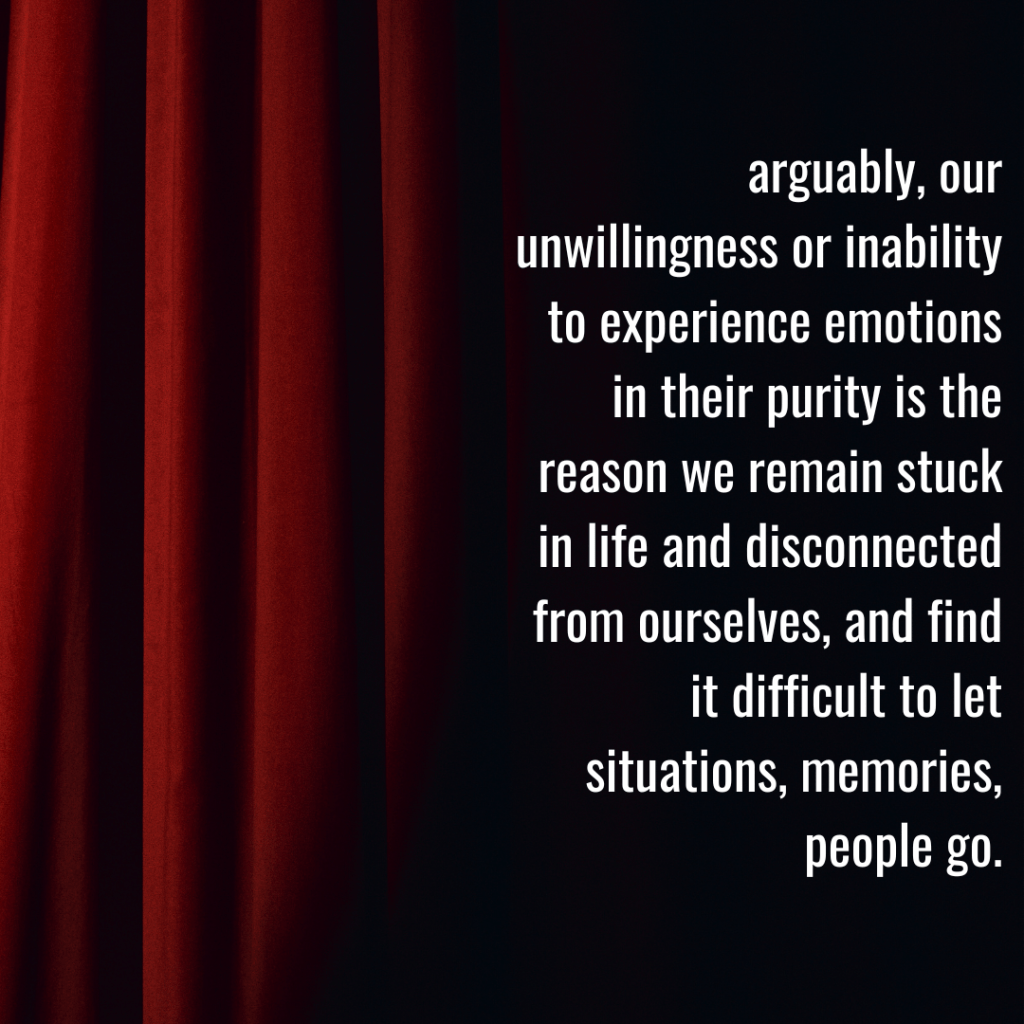
Customarily, we do not experience any rasā in its complete intensity, and we instead only taste it in partiality; muddled, adulterated. For instance, we rarely experience rage, partly because we are unwilling to open to its full intensity (perhaps out of preconceived notions of it being ‘wrong’, perhaps out of discomfort), and instead feel diluted anger. Our unwillingness to experience emotions in their purity is the reason we remain stuck in life, and find it difficult to let situations, memories, people go. (see more: The Theory of Rasa, Pravas Jivan Chaudhury, 1952)
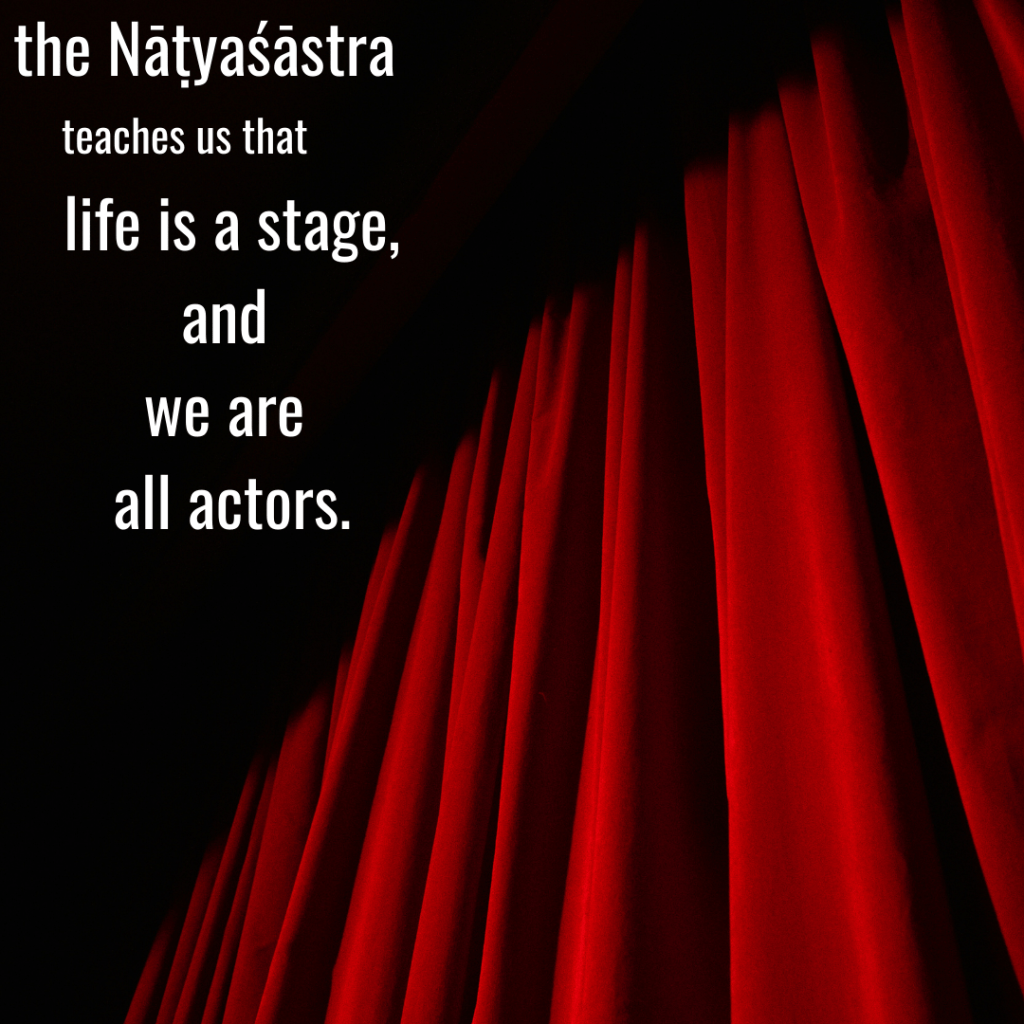
The Nāṭyaśāstra: Life as a Stage
One of the precepts of the Nāṭyaśāstra is that life is play, and we live as actors on a stage: continuously being offered the opportunity to tap into rasā, and, ultimately, into the depths of our beings.
At the WB immersive, we had the opportunity to live this precept by playacting characters we chose or felt connected to. The darkened ambiance of the secluded Scottish manor we stayed in (which included a real-life bar located in the heart of the house!) was a rich opportunity to delve inward, effects of which continue to percolate for me. I won’t provide an account of the three plays we were engaged in, as I believe it would be futile to try to describe the experience, and a chronological or narrative account won’t serve anyone who was not there; I will however centre on the effects of it.
Interestingly, the experience of life as stage, not as lived for me while on-retreat — in which my direct experience was more one of passive enjoyment in the absorption of delight of the senses (with an emphasis on taste, touch, and sight) — began to dawn as gradual understanding in the aftermath of the retreat. It was not very conscious, but I began to find myself recognising the different characters or personas of myself that I slip into as my day unfolds and to see how my experience of myself is ever-changing.
Even being in my body feels gradually different as the day progresses; sometimes there is lightness in my body, sometimes there is heaviness, sometimes there is tiredness. Similarly, my mind feels distinct in different times of the day; sometimes it is busy, sometimes it is easeful, sometimes it is burdened. None the better, none the worse.
I believe there was always some awareness of this inherent fluidity in me, but, in my lack of clarity, it was addled with uncertainty or fear; do these shifts in ways of being mean that I am fake or inauthentic — an impostor about to be found out?
In a way, yes; in the sense that my idea of myself as the solid identity of Téa is indeed a false one; as in, it is unstable. I am not just one character, I am many characters that come to play within me and through me in, for instance, the short timespan of a day; the friend I am to one person is different to the friend I am to another person, the scholar at university is different to the daughter I am to my parents. One’s impression of me will be different from another’s impression of me.
Neither of these facets of myself invalidate the other, only point to the complexity and fluidity of being that is intrinsic to each of us.
These reflections, triggered by the Nāṭyaśāstra experience, led me to understand the playfulness of life more in the retreat’s aftermath. Like, I am just acting characters. As my generation would say, it’s not that deep.
I only need to experience each character to the fullest.
Unleashed Anger
However, this process also led to an unleashing of an emotion I have been repressing, namely anger, and with an encounter of what Carl Jung would call ‘the Shadow’. I could not emote anger during the retreat in neither of my playacts, which made me question what blockages I had around it. Sitting with myself, I examined both my emotional landscape as well as my past conditioning and began to see the hindrances around expressing and experiencing anger that I had, coming from spiritual conditioning which dictated that it was ‘wrong’, as well as from past experiences in which I did express my anger which I internalised as shameful, and in which I felt rejected for being true to myself.
Concomitantly, I also realised I had been blocking my anger through reasoning: I am a stoic at heart, and my first reaction to any event that occurs into my life is to unpack it from distance, third-person view.
Every time anger arose for me, my intellect labelled it as irrational and diminished the emotion by unpacking the event as neither right nor wrong, and as the person who triggered my anger as an individual found in their own process lacking any malicious intention. In the face of reason, I felt hindered to follow or express my anger.
It was irrational, after all.
This was a limiting perspective: first, not only are emotions irrational by nature, but, both perspectives can co-exist: I can be angry at someone while also holding in my awareness the discernment that the person is not inherently evil or wrong and reality is complex. But when it comes up, I can enjoy my anger and viciousness to the fullest, with the sole of intention of extracting the rasā out of it — which gives me the freedom of space: space in which I can choose to both channel it in creative ways, and not to project nor repress it, I find.
(To be noted that I am still very much a beginner in familiarising myself with anger so my reflections might change.)
Second, a loosening happens: even if I do have a slip in discernment and I end up projecting my anger or viciousness onto another (we’re not perfect, right?), it is not a catastrophic event. As I ultimately am just a character playing themselves to the fullest in that context.
It sounds all good and reasonable on paper, but this loosening in my intellectual process triggered a true unleashing of all the ‘negative’ emotions I had suppressed throughout the years, from pure rage to envy, which came to me in waves until they hit me in full force.
I have been processing this unfolding by referring to my beloved Carl Jung’s theory of the Shadow.
Jung and the Shadow
Filling the conscious mind with ideal conceptions is a characteristic of Western theosophy, but not the confrontation with the shadow and the world of darkness. One does not become enlightened by imagining figures of light, but by making the darkness conscious.
“The Philosophical Tree” (1945). In CW 13: Alchemical Studies. P.335
Jung’s theory is that our individual consciousness is split into two: the conscious impulses, and the subconscious, repressed impulses we have, which we actively conceal from our awareness out of shame, guilt. He calls the repressed part of ourselves ‘the Shadow’. Jung declares that in order for one to achieve a healthy psychological state of wholeness (which he equates with the mystical ‘Self’ or the archetypal God lauded by religion), one must integrate the unconscious into the conscious. Jung even goes so far as equating encountering the Shadow with a first-hand encounter with God. (see Jung; Aion, Researches Into the Phenomenology of the Self, 1999)
However, Jung doesn’t exactly offer a roadmap to how to integrate the Shadow. He says it is an individual, possibly dangerous and maddening process that each must figure out for themselves, and also an essential journey to undertake in order to understand ourselves in our fullness.
In his view, there can be no self-understanding or self-realisation without integrating the Shadow.
In terms of a roadmap, Jung does assert that the first step is accepting your shadow and looking it straight in the eye.
That’s where I’m at right now: accepting my rage, envy and pettiness. In full honesty, part of me wants to rush through it and wishes for a quick, happily ever-after merging, and also wants a detailed handbook of how to do it. Jung says it can take years. I believe him. (See: Aion & The Archetypes)
Jungian scholars have mused that integration occurs naturally through a holding of the opposites formed by our repressed and conscious impulses, which creates tension in our consciousness, yet we are to expand our consciousness so that it holds into awareness both the shadow and the light. It is in this enlargement of consciousness that integration occurs, and one finally does not identify neither with the shadow, and neither with the light, achieving wholeness. This opens the doorway to stepping into the collective unconscious, a state of shared consciousness that, per Jung, is the base-structure onto which individual consciousness develops, and which holds all mysteries and archetypes of humanity. (See: Meeting the Shadow, edited by Connie Zweig & Jeremiah Abrams, 2020)
“Carrying such a tension of the opposites is like a Crucifixion. We must be as one suspended between the opposites, a painful state to bear. The problem of our duality can never be resolved on the level of the ego; it permits no rational solution. But where there is consciousness of a problem, the Self, the Imago Dei within us can operate and bring about an irrational synthesis of the personality. To put it another way, if we consciously carry the burden of the opposites in our nature, the secret, irrational, healing processes that go on in us unconsciously can operate to our benefit, and work toward the synthesis of the personality.”
(John A. Sanford, “Dr. Jekyll and Mr Hyde” in: Meeting the Shadow, 2020)
Incidentally, at one point last week, I experienced absolute, pure rage. I was by myself in my living room, and sank into it. At one point, the intensity of it scared me, but I didn’t turn from it. Then, it felt as if it almost exhausted itself — and it released me. It returned in waves in the following days, then dissolved again. Or flowed. How curious it is, to feel.
“Wholeness is not achieved by cutting off a portion of one’s being, but by integration of the contraries.”
Carl Jung
As a sidenote, since this process started moving in me, I have noticed an increase in my creativity, a shift in my self-expression. There’s more self-assurance. It feels like I found the voice I lost. Or some of it. 😊
Thankful to WhiskyBaba for this platform. Stay tuned for part three!
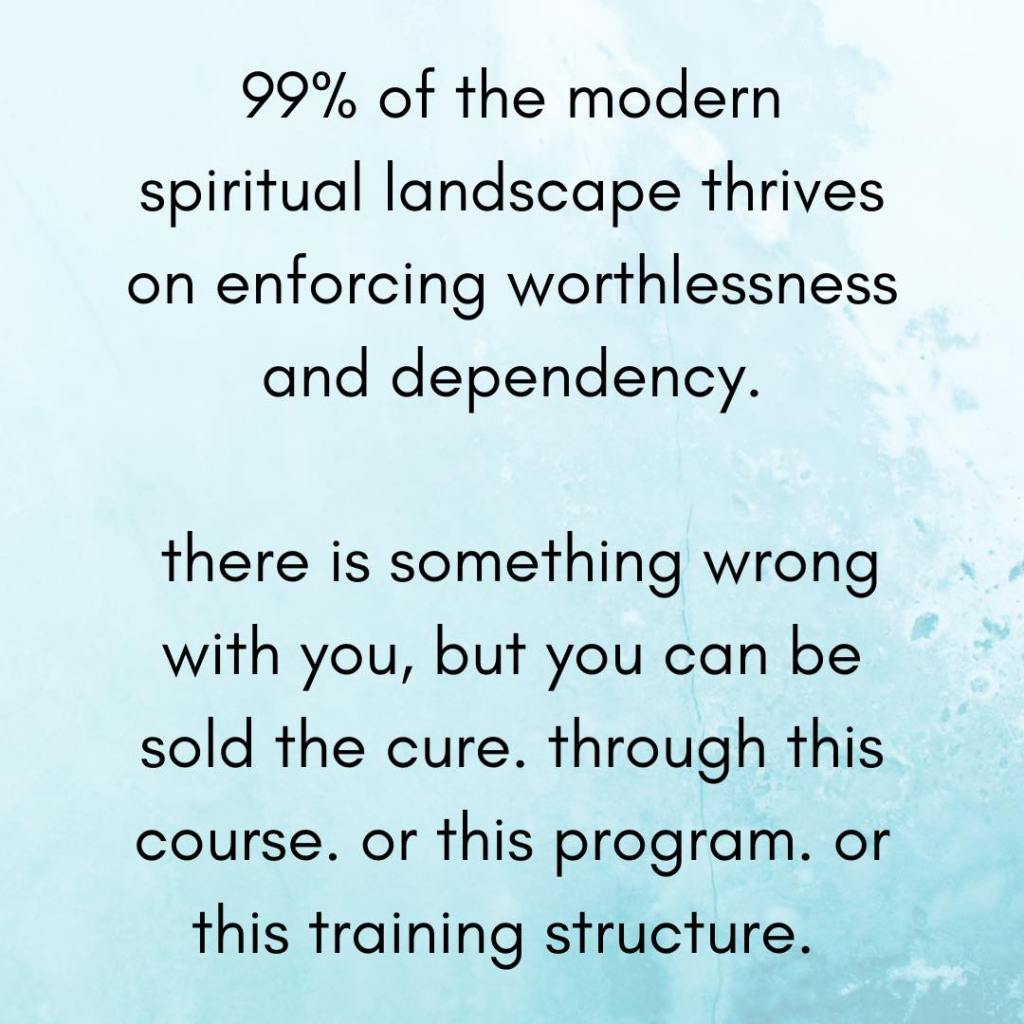
99% of the modern spiritual landscape thrives on enforcing worthlessness and dependency. there is something wrong with you, but you can be sold the cure. through this course. or this program. or this training structure.
this paradigm is packaged masterfully in esotericism and sanskrit terminology, with beacons of validatory hope offered that keep you hooked in a dopamine loop of hope: God loves you; you are God — which will mean nothing to you as long as your intrinsic experience of yourself continues to be one of absolute worthlessness.
once you are stuck in worthlessness while having access to no real tools to actually break through it, the reassuring promises of divine love or wholeness will act only as reinforcers of the one constant underlining message, which will continue to be, you are not worthy.
and because you are so excruciatingly insecure, you will believe it, and strive to become worthy. you will be cruel to yourself. you will give away your autonomy. you will beat yourself up for feeling anger or misalignment. for not being “surrendered”. for making what you fear are mistakes. you will compare yourself to others, you will become dependent on others. you will mistrust yourself. you will repress yourself.
you will think that the experience is anywhere but here, in you.
Now I am become Death, the destroyer of the worlds.
*Note, a more accurate translation is:
I am Time, the destroyer of all; I have come to consume the world.
BG: 11:32; trans. Eknath Easwaran.
Sometime ago, I was involved in a discussion about whether it was blasphemous for Oppenheimer to have quoted from the Bhagavadgītā upon seeing the explosion triggered by the atomic bomb he constructed. I was of the opinion that it was not. The opposing view was that Kṛṣṇa’s demolition was one of divine nature, whereas Oppenheimer’s manmade atomic bomb was not. Whereas, in this perspective, Kṛṣṇa’s violence and destruction were justified through Kṛṣṇa’s inherent divinity, Oppenheimer’s humanness disfigured his destruction with greed and impunity.
This comment rested at the back of my mind while I watched Oppenheimer the other night, and the film solidified my view.
I would maintain that, to one adhering to a non-dual outlook, there is no separation between Kṛṣṇa’s violence in the Bhagavadgītā (or, more accurately, in the Mahābhārata) and Oppenheimer’s manmade, humane violence. Violence is violence, and divinity (or Consciousness) is inherent in the fabric of that, as it is in all that is. The genius of Oppenheimer’s brain which created such a formidable and terrible invention functions on the same patterns that enable and are Kṛṣṇa’s destruction. There is nothing more inherently divine in death by astras (supranatural weapons controlled and imbued by mantras central to the Kurukṣetra war) than death by atomic bomb.
Not only do I argue that it was not blasphemous for Oppenheimer to quote the BG and internalise his work through its prism (and, incidentally, is blasphemy anything but a dual social construct? Can Consciousness be blasphemous of itself?), but I argue that this is exactly how the Bhagavadgītā is lived in direct experience. The Bhagavadgītā and the Mahābhārata are not lifeless ancient texts that are only accessible or relevant in an esoteric, abstract realm. The BG and the Mbh are lived here and now, from a moment to moment unfolding. I would maintain that we cannot pick and choose what we like from these texts or what aligns to our morals (such as teachings on goodness) and disregard the rest — or take it metaphorically. The last parvas of the Mbh are incredibly violent and include gory descriptions of war, and the BG occurs on the battlefield of said war. This, in my view, does not signify that the texts glorify violence — no more than they glorify any other aspect of creation. It is a sign that violence exists as a natural development of the triadic cycle of creation (creation — preservation — destruction), and it is a manifestation of Consciousness.
The Bhagavadgītā coming alive to Oppenheimer upon witnessing his own potential for destruction is a testament to the BG’s existence in the collective consciousness as an expression of truth, pulsing and flowering for the one who expands their individual consciousness enough to tap into it and to allow it to manifest through themselves.






 amaryllis