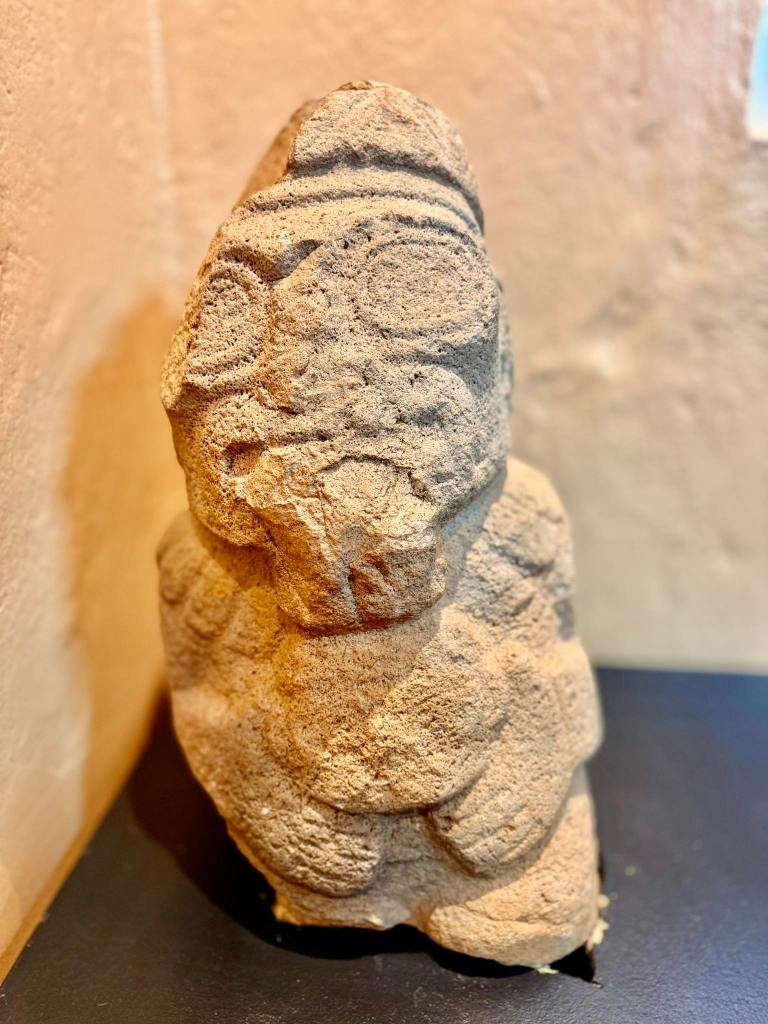
“Devourer(/s)” refers to monoliths depicting anthromorphised entities that eat sacrifices in the Pucará culture, a civilization that pre-dates the Inca. They are depicted with decorated hair and tattooed bodies, holding human heads and knives, or eating the head of a child (first photo).
Hearing a local talk about it reminded me of particular verses from the Mahābhārata which discuss the Kurukṣetra War. Perhaps the most famous one is said by Kṛṣṇa during the Bhagavad Gītā sermon, in which he identifies himself as Time (Kāla), and declares he’s come to consume the worlds.
In a perhaps less-known regional telling, the Pāṇḍavas see Draupadī and Kṛṣṇa take the forms of Kālī and Bhairava every night of the war, and devour the corpses laid on the battlefield. One day, when fighting, Bhīma sees Bhairava on the actual battlefield, drinking the blood of those slain with pleasure.
Kṛṣṇa lets the Pāṇḍavas know that the war was orchestrated to satiate the hunger of the Earth / the Goddess, and the entire war is a blood sacrifice to maintain the cosmic order (creation – preservation – destruction).
For me in both cases the Pucará and the Mahābhārata illustrate the devouring aspect of Time and existence, which consumes all cyclically, and is worshipped through and in the inevitable death of everything. The rituals, the monoliths, the tellings are perhaps signposts or reminders of this.