amaryllis (/ˌæməˈrɪlɪs/[1]) – bears the name of the shepherdess in virgil's pastoral eclogues. it stems from the greek ἀμαρύσσω (amarysso), meaning "to sparkle", and it is rooted in "amarella" for the bitterness of the bulb. the common name, "naked lady", comes from the plant's pattern of flowering that blooms when the foliage dies. in the victorian language of flowers, it means "radiant beauty".
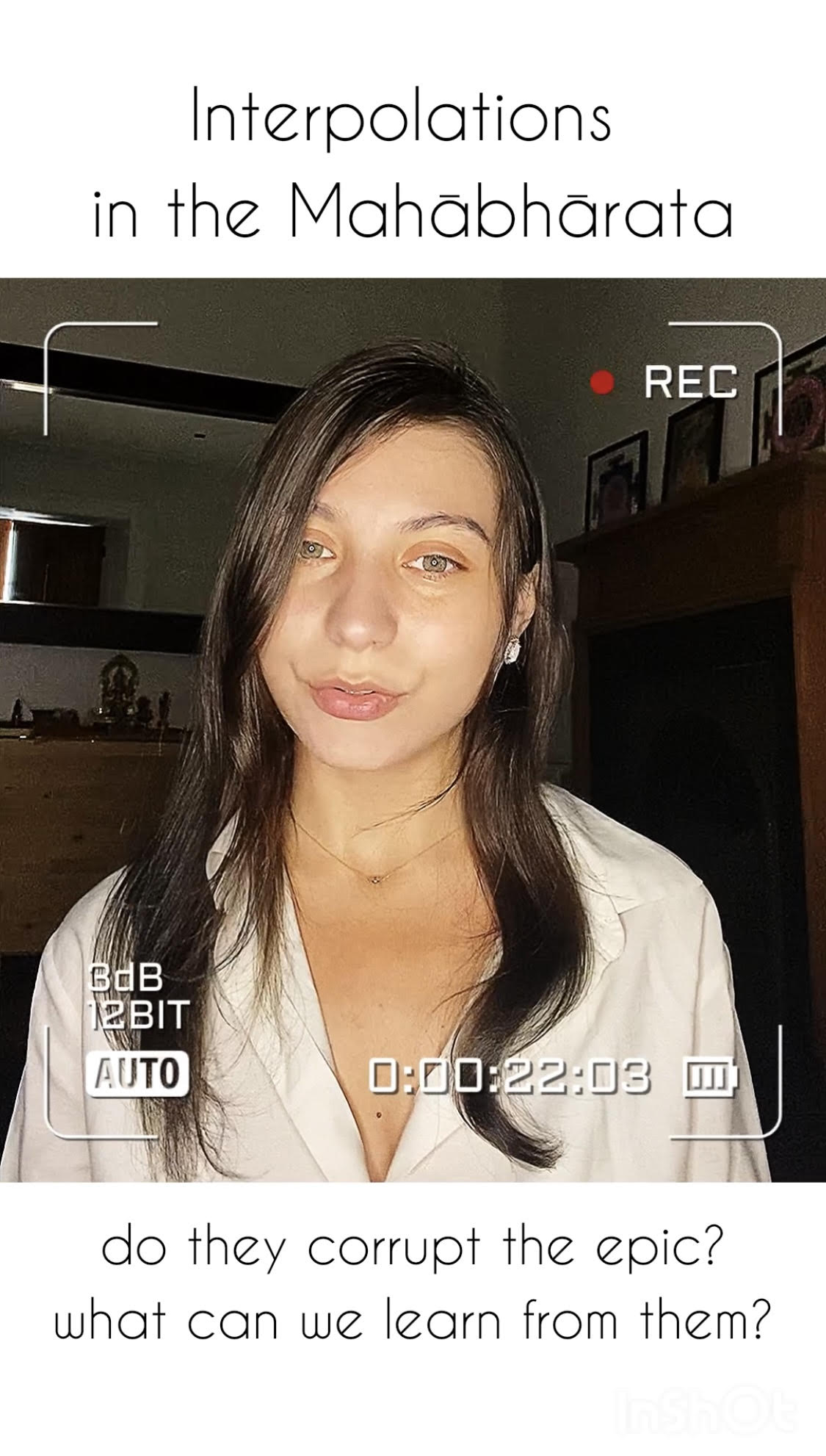
so, did Draupadī laugh at Duryodhana in the Palace of Illusions and did she insult Karṇa at her svayaṃvara? no. neither of these events appear in the critical edition of the Mahābhārata, and they are considered interpolations coming from uncertain sources.
how do we relate to these, however – considering that they are now completely imbued in the South Asian collective consciousness?
devoid of frustration! we relate to them in a way that is devoid of frustration. 😁 this is my first answer because i used to be very frustrated with interpolations, especially with those that, in my view, vilified Draupadī in any way. inquiring into my intense reactivity triggered by these led me on a rich introspective process, in which, first, i questioned the depths of my identification as a woman to Draupadī’s character (will write more on this in the future!). second, i began questioning how important it is for the Mahābhārata to remain intact in popular culture and in retellings, and if these interpolations corrupt the epic. one of the conclusions that i have reached, which i will expand on in my PhD thesis, is that these interpolations and retellings can teach us about how society has progressed through time, and can teach us about what moves us as humans, and about the ways we continuously try to make meaning and to find reflections of ourselves in the external world. for instance, interpolations that might vilify Draupadī’s character, in my view, can pinpoint to blind spots in society which can uncover latent misogyny, whereas interpolations which glorify Karṇa can pinpoint to people’s identification with his particular character, which to many represents a symbol of class struggle. in this, i believe there is much to uncover; as scholars, and i have been guilty of this, we usually tend to dismiss interpolations, and i would maintain that we lose a lot by doing so. because everything is valid, and i would argue that every single retelling can teach us more about the ways in which this epic is actually lived, and comes alive for people. 🖤
did Draupadī’s disrobing ‘really’ happen?
yes, as in, it appears in the critical edition, and it is not considered an interpolation. there have been scholars who have argued for Draupadī’s disrobing to be recognised as an interpolation (one scholar in particular) but their claims have been rebuked.
however, i do not want to talk about the validity or invalidity of these arguments, but, as a follow-up to my previous video, i want to briefly discuss what i find most fascinating about these debates on interpolations, which is that i think they mirror back to us our own possible blind spots and our biases as researchers. this is a great generalisation, but i have noticed that people who are more drawn to argue for Draupadī’s disrobing being recognised as an interpolation might be more dismissive of the female experience as a whole in academia or in various strands of literature, whereas, for those of us belonging on the other side of the spectrum, our blind spots might be being too entrenched in validating the female experience or in being overfocused on it, and i count myself in this category. i believe there is worth to blind spots, though – i think they can be important or can work to our advantage in relative terms, in the same way overattachment to our own research can – in the sense that, both can provide fuel for our work as well as solidify belief in it – so, nothing is good or bad, no binary thinking here! 😁 but, i do think that this can be a very fruitful area for contemplation for each of us, in which we could question our overattachment to a particular argumentative thread. what can be mirrored back to us through it? for instance, i find that a lot of my attachment to certain narrative threads can mirror back to me my attachment to my female identity; which, again, if channelled properly, can be great fuel, but i do find it important for me to hold it in my awareness and deconstruct it internally if not externally through the means of, for example, an academic paper.
how everything can be great fuel for inner work – even academic research! 🤍
The Nāṭyaśāstra is a Sanskrit treatise on the performing arts, authored by sage Bharatamuni.
Most notably, it addresses the aesthetic theory of rasā, which translates from Sanskrit as ‘essence’, ‘taste’ or ‘nectar’. Herein, eight rasās are identified, which encapsulate the totality of human expression and experience:
śṛṅgāraḥ (शृङ्गारः) (loosely translated as love or eroticism)
hāsyam (हास्यं): (laughter)
raudram (रौद्रं): (rage)
kāruṇyam (कारुण्यं): (compassion)
bībhatsam (बीभत्सं): (disgust)
bhayānakam (भयानकं) (terror)
vīram (वीरं) (heroism)
adbhutam (अद्भु) (wonder, astonishment)
The Nāṭyaśāstra pinpoints the ultimate, supreme aim of any work of performance art to be titillating the interior landscape of the one in the audience to experience pure rasā.
However, access to rasā in its purity is not limited to the performing arts medium; each experience offers the opportunity to tap into rasā, if one opens themselves to it.
Furthermore, rasās are given so much importance by Bharatamuni (and also by Abhinavagupta in his magnum opus Tantrāloka) because arguably it is by experiencing rasā in fullness that one can be offered a gateway to experiencing and understanding the essence of their being and consciousness.
Customarily, we do not experience any rasā in its complete intensity, and we instead only taste it in partiality; muddled, adulterated. For instance, we rarely experience rage, partly because we are unwilling to open to its full intensity (perhaps out of preconceived notions of it being ‘wrong’, perhaps out of discomfort), and instead feel diluted anger. Our unwillingness to experience emotions in their purity is the reason we remain stuck in life, and find it difficult to let situations, memories, people go. (see more: The Theory of Rasa, Pravas Jivan Chaudhury, 1952)
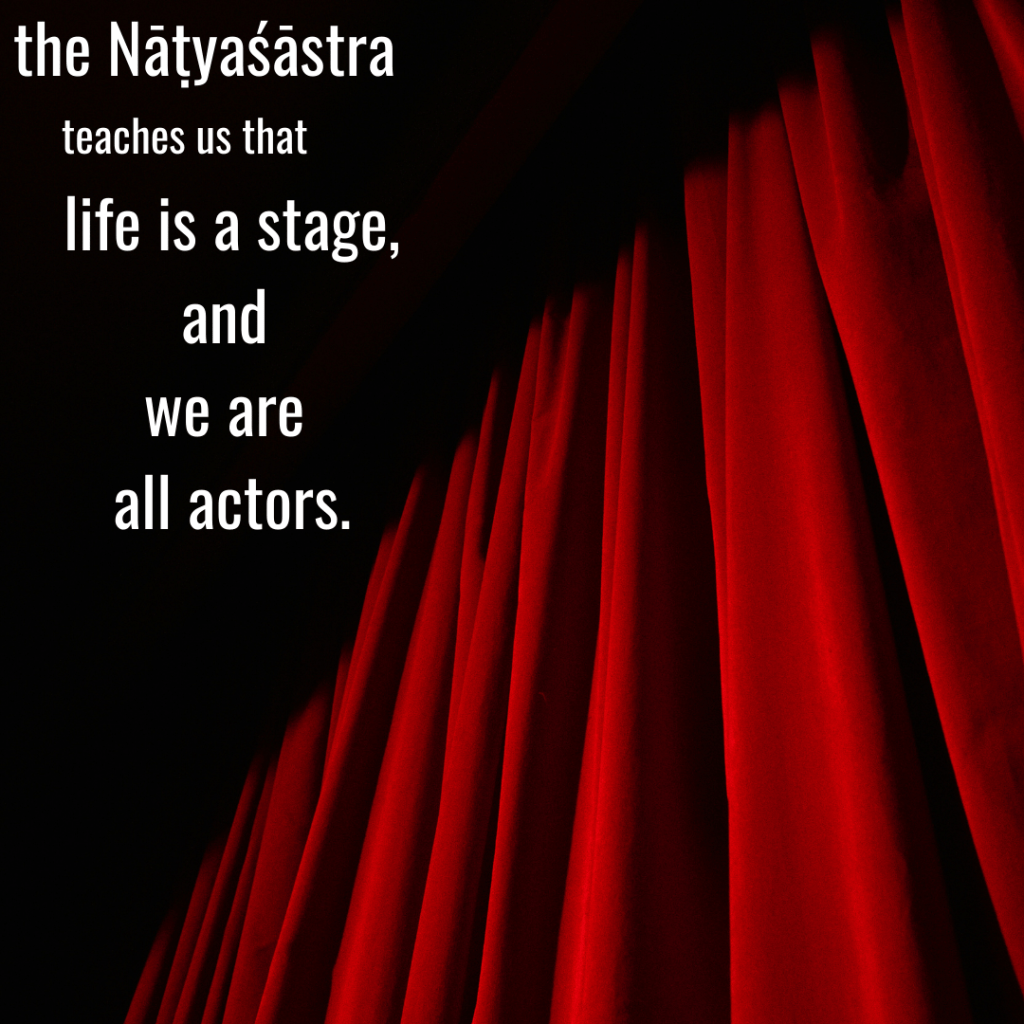
The Nāṭyaśāstra: Life as a Stage
One of the precepts of the Nāṭyaśāstra is that life is play, and we live as actors on a stage: continuously being offered the opportunity to tap into rasā, and, ultimately, into the depths of our beings.
At the WB immersive, we had the opportunity to live this precept by playacting characters we chose or felt connected to. The darkened ambiance of the secluded Scottish manor we stayed in (which included a real-life bar located in the heart of the house!) was a rich opportunity to delve inward, effects of which continue to percolate for me. I won’t provide an account of the three plays we were engaged in, as I believe it would be futile to try to describe the experience, and a chronological or narrative account won’t serve anyone who was not there; I will however centre on the effects of it.
Interestingly, the experience of life as stage, not as lived for me while on-retreat — in which my direct experience was more one of passive enjoyment in the absorption of delight of the senses (with an emphasis on taste, touch, and sight) — began to dawn as gradual understanding in the aftermath of the retreat. It was not very conscious, but I began to find myself recognising the different characters or personas of myself that I slip into as my day unfolds and to see how my experience of myself is ever-changing.
Even being in my body feels gradually different as the day progresses; sometimes there is lightness in my body, sometimes there is heaviness, sometimes there is tiredness. Similarly, my mind feels distinct in different times of the day; sometimes it is busy, sometimes it is easeful, sometimes it is burdened. None the better, none the worse.
I believe there was always some awareness of this inherent fluidity in me, but, in my lack of clarity, it was addled with uncertainty or fear; do these shifts in ways of being mean that I am fake or inauthentic — an impostor about to be found out?
In a way, yes; in the sense that my idea of myself as the solid identity of Téa is indeed a false one; as in, it is unstable. I am not just one character, I am many characters that come to play within me and through me in, for instance, the short timespan of a day; the friend I am to one person is different to the friend I am to another person, the scholar at university is different to the daughter I am to my parents. One’s impression of me will be different from another’s impression of me.
Neither of these facets of myself invalidate the other, only point to the complexity and fluidity of being that is intrinsic to each of us.
These reflections, triggered by the Nāṭyaśāstra experience, led me to understand the playfulness of life more in the retreat’s aftermath. Like, I am just acting characters. As my generation would say, it’s not that deep.
I only need to experience each character to the fullest.
Unleashed Anger
However, this process also led to an unleashing of an emotion I have been repressing, namely anger, and with an encounter of what Carl Jung would call ‘the Shadow’. I could not emote anger during the retreat in neither of my playacts, which made me question what blockages I had around it. Sitting with myself, I examined both my emotional landscape as well as my past conditioning and began to see the hindrances around expressing and experiencing anger that I had, coming from spiritual conditioning which dictated that it was ‘wrong’, as well as from past experiences in which I did express my anger which I internalised as shameful, and in which I felt rejected for being true to myself.
Concomitantly, I also realised I had been blocking my anger through reasoning: I am a stoic at heart, and my first reaction to any event that occurs into my life is to unpack it from distance, third-person view.
Every time anger arose for me, my intellect labelled it as irrational and diminished the emotion by unpacking the event as neither right nor wrong, and as the person who triggered my anger as an individual found in their own process lacking any malicious intention. In the face of reason, I felt hindered to follow or express my anger.
It was irrational, after all.
This was a limiting perspective: first, not only are emotions irrational by nature, but, both perspectives can co-exist: I can be angry at someone while also holding in my awareness the discernment that the person is not inherently evil or wrong and reality is complex. But when it comes up, I can enjoy my anger and viciousness to the fullest, with the sole of intention of extracting the rasā out of it — which gives me the freedom of space: space in which I can choose to both channel it in creative ways, and not to project nor repress it, I find.
(To be noted that I am still very much a beginner in familiarising myself with anger so my reflections might change.)
Second, a loosening happens: even if I do have a slip in discernment and I end up projecting my anger or viciousness onto another (we’re not perfect, right?), it is not a catastrophic event. As I ultimately am just a character playing themselves to the fullest in that context.
It sounds all good and reasonable on paper, but this loosening in my intellectual process triggered a true unleashing of all the ‘negative’ emotions I had suppressed throughout the years, from pure rage to envy, which came to me in waves until they hit me in full force.
I have been processing this unfolding by referring to my beloved Carl Jung’s theory of the Shadow.
Jung and the Shadow
Filling the conscious mind with ideal conceptions is a characteristic of Western theosophy, but not the confrontation with the shadow and the world of darkness. One does not become enlightened by imagining figures of light, but by making the darkness conscious.
“The Philosophical Tree” (1945). In CW 13: Alchemical Studies. P.335
Jung’s theory is that our individual consciousness is split into two: the conscious impulses, and the subconscious, repressed impulses we have, which we actively conceal from our awareness out of shame, guilt. He calls the repressed part of ourselves ‘the Shadow’. Jung declares that in order for one to achieve a healthy psychological state of wholeness (which he equates with the mystical ‘Self’ or the archetypal God lauded by religion), one must integrate the unconscious into the conscious. Jung even goes so far as equating encountering the Shadow with a first-hand encounter with God. (see Jung; Aion, Researches Into the Phenomenology of the Self, 1999)
However, Jung doesn’t exactly offer a roadmap to how to integrate the Shadow. He says it is an individual, possibly dangerous and maddening process that each must figure out for themselves, and also an essential journey to undertake in order to understand ourselves in our fullness.
In his view, there can be no self-understanding or self-realisation without integrating the Shadow.
In terms of a roadmap, Jung does assert that the first step is accepting your shadow and looking it straight in the eye.
That’s where I’m at right now: accepting my rage, envy and pettiness. In full honesty, part of me wants to rush through it and wishes for a quick, happily ever-after merging, and also wants a detailed handbook of how to do it. Jung says it can take years. I believe him. (See: Aion & The Archetypes)
Jungian scholars have mused that integration occurs naturally through a holding of the opposites formed by our repressed and conscious impulses, which creates tension in our consciousness, yet we are to expand our consciousness so that it holds into awareness both the shadow and the light. It is in this enlargement of consciousness that integration occurs, and one finally does not identify neither with the shadow, and neither with the light, achieving wholeness. This opens the doorway to stepping into the collective unconscious, a state of shared consciousness that, per Jung, is the base-structure onto which individual consciousness develops, and which holds all mysteries and archetypes of humanity. (See: Meeting the Shadow, edited by Connie Zweig & Jeremiah Abrams, 2020)
“Carrying such a tension of the opposites is like a Crucifixion. We must be as one suspended between the opposites, a painful state to bear. The problem of our duality can never be resolved on the level of the ego; it permits no rational solution. But where there is consciousness of a problem, the Self, the Imago Dei within us can operate and bring about an irrational synthesis of the personality. To put it another way, if we consciously carry the burden of the opposites in our nature, the secret, irrational, healing processes that go on in us unconsciously can operate to our benefit, and work toward the synthesis of the personality.”
(John A. Sanford, “Dr. Jekyll and Mr Hyde” in: Meeting the Shadow, 2020)
Incidentally, at one point last week, I experienced absolute, pure rage. I was by myself in my living room, and sank into it. At one point, the intensity of it scared me, but I didn’t turn from it. Then, it felt as if it almost exhausted itself — and it released me. It returned in waves in the following days, then dissolved again. Or flowed. How curious it is, to feel.
“Wholeness is not achieved by cutting off a portion of one’s being, but by integration of the contraries.”
Carl Jung
As a sidenote, since this process started moving in me, I have noticed an increase in my creativity, a shift in my self-expression. There’s more self-assurance. It feels like I found the voice I lost. Or some of it. 😊
Thankful to WhiskyBaba for this platform. Stay tuned for part three!
“is there something wrong with my brain?”, i genuinely wondered on an afternoon in which excruciating thoughts looped and pressed onto each other, and i felt like had lost control of my mind.
i have exhibited symptoms of mild ocd since childhood, namely physical and mental compulsions generally activated in periods of extreme stress or busyness. while i learned to gain control over physical compulsions in my teenage years by practicing inquiring into the mind and meditation as well as with the help of therapy, mental compulsions, known by psychologists as ‘pure o’, continued to emerge in different phases, under the hood, so to speak – in the sense that the lack of physical symptoms led me to assume that there were no mental latches (term utilised for a fixated compulsion), and i generally continued merrily with my life until pure o would peek back its head with a latch, and i would be left stunned, wondering what the disconnect had been; what was wrong; and if my brain was broken. this was until i discovered the work of Robert Bray, who worked with his mind & compulsions by exploring the work of the ancient greek and roman philosophers (did you know that CBT and most modern therapies have been built on their ideas?) through whom i discovered the work of Dr. Albert Ellis, the founder of REBT (the mother of CBT) which he coined in 1950s. according to them, even more important than exposure techniques, the key to working with such ‘disorders’ is to identify your core fears and irrational beliefs and deconstruct them.
although there were times i wished that my brain was wired differently, it has been being exactly as i am that brought me most richness by sending me on a quest to understand my mind. on this quest, i studied Jung in my undergrad, as well as independently conducted my own studies in the realm of modern psychology, which i paused for the past two-three years as i took a different approach to understanding myself outside of these bounds. a piece was still missing, though, and i returned to my studies a few months ago. i have since immersed myself into the application of REBT – which i was surprised to recognise as the source of most techniques of self-inquiry that i know of, which seem to have been developed from it.
i have been applying REBT in my life to both process my emotions and the world with reason and gentleness, as well as to enlarge my perspectives and to push myself past my insecurities. it is working wonders, and i will begin to share my process with REBT on my socials – both for my own clarity and to bring more light to such pioneering work that has magnificent potential for growth.
brief 101: so, what is REBT? REBT is a method in which you identify your irrational beliefs and deconstruct them through a technique called ‘disputing’.
why REBT? what is the missing piece in the popularised techniques of self-exploration?
in my very humble opinion, the premise. i am simply looking here at what has worked / has not worked for me, i don’t have an expert opinion. the premise ellis starts from is a thorough understanding of the fabric of the ego, as well as of what we know as ‘self-esteem’; eg. your very understanding of yourself as a self that you can rate as ‘good’ or ‘bad’ is IRRATIONAL. you do not exist as such. and so, REBT builds upon the disputation of this fundamental one belief: that in yourself as the person you think you are, which is nothing but a myth you constructed. enjoy the introduction to the ‘myth of self-esteem’ by Dr. Albert Ellis.
Pure O Journey, Chronological Chronicles: from fearing that my brain was broken to learning to embrace it & to work with it harmoniously. you can watch and listen to me speak about it on TikTok here.
going in more depth into my journey as well as into the techniques (such as REBT) that i use to understand myself and my brain better, as well as to live harmoniously both with myself and with others.
i have exhibited symptoms of mild ocd since childhood; at the time it would manifest mainly in the form of physical compulsions, such as repeating an action for numerous times, rearranging objects in particular geometric shapes, picking specific colours, fixating on wanting to have ‘good’ thoughts and to act with a ‘good’ thought in mind (the last still comes up!). all of this was done with a particular magical thinking mindset of ‘ensuring’ security, with a compulsion of wishing that by controlling a certain action or my external circumstance i could ensure control amidst uncertainty. the compulsions weren’t consistent, but would emerge in certain periods. i was an academically inclined child, so i would go through periods of extreme busyness and stress of competitions, exams, which was when the compulsions would manifest.
in my teenage years, as hormonal changes came into the picture and as life got busier and more vibrant, there were more such periods of busyness and i was compelled to tackle my compulsions. with the help of predominantly psychedelic explorations as well as therapy, meditation and reads in spirituality and psychology, i began to understand how i functioned more and removed the component of physical compulsions.
mental compulsions, known as pure o, continued unbeknown to me; i was not well informed on this topic and had assumed that physical compulsions were the only manifestation of a compulsive ‘disorder’.
the continuation of mental compulsions and subsequent distress and anxiety led to moments in which i wondered if there was something wrong with me, or if my brain was broken, which was painful.
flashforward, i paused my independent quest in psychology for about three years as i sought my spiritual longing, and began practicing in a (very beautiful) tradition which included a morning (very beautiful) ritual that held in it rules of cleanliness and reverence. with an edge created here by external factors, my physical compulsions came back with a force, and i would spend 2-3 hours every day with cleanliness compulsions ruling me, while, in my lack of clarity, i genuinely believed i was just following rules with care. after my path organically took me onto another direction (for radically different reasons, of course ), i renounced ritual at one point, which followingly led to me realise, in retrospect, that my physical compulsions had returned in that form. i was suddenly hit by a flash of clarity into seeing how outside of this mental latches (will give examples in future vids!) had continued throughout the years. i realised this had not been the quick fix i had assumed it was, and resumed my quest to understand my brain though psychology and philosophy.
this is how i discovered the work of Robert Bray, which derives from ancient philosophies and includes exposure therapy. through him i discovered the amazing Dr. Albert Ellis and his REBT. i have tried several action-oriented techniques through the years (i believe most very closely resemble REBT, which makes sense as REBT is considered the mother of CBT and imo what we see almost everywhere in the new-age world are repackages of CBT), but the premise of this one, which i will expand on in future shares, works best for me in leading me to harmony with my mind and with the world. more coming soon. i set up an IG where i’ll compile all of this, @easingintothemind, you can find me there if this evokes any interest. here’s to understanding ourselves!
APPLICATIONS:
IRRATIONAL BELIEF – I AM NOT GOOD ENOUGH
the formula of REBT, coined by Dr. Albert Ellis in the 1950s, is based on the work of ancient philosophers such as Marcus Aurelius. (sidenote, i’m just getting into Marcus Aurelius, and, ah, his words are gems!). i discovered it through the recommendation of OCD expert Robert Bray. out of all techniques of rewiring cognitive patterns i’ve used, it has proved most efficient in deconstructing pure o so far!
known as the A-B-C-D-E-F model, its premise is: most of the distress we experience is unnecessary suffering which arises from holding onto irrational beliefs. (i think this differentiates REBT from other action-orientated techniques of therapy, as it doesn’t promise to end suffering, but to instead dilute unnecessary suffering). it provides you this model to identify the irrational belief, dispute it, replace it & process.
let’s take an example in which i applied REBT!
situation: i want to have an experience by attending a specific event.
adversity: a thought arises; i want it, but what if i am not good enough for it?
belief: if i have this thought, there must be some truth to it. perhaps * i * should not go for it and protect myself from the possibility of rejection.
consequence: my chest contracts, i experience distress & there is the possibility of not going for what i want.
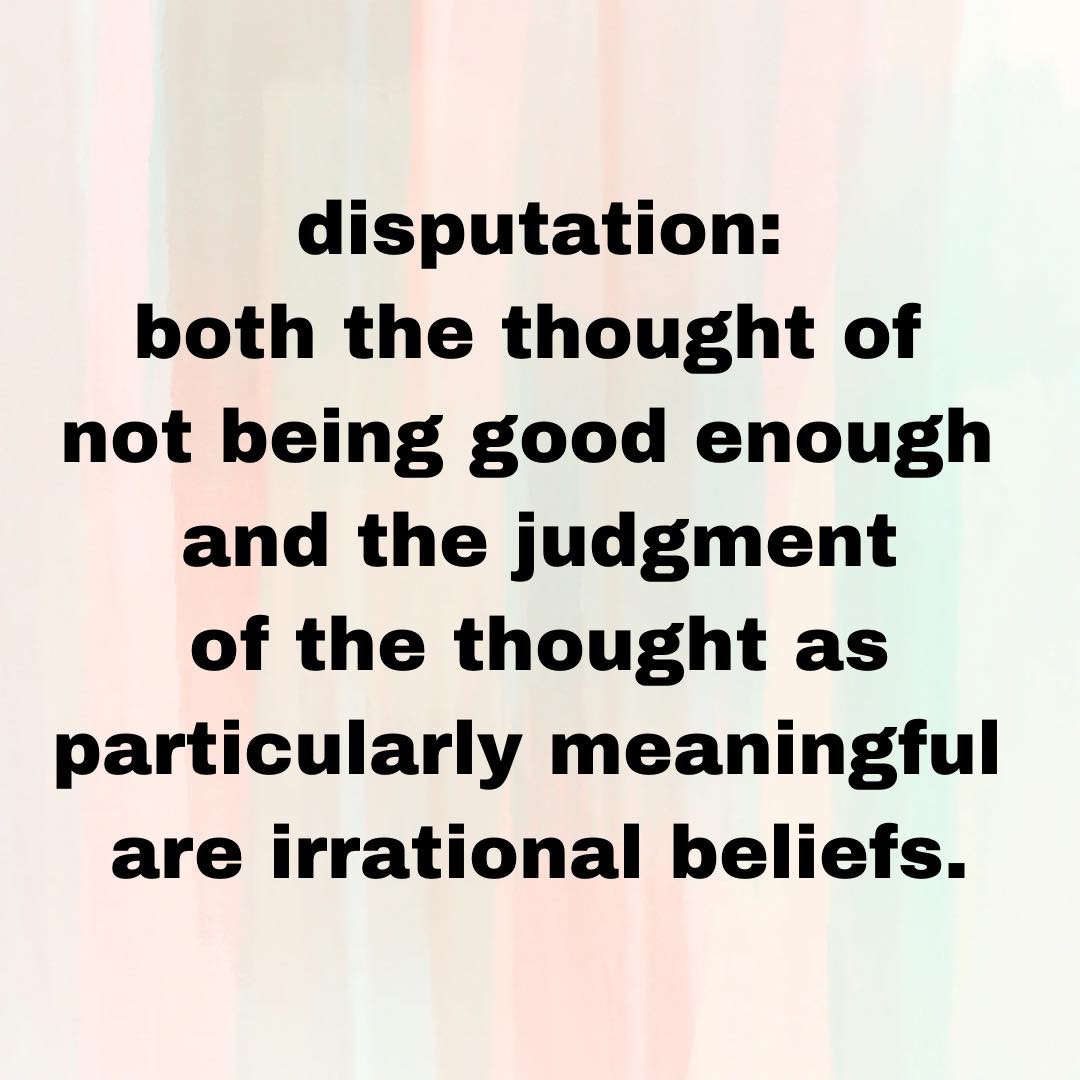
disputation: both the thought of not being good enough and the judgment of the thought as particularly meaningful are irrational beliefs. being “good enough” is a volatile concept which only exists in an even more volatile & subjective scale of comparison that cannot be quantified in reality. a thought is a cognitive process which arises from conditioning and from what we consume and have consumed on a daily basis over years with a degree of randomness; a thought is not a fact which has any inherent meaning other than that which i assign to it. if i have to label or judge my thoughts, per Ellis, it would be more rational to judge them as “effective” or “ineffective” (to one’s goal – more on this later).
effective new belief: thoughts and doubt have arisen and i can choose to remain undisturbed by either.
new feelings: relief. self-assurance. there is nothing wrong.
#pureo compulsion example as identified by Robert Bray, MD:
dissecting a past situation seen as unfavourable to catch patterns from multiple angles in order to ensure it won’t happen again. *to be differentiated from learning from past happenings in retrospect. a compulsion distinguishes itself through over-fixation as well as rooted core-fear.
my experience with this:
i dissected a particular mess i got myself into from hundreds of angles almost daily after i got myself out of it. i thought that if i dissected it hard enough, i could catch all of the giveaway signs and would ensure that i would never, ever put myself in that dynamic again – and protect myself. not only was it stressful to follow this thread, but it only stuck me into dead ends and loops of thinking which morphed into other loops of thinking.
breaking down the compulsion:
what is the rooted core-fear? that i will be in pain again.
what is the irrational belief behind this compulsion? that there can ever be a certainty.
disputing through REBT: there is no certainty that any situation would repeat itself with the same patterns and giveaway signs. life is too complex. yes, i might get hurt again. yes, i might end up in that dynamic again. yes, i might have to pull myself out of that dynamic again. it might not be pleasant.
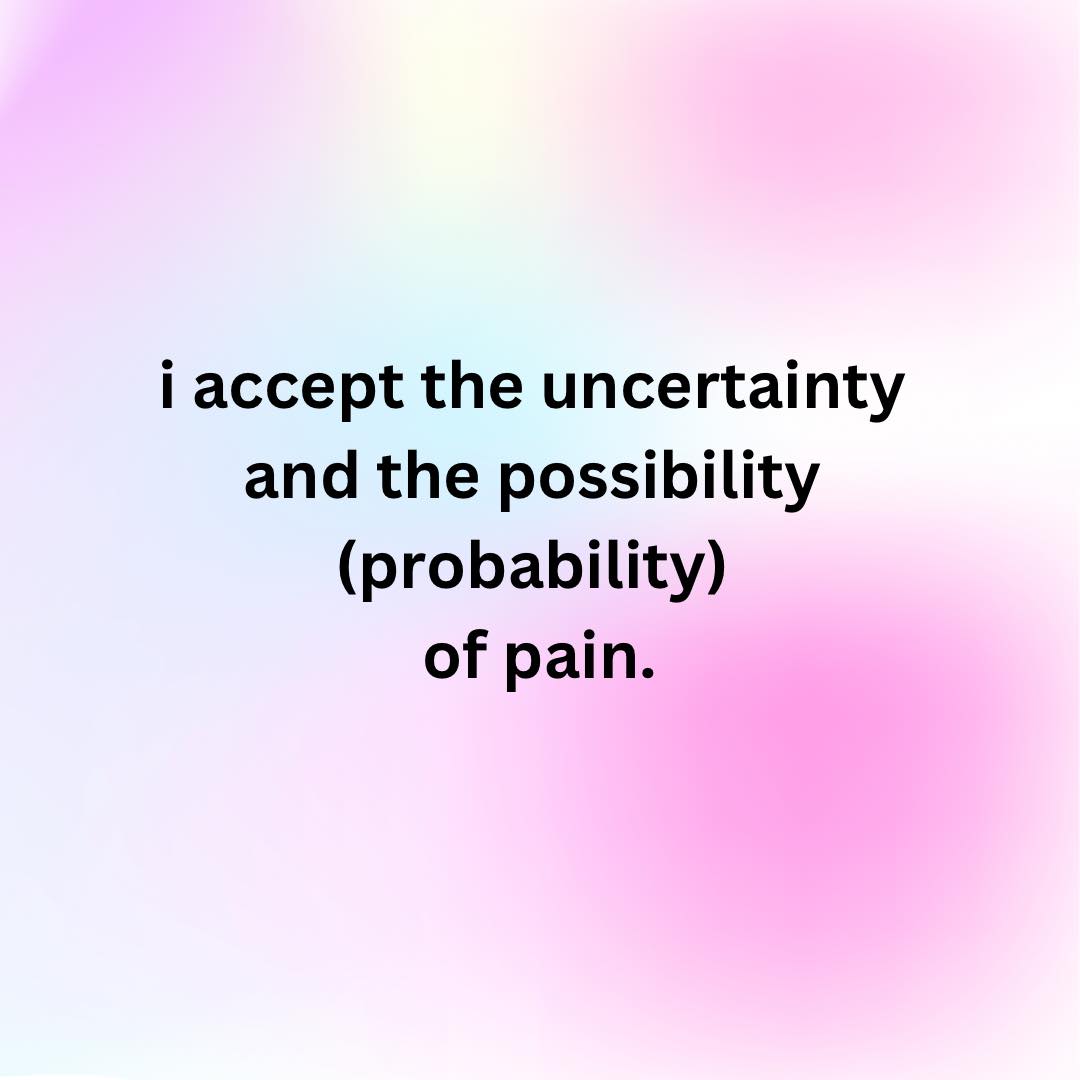
i accept the uncertainty of that and the possibility (probability) of pain.
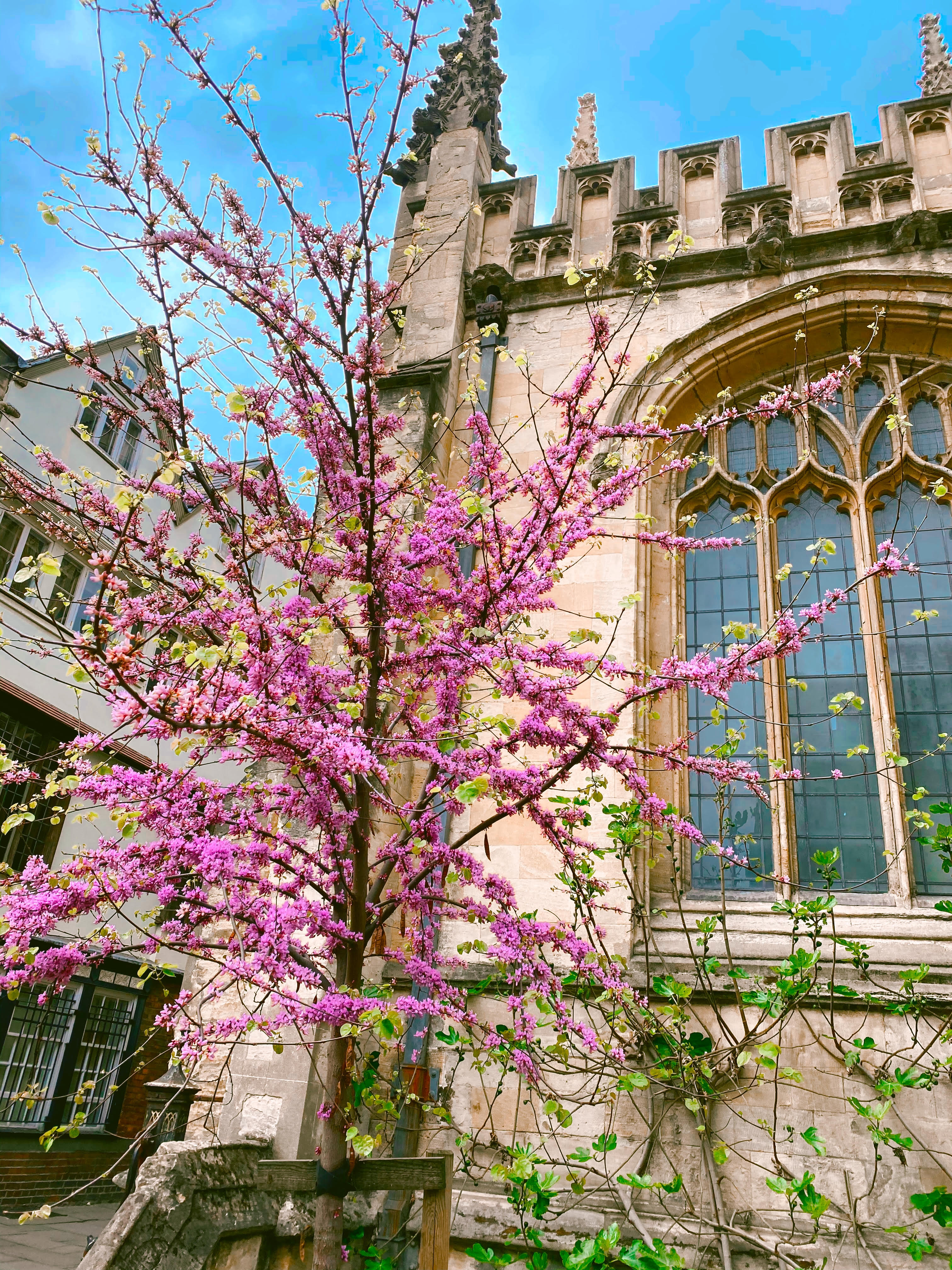
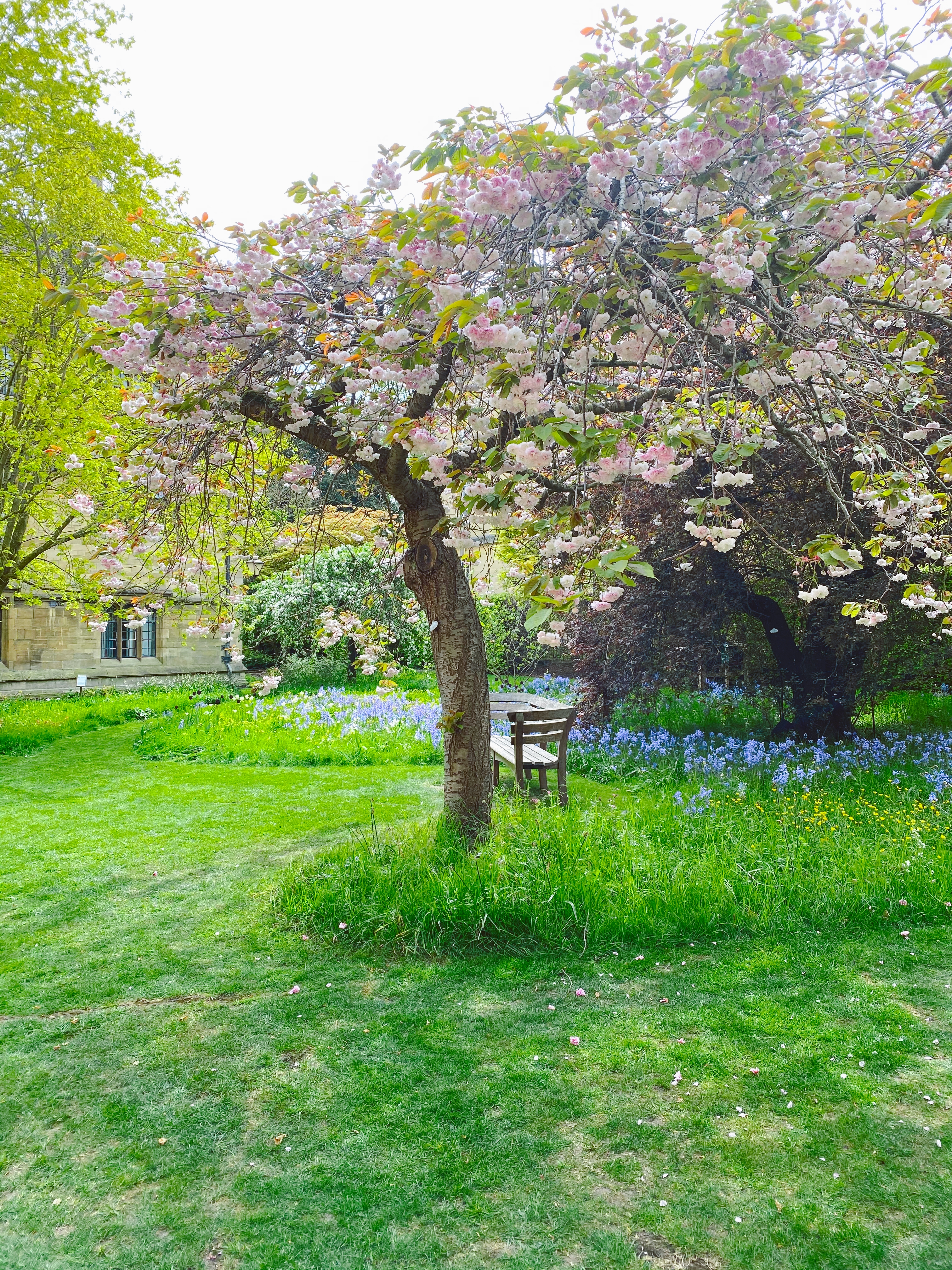
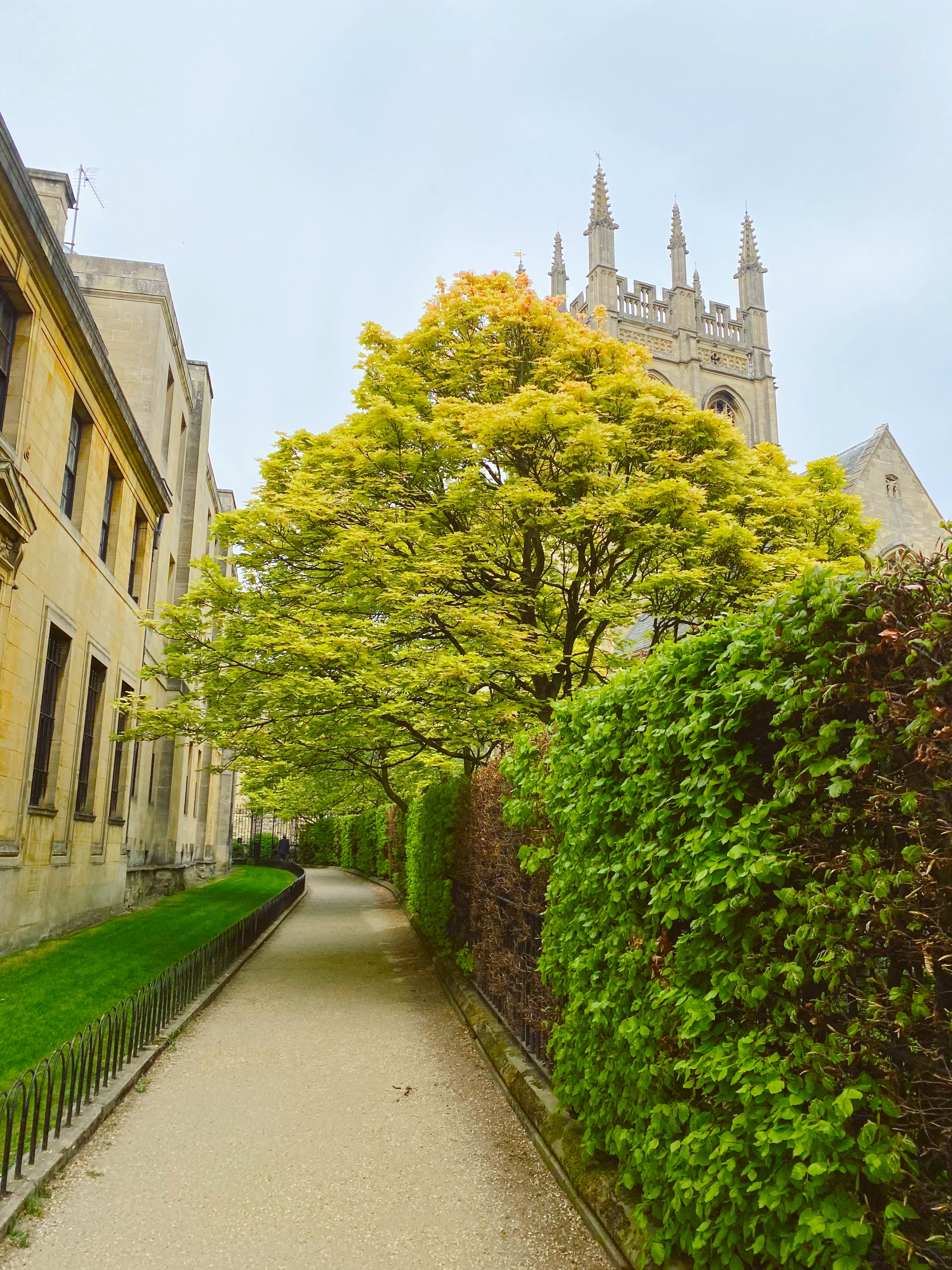
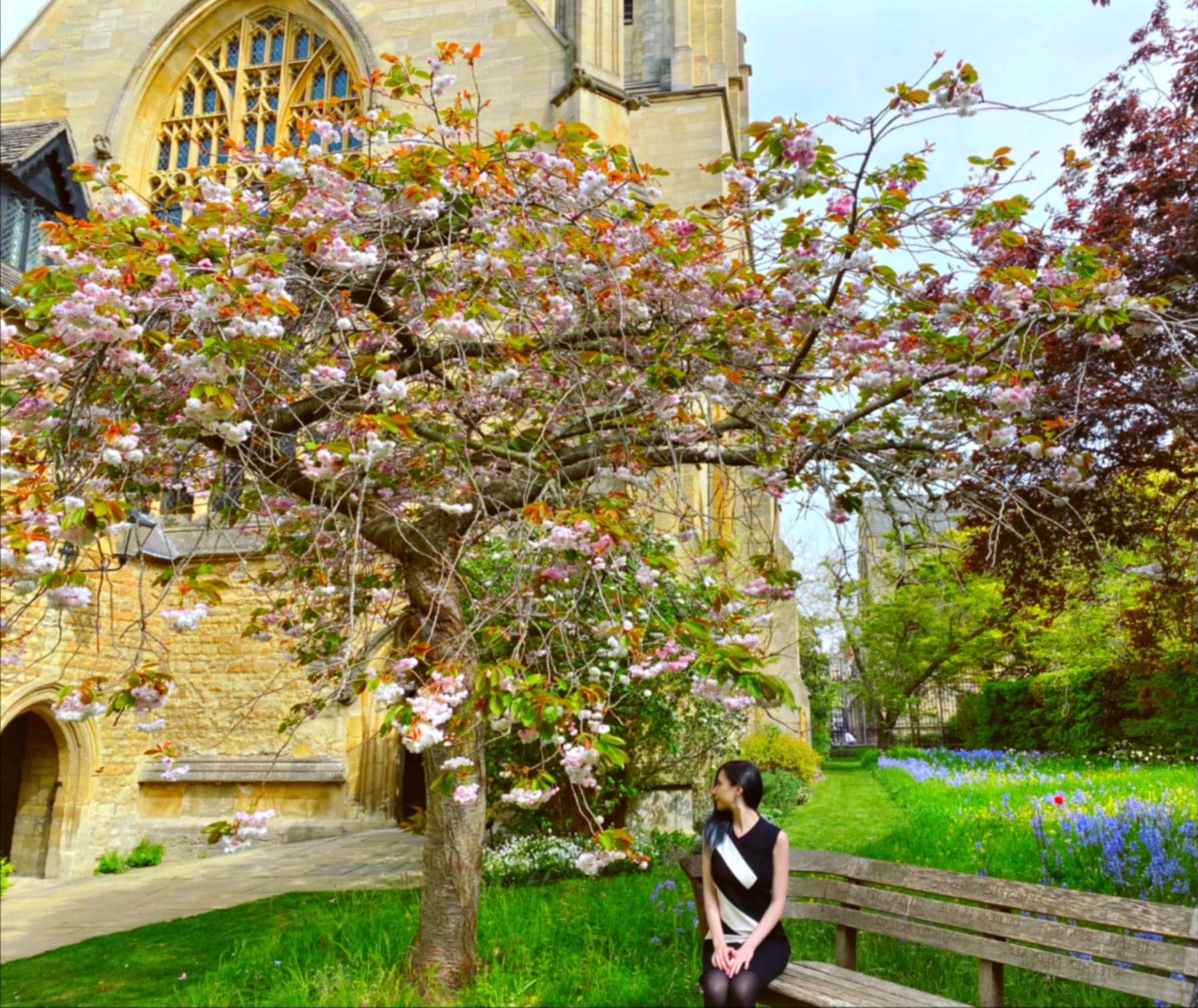
Oxford, in bloom! a wonder to walk where the great C.S. Lewis & J. R. R. Tolkien walked. 🌸 i ventured on Addison’s Walk, where C.S. Lewis, J.R.R. Tolkien & Hugo Dyson most famously discussed myth, philosophy and religion while pacing through the trees. Lewis recounted a walk of theirs to his dear friend, writing as follows: “These hauntingly beautiful lands which somehow never satisfy,—this passion to escape from death plus the certainty that life owes all its charm to mortality—these push you on to the real thing because they fill you with desire and yet prove absolutely clearly that in [William] Morris’s world that desire cannot be satisfied. (…) The [George] MacDonald conception of death—or, to speak more correctly, St Paul’s—is really the answer to Morris (…). He is an unwilling witness to the truth. He shows you just how far you can go without knowing God, and that is far enough to force you . . . to go further.” Lewis later wrote a poem about Addison’s Walk: “I heard in Addison’s Walk a bird sing clear: This year the summer will come true. This year. This year. … Often deceived, yet open once again your heart, Quick, quick, quick, quick!—the gates are drawn apart.” 🙏 source: Justin Taylor. 💗
♥️ happy to be graduating with a distinction in my first master’s degree!
♥️ what a transformative journey this MA has been – i would not lightly call my last year at lancaster university life-changing! my studies in Indian philosophy and literature, with an emphasis on the exquisite Mahābhāratam, combined with my wondrous immersion in oral practice traditions at Śabda Institute, have radically challenged and changed my perception of both myself and the world, and introduced me to so much beauty, wisdom and wonder.
the pressing longing to * know * that had been hounding me since my teens, it was for * this *. i often joke that it feels as if i wasn’t living before – only dreaming!
grateful to my supervisor, Dr. Brian Black, who guided me in my research and introduced me to the Mahābhārata and its complexities, and incredibly grateful to my beloved teacher, Dr. Kavitha Chinnaiyan, whose teachings are the foundation of all that i do; i am so fortunate that my studies at Śabda Institute enrich my academic writing with the insights, delight and fervour that are only accessible to practitioners.
lifetimes of refinement to go!
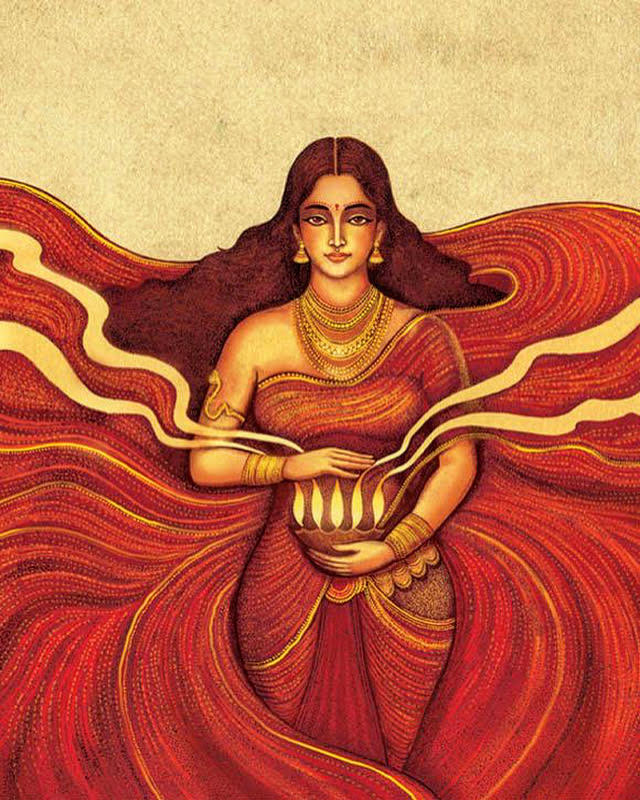
🌺 with the occasion of graduating from my master’s, taking a trip down memory lane to revisit the dearest pieces i worked on during my MA, namely “Feminine Dimensions of ‘God’: The Deification of Mahābhāratam’s Tragic Heroine”, “The Western Revival of Goddess Worship” & “The Question of Religious Violence in the Mahābhārata“. 🌺 my first paper explored the richness of the non-dual concept of ‘God’ by addressing the intricate worship of Draupadī, the Mahābhārata’s enigmatic female character – whose tragic and distinct storyline establishes her as a multifaceted heroine: a devoted wife; a caring mother; an abused and vindictive woman; a polyandrous empress; an avatāra of the Goddess; the Supreme Parāśakti, the all-pervading absolute reality herself; the celestial Śrī. i argued that, through the worship of an abused & vengeful woman, her devotees are deifying the entirety of the human experience. this piece has been my heart and soul, as my love for the fireborn Yājñasenī Draupadī knows no bounds. ♥️ 🌺 my second essay employed a discourse rooted in psychoanalysis, and was centred on the therapeutic values Goddess archetypes hold for the traumatised female psyche + commented on the ramifications of the phenomenon of religious revival in a secular age. 🌺 my third paper deconstructed the hypothesis of the existence of instigation to religious violence in the Mahābhārata – but this perhaps deserves a post of its own, so some other time. ♥️ current situation is incessant editing, and i am hopeful that in 2022 they will feel ready for publication. cannot wait to share my findings. image: “The Flaming Tresses of Draupadī” by Onkar Fondekar, for the illustration of the cover of the book of the same name written by Veerappa Moily, Rupa Publications. ♥️
finally, attaching below the praise i received for my MA dissertation, which i plan to publish one day:
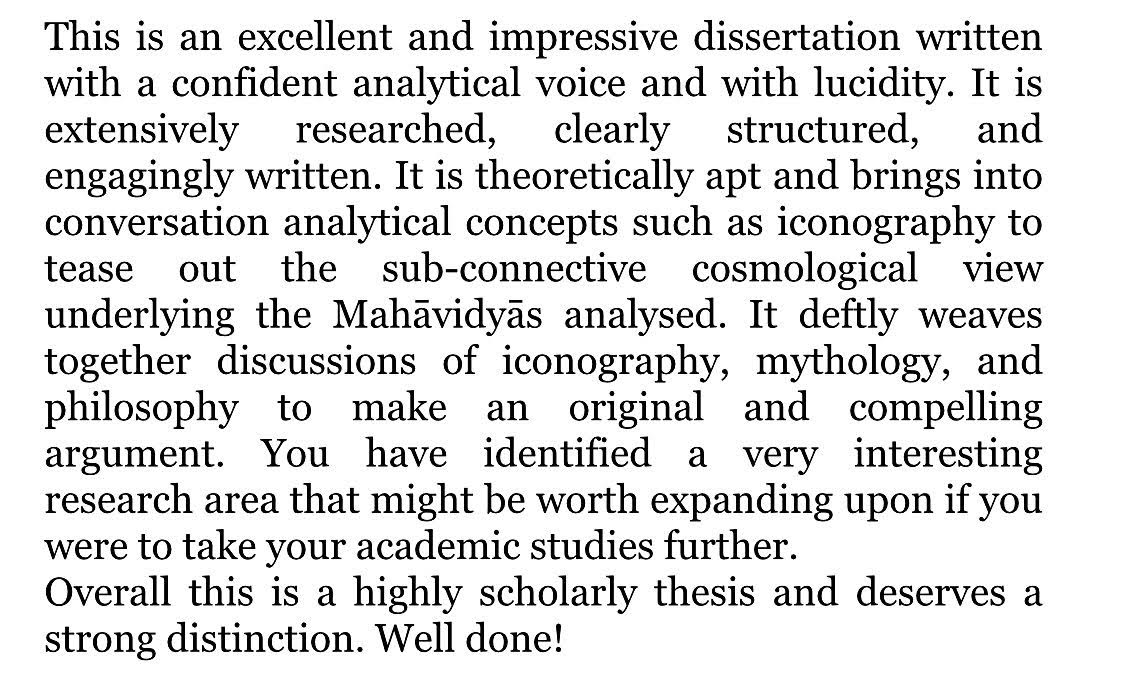
“This is an excellent and impressive dissertation written with a confident analytical voice and with lucidity. It is extensively researched, clearly structured, and engagingly written. It is theoretically apt and brings into conversation analytical concepts such as iconography to tease out the sub-connective cosmological view underlying the Mahāvidyās analysed. It deftly weaves together discussions of iconography, mythology, and philosophy to make an original and compelling argument. You have identified a very interesting research area that might be worth expanding upon if you were to take your academic studies further.
Overall this is a highly scholarly thesis and deserves a strong distinction. Well done!”
my christmas gift from dad has been the final draft of my MA dissertation, bound and printed on the glossiest paper (my favourite!). couldn’t take my eyes off how glorious the images of the Mahāvidyā Devīs looked. ♥️ the most precious christmas gift of all time for me. ♥️ cover-image: Mātaṅgī by Kailash Raj | Lalitā by Ekabhumi Ellik, Colouring Shakti. (2015) | the creations of the two artists are mesmerising and would recommend all to check them out! ♥️
today i presented my paper “purity, impurity & pollution in non-dual philosophy” at the “philosophy across disciplines” conference organised by newcastle university! it was my first time presenting at a conference! i was nervous and excited. incredibly grateful for this wonderful opportunity!
and, journal-musing: this term has been so fruitful, despite working completely from home! i haven’t spent so much time at home since high school and, to an extent, i’ve felt like i was transported back to that time – minus the insecurities !
anyway, Mahābhārata’s been living in my head rent-free, and i’ve dedicated my time & research to writing about violence & religious conflict as they transpire in my beloved Kṛṣṇa’s actions and speech in the Kurukṣetra war & in the Bhagavad-gītā. additionally, i’m excited to be completing my first independent study, an exploration of issues of purity & impurity in non-dual philosophy, and to be undertaking a small research project into consumer spirituality and the relentless commodification that comes with it.
all in all, i am deeply grateful to be offered the opportunity to explore the marvellous Mahābhārata once more. its poetic teachings and ample cosmological symbolism have permeated through me and i often wish its universe would swallow me whole nonetheless, i’m certain that one needs to dedicate ten lifetimes to one parva, and i am not exaggerating ! as Vyāsa himself states in Ādi Parva: ~ what is found here, may be found elsewhere. what is not found here, will not be found elsewhere ~
i’ve never had so much workload crammed into such a short timespan, but i’ve been trying to savour the flavour of busyness. it’s alien to be doing all of this in my childhood home. it’s a fun parallel, though – whilst musing on the Bhagavad-gītā (by the way, we are exploring the B-g in our monthly satsaṅgs at #sabdainstitute with our beloved teacher Dr. Kavitha Chinnaiyan!), it dawned on me that i was so hungry for this knowledge in my teens, but i didn’t know where or how to look. it came to me in the end, and what a great joy it is ~ to sip the honey of “the stainless lotus of the Mahābhārata, born on the waters of the words of Vyāsa, fully blossomed through the grace of Hari…” ~ {my vague attempt at translating a śloka}




 enjoy the introduction to the ‘myth of self-esteem’ by Dr. Albert Ellis.
 you can watch and listen to me speak about it on TikTok
  going in more depth into my journey as well as into the techniques (such as REBT) that i use to understand myself and my brain better, as well as to live harmoniously both with myself and with others.
 here’s to understanding ourselves!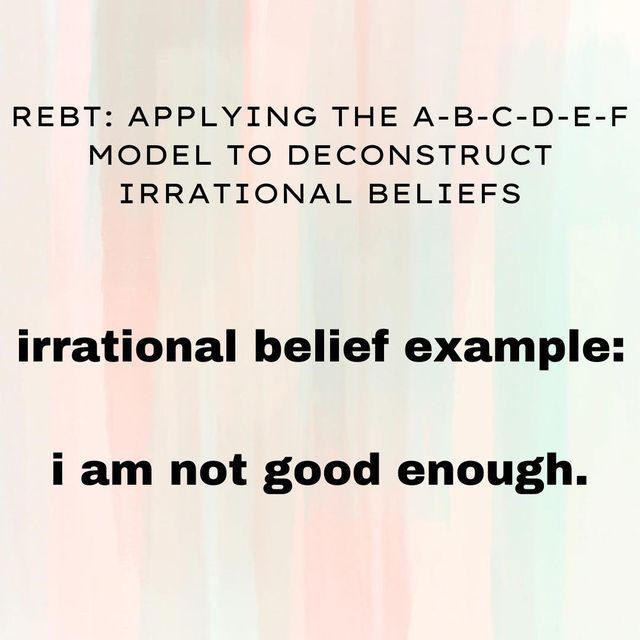







 i was nervous and excited. incredibly grateful for this wonderful opportunity!
 !
! additionally, i’m excited to be completing my first independent study, an exploration of issues of purity & impurity in non-dual philosophy, and to be undertaking a small research project into consumer spirituality and the relentless commodification that comes with it.



 amaryllis