25 in the Himālayas

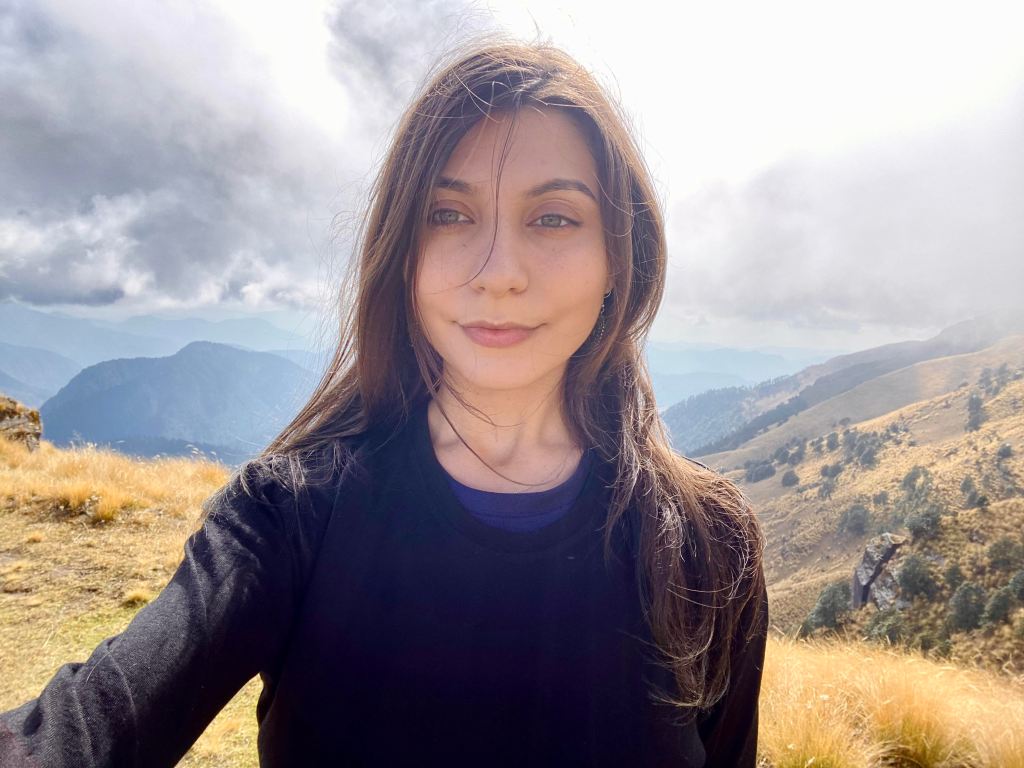
i turned 25 in the Himālayas, on the resplendent Khaliya trek, and camped in a remote meadow that can only be described as the land of the apasāras. ❤️‍🔥

hiking, i reflected on 24, which was the year of the great heartbreak: of fierce grace. the path burned through what i had worshipped as truth and held most dear, and violently pushed me to transform.

on last year’s pilgrimage to the Himālayas, i had prayed on a trek to Gomukh: “free me. i will do whatever it takes.” when the whatever it took came, it was not what i had imagined, and it broke my heart. i had thought i had known heartbreak, but all paled before the pain of facing the untruths i had clung to under the name of God. seeing through your own deceptions is a harsh business.

as the projections i had built my spiritual life around began crumbling, i was left feeling disillusioned, and i was tempted to renounce my search for God. one of the darkest nights of the soul of 24 was one of doubt, in which i doubted everything. i bitterly cursed my trust, and felt repulsed by the dynamics of modern spirituality. i reasoned, if such power dynamics can be built on spiritual teachings, then the teachings must be false.

and yet my intuition, which i had cut myself off from, arose gently; a tiny voice silently telling me that the truth i was seeking does exist. it is pulsing underneath the mirage. my intuition told me not to close myself. to trust the play and uncover the teachings. to keep moving and follow the energy.

diving deep into disillusionment paradoxically opened my system to increasing expansion as well as to a love of an encompassing nature that i had not tasted before.

followingly, one thing i have experienced, is this: freedom rests in autonomy on the spiritual path. the teachings, the dimensions of God, such as the Mahāvidyās, the Devas and Devīs, are real – only not in the way we tend to think about them and not in the way they are taught in modern spirituality. you have to experience them for yourself. you are intrinsically worthy of it. keep moving. ❤️‍🔥

my motto for 25 is: whatever it takes. ❤️‍🔥

Glimpses in the Nature of Reality in the Mahābhārata

Something I find fascinating about the Critical Edition of the Mahābhārata is that the characters sporadically move from addressing Kṛṣṇa as an embodied mortal (as their friend, cousin, son-in-law etc) to addressing him as the Godhead; as Viṣṇu, as the Supreme Being, and as Īśvara. The succession of change between the modes of address can sometimes even happen on the same page, at a distance of a few lines. The veil is lifted, and the characters see through Kṛṣṇa’s illusion, and, through that, they become immersed in the nature of Reality; the veil promptly drops back, and God is lost.

An argument for this could be that the divine modes of address are interpolations, a theory being that Kṛṣṇa became identified with Viṣṇu only in later renditions of the Mahābhārata. While this could be true at the level of historical analysis of the epic, for me, there is a subtler teaching encased here: how all of us, without exception, glimpse into the nature of Reality as we move through life, yet we perpetually proceed to return to becoming engrossed in the superimpositions we project upon Reality; and the dance continues. From Truth to dream, from dream to Truth. It is quite endearing, really. What committed and imaginative dreamers we are! 💙

Adyashanti once talked about how one inadvertently glimpses truth; it is, after all, inescapable as it is our nature; the trick is not forgetting / losing the glimpse.

Gorgeous artwork of Kṛṣṇa: Awedict.

the flow of knowledge

knowledge flows from teacher to student, and from student to teacher.

at the beginning of my academic journey, i was continuously surprised by the way the majority of our professors engaged with me and my colleagues; not only did they genuinely express interest in our opinions, but they also valued our input, ensured the openness of dialogue between us, and consistently encouraged us to become independent in thought and in writing. the learning environment i had been exposed to until then, namely secondary education in my home country, had been completely different: it had been one of strict hierarchy, in which plurality of thought was not existent, and in which the minds and experiences of students were not valued. it took me awhile to become used to – well, being valued, and to valuing my input myself.

i remember one particular exchange i had with a professor of mine, in which i expressed my understanding of one subject and proceeded to reflexively dismiss it by cloaking it in the “i am just a student, and who am i to say anything about this” garb. my professor stopped me and said something along the lines of: “yes, we are just people. but that doesn’t mean our contributions can’t be meaningful.”

the first week of my Ph.D. was similar: professors consistently reminded me and my colleagues that we are more than students, and they see us as valuable members of a research community that works together. they encouraged us to renounce our inhibitions, and to think, write and act as such.

it has become exceedingly important for me in my journey to be in such learning environments in which, past the roles of students and teachers that we play, there is an understanding of the flow of knowledge, which, in my view, would be limiting to think of as flowing rigidly in only one direction. knowledge flows from teacher to student, but also from student to teacher, and from student to student. i believe that to cut oneself off from receiving the flow from any source because of preconceived ideas of how it flows, and who to learn from, is a great loss.

sometime ago, i had a great conversation with my dear friend Avi Sato about how these same principles of knowledge flow apply in the area of spirituality as well, nuance which had long eluded me. 

twenty-four summers rekindle the fire

in my sixteenth autumn, Nature called me to her,
burned into my cells the yearning to meet my depths
and i tasted myself wildly in her fold
until wisteria tangled my feet
and life pulled me from myself by my hair
and i lost the thread, the web, the call.

𝒊 𝒘𝒂𝒔 𝒋𝒖𝒔𝒕 𝒂 𝒈𝒊𝒓𝒍
i told the river as it broke through my skin
i forgot the lessons, i forgot the actual call.
i could only hear an echo of it and i followed fragments of memory. it seemed like the call. it felt like the call. it wasn’t. i was just a girl.

your terence said, if you are to follow,
only follow Nature.
it is funny, how sixteen autumns of cracking fire could understand
what twenty springs of dimmed flame did not.

twenty four summers rekindle the fire with rage, bare skin and an open chest,
and with my girlhood as the blood offering.

watch me
answering your call again
with my hair burnt and my thighs bled.

like the dragon woman who ate horseflesh in the red sea,
i sink my teeth into my girlhood and consume it rapaciously in the forest.

mad eyes, i pledge:
this time, it will just be me,
and you, and the wildness.

The WhiskyBaba Experience: Encountering the Jungian Shadow by Enlivening the Nāṭyaśāstra

The Nāṭyaśāstra: The Theory of Rasā

The Nāṭyaśāstra is a Sanskrit treatise on the performing arts, authored by sage Bharatamuni.

Most notably, it addresses the aesthetic theory of rasā, which translates from Sanskrit as ‘essence’, ‘taste’ or ‘nectar’. Herein, eight rasās are identified, which encapsulate the totality of human expression and experience:

śṛṅgāraḥ (शृङ्गारः) (loosely translated as love or eroticism)

hāsyam (हास्यं): (laughter)

raudram (रौद्रं): (rage)

kāruṇyam (कारुण्यं): (compassion)

bībhatsam (बीभत्सं): (disgust)

bhayānakam (भयानकं) (terror)

vīram (वीरं) (heroism)

adbhutam (अद्भु) (wonder, astonishment)

The Nāṭyaśāstra pinpoints the ultimate, supreme aim of any work of performance art to be titillating the interior landscape of the one in the audience to experience pure rasā.

However, access to rasā in its purity is not limited to the performing arts medium; each experience offers the opportunity to tap into rasā, if one opens themselves to it.

Furthermore, rasās are given so much importance by Bharatamuni (and also by Abhinavagupta in his magnum opus Tantrāloka) because arguably it is by experiencing rasā in fullness that one can be offered a gateway to experiencing and understanding the essence of their being and consciousness.

Customarily, we do not experience any rasā in its complete intensity, and we instead only taste it in partiality; muddled, adulterated. For instance, we rarely experience rage, partly because we are unwilling to open to its full intensity (perhaps out of preconceived notions of it being ‘wrong’, perhaps out of discomfort), and instead feel diluted anger. Our unwillingness to experience emotions in their purity is the reason we remain stuck in life, and find it difficult to let situations, memories, people go. (see more: The Theory of Rasa, Pravas Jivan Chaudhury, 1952)

The Nāṭyaśāstra: Life as a Stage

One of the precepts of the Nāṭyaśāstra is that life is play, and we live as actors on a stage: continuously being offered the opportunity to tap into rasā, and, ultimately, into the depths of our beings.

At the WB immersive, we had the opportunity to live this precept by playacting characters we chose or felt connected to. The darkened ambiance of the secluded Scottish manor we stayed in (which included a real-life bar located in the heart of the house!) was a rich opportunity to delve inward, effects of which continue to percolate for me. I won’t provide an account of the three plays we were engaged in, as I believe it would be futile to try to describe the experience, and a chronological or narrative account won’t serve anyone who was not there; I will however centre on the effects of it.

Interestingly, the experience of life as stage, not as lived for me while on-retreat — in which my direct experience was more one of passive enjoyment in the absorption of delight of the senses (with an emphasis on taste, touch, and sight) — began to dawn as gradual understanding in the aftermath of the retreat. It was not very conscious, but I began to find myself recognising the different characters or personas of myself that I slip into as my day unfolds and to see how my experience of myself is ever-changing.

Even being in my body feels gradually different as the day progresses; sometimes there is lightness in my body, sometimes there is heaviness, sometimes there is tiredness. Similarly, my mind feels distinct in different times of the day; sometimes it is busy, sometimes it is easeful, sometimes it is burdened. None the better, none the worse.

I believe there was always some awareness of this inherent fluidity in me, but, in my lack of clarity, it was addled with uncertainty or fear; do these shifts in ways of being mean that I am fake or inauthentic — an impostor about to be found out?

In a way, yes; in the sense that my idea of myself as the solid identity of Téa is indeed a false one; as in, it is unstable. I am not just one character, I am many characters that come to play within me and through me in, for instance, the short timespan of a day; the friend I am to one person is different to the friend I am to another person, the scholar at university is different to the daughter I am to my parents. One’s impression of me will be different from another’s impression of me.

Neither of these facets of myself invalidate the other, only point to the complexity and fluidity of being that is intrinsic to each of us.

These reflections, triggered by the Nāṭyaśāstra experience, led me to understand the playfulness of life more in the retreat’s aftermath. Like, I am just acting characters. As my generation would say, it’s not that deep.

I only need to experience each character to the fullest.

Unleashed Anger

However, this process also led to an unleashing of an emotion I have been repressing, namely anger, and with an encounter of what Carl Jung would call ‘the Shadow’. I could not emote anger during the retreat in neither of my playacts, which made me question what blockages I had around it. Sitting with myself, I examined both my emotional landscape as well as my past conditioning and began to see the hindrances around expressing and experiencing anger that I had, coming from spiritual conditioning which dictated that it was ‘wrong’, as well as from past experiences in which I did express my anger which I internalised as shameful, and in which I felt rejected for being true to myself.

Concomitantly, I also realised I had been blocking my anger through reasoning: I am a stoic at heart, and my first reaction to any event that occurs into my life is to unpack it from distance, third-person view.

Every time anger arose for me, my intellect labelled it as irrational and diminished the emotion by unpacking the event as neither right nor wrong, and as the person who triggered my anger as an individual found in their own process lacking any malicious intention. In the face of reason, I felt hindered to follow or express my anger.

It was irrational, after all.

This was a limiting perspective: first, not only are emotions irrational by nature, but, both perspectives can co-exist: I can be angry at someone while also holding in my awareness the discernment that the person is not inherently evil or wrong and reality is complex. But when it comes up, I can enjoy my anger and viciousness to the fullest, with the sole of intention of extracting the rasā out of it — which gives me the freedom of space: space in which I can choose to both channel it in creative ways, and not to project nor repress it, I find.

(To be noted that I am still very much a beginner in familiarising myself with anger so my reflections might change.)

Second, a loosening happens: even if I do have a slip in discernment and I end up projecting my anger or viciousness onto another (we’re not perfect, right?), it is not a catastrophic event. As I ultimately am just a character playing themselves to the fullest in that context.

It sounds all good and reasonable on paper, but this loosening in my intellectual process triggered a true unleashing of all the ‘negative’ emotions I had suppressed throughout the years, from pure rage to envy, which came to me in waves until they hit me in full force.

I have been processing this unfolding by referring to my beloved Carl Jung’s theory of the Shadow.

Jung and the Shadow

Filling the conscious mind with ideal conceptions is a characteristic of Western theosophy, but not the confrontation with the shadow and the world of darkness. One does not become enlightened by imagining figures of light, but by making the darkness conscious.

“The Philosophical Tree” (1945). In CW 13: Alchemical Studies. P.335

Jung’s theory is that our individual consciousness is split into two: the conscious impulses, and the subconscious, repressed impulses we have, which we actively conceal from our awareness out of shame, guilt. He calls the repressed part of ourselves ‘the Shadow’. Jung declares that in order for one to achieve a healthy psychological state of wholeness (which he equates with the mystical ‘Self’ or the archetypal God lauded by religion), one must integrate the unconscious into the conscious. Jung even goes so far as equating encountering the Shadow with a first-hand encounter with God. (see Jung; Aion, Researches Into the Phenomenology of the Self, 1999)

However, Jung doesn’t exactly offer a roadmap to how to integrate the Shadow. He says it is an individual, possibly dangerous and maddening process that each must figure out for themselves, and also an essential journey to undertake in order to understand ourselves in our fullness.

In his view, there can be no self-understanding or self-realisation without integrating the Shadow.

In terms of a roadmap, Jung does assert that the first step is accepting your shadow and looking it straight in the eye.

That’s where I’m at right now: accepting my rage, envy and pettiness. In full honesty, part of me wants to rush through it and wishes for a quick, happily ever-after merging, and also wants a detailed handbook of how to do it. Jung says it can take years. I believe him. (See: Aion & The Archetypes)

Jungian scholars have mused that integration occurs naturally through a holding of the opposites formed by our repressed and conscious impulses, which creates tension in our consciousness, yet we are to expand our consciousness so that it holds into awareness both the shadow and the light. It is in this enlargement of consciousness that integration occurs, and one finally does not identify neither with the shadow, and neither with the light, achieving wholeness. This opens the doorway to stepping into the collective unconscious, a state of shared consciousness that, per Jung, is the base-structure onto which individual consciousness develops, and which holds all mysteries and archetypes of humanity. (See: Meeting the Shadow, edited by Connie Zweig & Jeremiah Abrams, 2020)

“Carrying such a tension of the opposites is like a Crucifixion. We must be as one suspended between the opposites, a painful state to bear. The problem of our duality can never be resolved on the level of the ego; it permits no rational solution. But where there is consciousness of a problem, the Self, the Imago Dei within us can operate and bring about an irrational synthesis of the personality. To put it another way, if we consciously carry the burden of the opposites in our nature, the secret, irrational, healing processes that go on in us unconsciously can operate to our benefit, and work toward the synthesis of the personality.”

(John A. Sanford, “Dr. Jekyll and Mr Hyde” in: Meeting the Shadow, 2020)

Incidentally, at one point last week, I experienced absolute, pure rage. I was by myself in my living room, and sank into it. At one point, the intensity of it scared me, but I didn’t turn from it. Then, it felt as if it almost exhausted itself — and it released me. It returned in waves in the following days, then dissolved again. Or flowed. How curious it is, to feel.

“Wholeness is not achieved by cutting off a portion of one’s being, but by integration of the contraries.”

Carl Jung

As a sidenote, since this process started moving in me, I have noticed an increase in my creativity, a shift in my self-expression. There’s more self-assurance. It feels like I found the voice I lost. Or some of it. 😊

Thankful to WhiskyBaba for this platform. Stay tuned for part three!

Contemplations on the Modern Spiritual Landscape

99% of the modern spiritual landscape thrives on enforcing worthlessness and dependency. there is something wrong with you, but you can be sold the cure. through this course. or this program. or this training structure.

this paradigm is packaged masterfully in esotericism and sanskrit terminology, with beacons of validatory hope offered that keep you hooked in a dopamine loop of hope: God loves you; you are God — which will mean nothing to you as long as your intrinsic experience of yourself continues to be one of absolute worthlessness.

once you are stuck in worthlessness while having access to no real tools to actually break through it, the reassuring promises of divine love or wholeness will act only as reinforcers of the one constant underlining message, which will continue to be, you are not worthy.

and because you are so excruciatingly insecure, you will believe it, and strive to become worthy. you will be cruel to yourself. you will give away your autonomy. you will beat yourself up for feeling anger or misalignment. for not being “surrendered”. for making what you fear are mistakes. you will compare yourself to others, you will become dependent on others. you will mistrust yourself. you will repress yourself.

you will think that the experience is anywhere but here, in you.

don’t fall for it.

only you can liberate yourself.

God is here and now.

I Am Become Death, the Destroyer of the Worlds: On Oppenheimer and the Bhagavadgītā

Now I am become Death, the destroyer of the worlds.

*Note, a more accurate translation is:

I am Time, the destroyer of all; I have come to consume the world.

BG: 11:32; trans. Eknath Easwaran.

Sometime ago, I was involved in a discussion about whether it was blasphemous for Oppenheimer to have quoted from the Bhagavadgītā upon seeing the explosion triggered by the atomic bomb he constructed. I was of the opinion that it was not. The opposing view was that Kṛṣṇa’s demolition was one of divine nature, whereas Oppenheimer’s manmade atomic bomb was not. Whereas, in this perspective, Kṛṣṇa’s violence and destruction were justified through Kṛṣṇa’s inherent divinity, Oppenheimer’s humanness disfigured his destruction with greed and impunity.

This comment rested at the back of my mind while I watched Oppenheimer the other night, and the film solidified my view.

I would maintain that, to one adhering to a non-dual outlook, there is no separation between Kṛṣṇa’s violence in the Bhagavadgītā (or, more accurately, in the Mahābhārata) and Oppenheimer’s manmade, humane violence. Violence is violence, and divinity (or Consciousness) is inherent in the fabric of that, as it is in all that is. The genius of Oppenheimer’s brain which created such a formidable and terrible invention functions on the same patterns that enable and are Kṛṣṇa’s destruction. There is nothing more inherently divine in death by astras (supranatural weapons controlled and imbued by mantras central to the Kurukṣetra war) than death by atomic bomb.

Not only do I argue that it was not blasphemous for Oppenheimer to quote the BG and internalise his work through its prism (and, incidentally, is blasphemy anything but a dual social construct? Can Consciousness be blasphemous of itself?), but I argue that this is exactly how the Bhagavadgītā is lived in direct experience. The Bhagavadgītā and the Mahābhārata are not lifeless ancient texts that are only accessible or relevant in an esoteric, abstract realm. The BG and the Mbh are lived here and now, from a moment to moment unfolding. I would maintain that we cannot pick and choose what we like from these texts or what aligns to our morals (such as teachings on goodness) and disregard the rest — or take it metaphorically. The last parvas of the Mbh are incredibly violent and include gory descriptions of war, and the BG occurs on the battlefield of said war. This, in my view, does not signify that the texts glorify violence — no more than they glorify any other aspect of creation. It is a sign that violence exists as a natural development of the triadic cycle of creation (creation — preservation — destruction), and it is a manifestation of Consciousness.

The Bhagavadgītā coming alive to Oppenheimer upon witnessing his own potential for destruction is a testament to the BG’s existence in the collective consciousness as an expression of truth, pulsing and flowering for the one who expands their individual consciousness enough to tap into it and to allow it to manifest through themselves.

God is not the socio-moral norms of religion

God is not the socio-moral norms of religion. the socio-moral norms of religion are historical remnants of a time in which religion ruled society and culture and were means to both regulate and ensure harmony (eg. don’t harm another precept) or control and subjugate in the instances in which abuses of power occurred.

you won’t find God by adhering to archaic socio-moral norms belonging to scriptures from centuries ago. it might seem as an evident statement, but i have recently been struck by how insidious dichotomies of morality run inside of me, despite the fact that i adhere to a non-dual view (tldr on non-duality: the belief in one absolute, genderless, formless consciousness that pervades and is all that is).

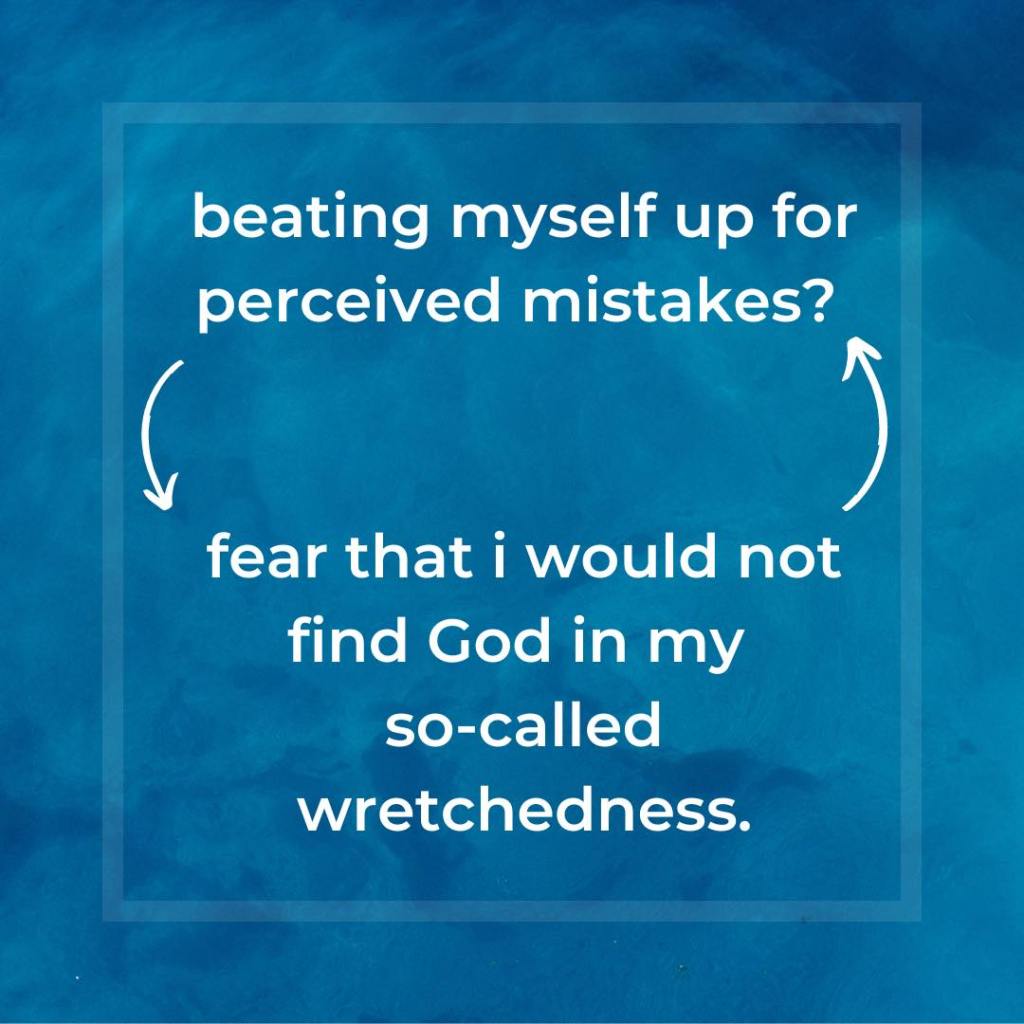
having seen how deeply remnants of morality are sown into me, i have been reflecting on: where has my obsessive streak of wanting to be a good person come from? from a subconscious understanding that it is in that morality that i will find God. what is my tendency to beat myself up rooted in whenever i do something which i perceive to be a mistake? in a fear that i would not find God in my so-called wretchedness. where does shame come from, with an emphasis on the shame that continues to shroud my connection to my sexuality? from internalising shame around sexuality as a ‘sin’, a wanton nail in the coffin that would ensure my perpetual disconnection to God.

God is beyond virtue and sin.

the other day, i told myself: damn it, use your intellect. no matter the fairytale story conjured about a higher power, how could that higher power ever punish, reject or be angered with me, or with anyone for the matter?

i was engaged in particularly unvirtuous-ly considered behaviour recently when it hit me, i feel so loved and accepted by God right now, and i am – inherently. and i don’t have to do anything else rather than be myself to be loved or accepted. note: it might seem contradictory to assign the wilfulness of love & acceptance to the non-dual understanding of consciousness, but it’s one of those contradictions that somehow just ‘is’ and i feel like can’t be explained. the love is there. 💙

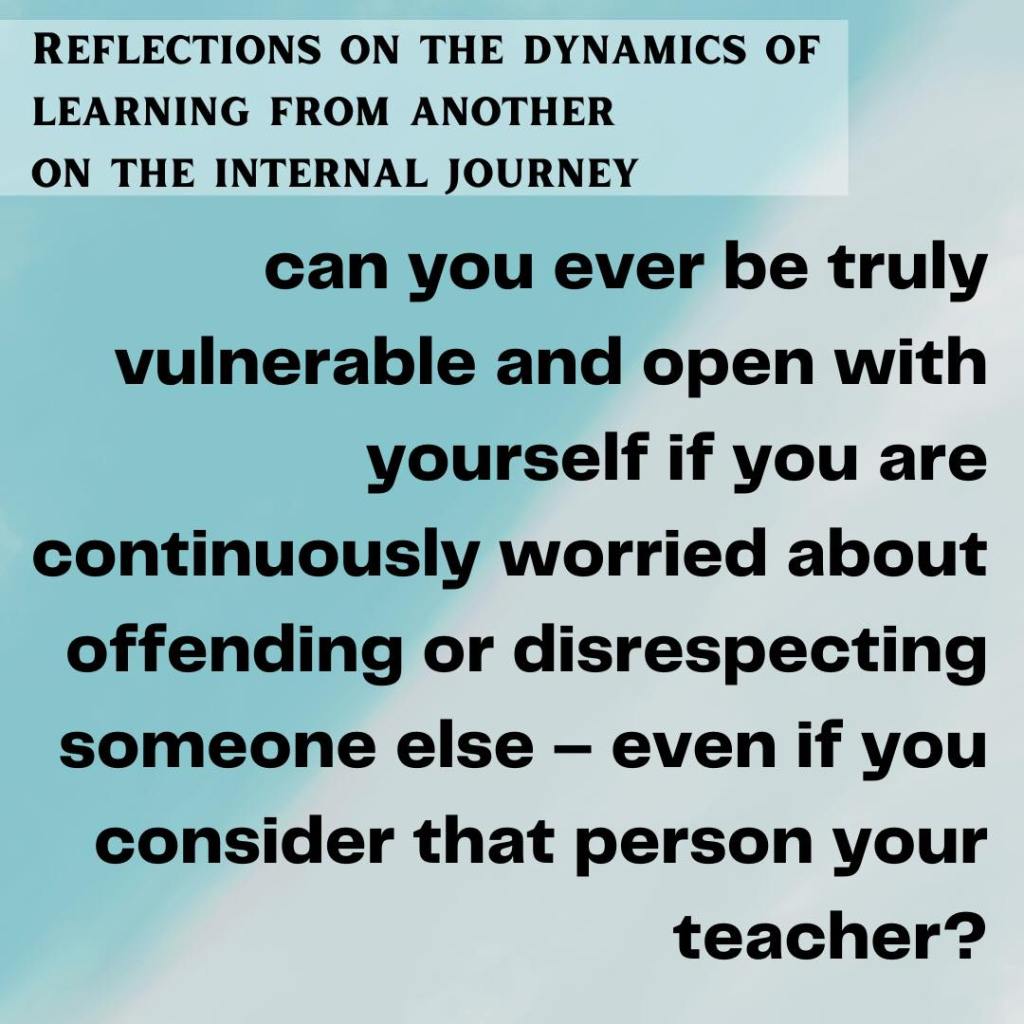
reflections on the dynamics of learning from another on the internal journey

today i discussed with a friend and fellow spiritual practitioner about our experiences with learning from people and receiving guidance on the internal journey. they shared with me about their moments of disagreement with their teacher, and about how such moments often end in comedic relief or deepened openness.

incidentally, i have recently experienced such a moment myself, in which i felt frustrated with the person i am learning from, and my first impulse was to suppress my frustration – which is the modus operandi i have internalised from past experiences, having come to associate disagreement or conflict with one you are learning from with lack of surrender or respect, with something being wrong with me as a ‘student’ – as myself. (*note: i don’t resonate with using ‘teacher’ – ‘student’ labels anymore, but for simplification sake).

i was set to suppress myself this time as well, only a pestering thought or feeling lingered and pulled at me.

the thought was: “i can’t do this to myself again”.

so i reached out, asked if i could share, expressed all of it as it came, as irrational and messy as it was – and breathed in relief. when the response came, it was most welcoming and kind. and i thought to myself, oh.

it can be like this. easeful. it can be like this; a non-judgmental container in which a full capacity for self-expression is allowed, in my niceness and in my ugliness, in which there is no fear of being wrong or of making an offence.

i sat with this for many hours later, for the first time in years seeing how heavy the burden of having curbed my self-expression had been – in and out of ‘spirituality’ (which, yes, encompasses all, but again for simplification sake).

followingly, questions that came to mind on this dynamic were:

can you ever truly be vulnerable and open with someone if you are continuously worried about offending or disrespecting them? and, can you ever be truly vulnerable and open with yourself if you are continuously worried about offending or disrespecting someone else – even if you consider that person your teacher? (extrapolating this, i believe this applies to our relationship with God as well – how can we connect if we live in self-imposed fears of God?)

although i do think that there is no right or wrong ‘teacher’ (and, extending this to the playground of life, person, friend, whichever the role etc), or right or wrong place to be in, i personally have decided that i want to learn from someone i can speak freely to, and be freely with. if i spend more time being on edge than expanding, i’m out. 

Whisky as Sacrament: Cleansing the Doors of Perception | The WhiskyBaba Experience

Introduction: The Way of Sacraments

“If the doors of perception were cleansed every thing would appear to man as it is, Infinite. For man has closed himself up, till he sees all things thro’ narrow chinks of his cavern.”

William Blake, The Marriage of Heaven and Hell (1970).

From psilocybin, ayahuasca and cannabis to wine and spirits, the practice of utilising intoxicants as sacraments for internal, embodied, or transcendental expansion is a well-established one in numerous spiritual traditions (see Terence Mckenna, The Food of the Gods, 1992).

Single malt scotch is such a sacrament, which, when consumed with proper, ritualised awareness, can become a tool to enter what William Blake and Aldous Huxley called ‘the doors of perception’: a broadening of one’s understanding and processing of the immediate reality.
Known as ‘the water of life’, the medicinal properties of whisky, such as its anti-inflammatory attributes, its potential to reduce blood fat and lower the risk of heart-disease (and many more!) are well-known to whisky-lovers. However, research into whisky’s potential is nowhere near complete, and pioneers continue to make groundbreaking discoveries that continuously innovate our understanding of whisky’s promise.

The WhiskyBaba Approach
Such pioneering research is being put forward by Dr. Sumit Kesarkar through Whiskybaba.in.

Whiskybaba.in’s research centres on unlocking neuro-hormonal intelligence in our systems through the consumption of certain single malt scotch whiskies, on the foundations of the āyurvedic algorithms of rasā.

This method, developed by Dr. Sumit Kesarkar, targets kaśāya rasā, or the astringent complex, which impacts the body’s macro and micro levels to process, digest, excrete mental and physical wastes, and keep one’s system open to profound sensory experience.
Whisky is consumed with a special breath / practice that was developed with the purpose of maximising and accessing the substance’s neural potential. The breath is known as the Sfaim breath, which is demonstrated on the WB channel.With this breath, one can activate parts of the brain which are generally difficult to access in the daily unfolding of life, which results in a heightened expansion of the senses, as well as in the opening of the potential to rewire and dive deeper into the mind.

Whisky is consumed in a larger context in which a proper lifestyle is cultivated (meaning, a discipline structured on āyurvedic principles, such as eating and sleeping at set times and avoiding inflammatory foods, which results in a regulated body and system that can absorb the substance at maximum potential), as well as with the mindset of viewing whisky as a sacrament.

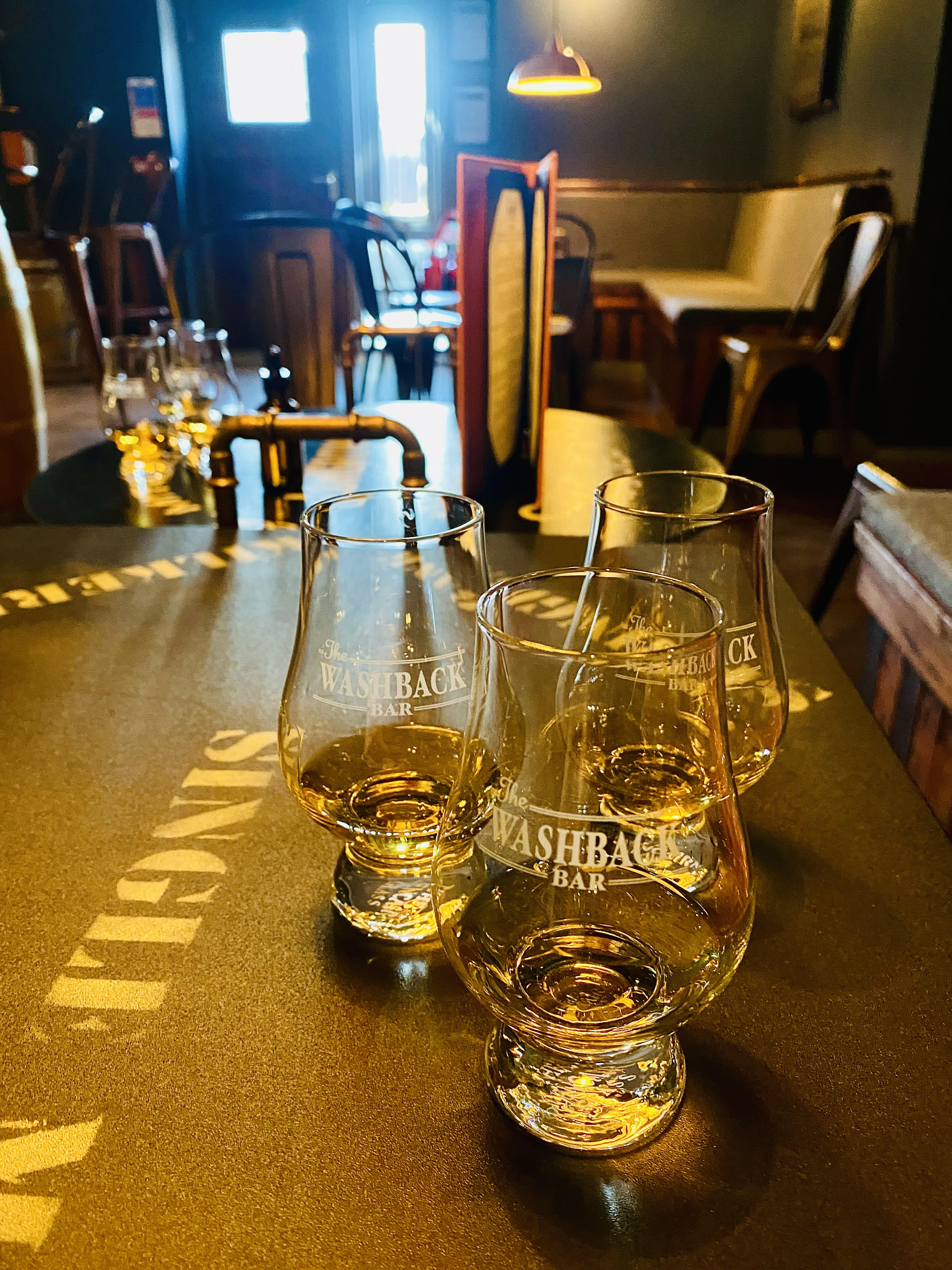
The mindset of viewing whisky as a sacrament can mean many things: from drinking with the awareness that one is consuming a substance that has the potential to unlock their brain patterns (as opposed to drinking with casualness for entertainment purposes) to ensuring a perfect ambiance (for instance, on the WB retreat the ambiance was created within a Scottish heritage manor that echoed with silence and an air of mystery; but the ambiance need not to be so imposing in terms of daily use, as in, one can ensure it — or I do — by choosing to consume whisky on their own, in quietude, with single-pointedness; not while watching TV or doing other things, but with maximum attention accorded to the process).

Lastly, the whisky that is consumed must fit an astringency profile, which indicatively needs to fulfil the following criteria: 50%+ alcohol vol., cask strength, matured in casks such as European oak, and it is best consumed approximatively two hours after dinner, which in line with the lifestyle principles priorly mentioned would be around 8pm.

Experiencing Whisky

I started drinking whisky every evening since July 2022, following a(n unfortunately brief) taste of the WhiskyBaba experience in Edinburgh. I drank a dram by myself, sat with myself, and experienced myself in the expansion of that. I sometimes rested in quietude, enjoying the heightened sensations, the sharpening of the intellect and the internal pulsations that resulted from the absorption of the sacrament. I sometimes danced, gazing at myself in my mirror and feeling the joy of connection to the movement of my body. I sometimes cried and I sometimes smiled. I sometimes called friends and poured my heart.

The evening ritualisation of whisky led to profound shifts in perspective on three planes.

First, a spur in creativity. At that time, in terms of creative writing, I had been exclusively writing poetry for approximatively six to seven years. I identified (or limited myself as) a poet, and had not felt any inkling toward creating prose in the given time-period. However, to my great surprise, in the quietude of the early evening, my mind began to weave stories and characters together, and I started writing prose fiction. Whatever blockage I had toward this genre (which, looking back, if I were to linearly pinpoint, came from undigested experiences with the world and writers of prose as a teenager) loosened, and I wrote flowingly; unashamedly. The topics varied and trickled out of my brain in waves.

Oftentimes, when I write, I cannot help but write with an audience in my mind, which can corrupt the process by diluting it and moulding it to the preferences or validation of a specific imagined target-group; the concept of an audience disappeared in those evenings, and I wrote as if in a vacuum. I wrote things which would have made me cringe (and sometimes did!) in the early morning, but I did not care. They were in me and were welcomed because they existed in that space-time quantum. It was cathartic.

Second, I arrived at a sudden insight of seeing that I had been holding onto shame around my sexuality, and was both repressing myself and feeling unfulfilled, as well as isolated in my life. Painful experiences as well as buried desires came to the surface, and there was no other way to proceed but to welcome them. This led to taking action in my life: after a very long break, I began dating again, as well as started reconnecting with friends and rebuilding my social life.

Third, a glimpse into what Carl Jung would name the ‘shadow-self’ dawned upon me. The shadow-self is represented by aspects of ourselves we deem as ‘dark’ and hide from our conscious mind out of fear of seeing ourselves. I realised that I was seeing myself as split into two: the light me, composed of parts of me that could be deemed as socially acceptable, such as occasional generosity and occasional kindness, and the dark me, the parts of me that could lead to social rejection, the one that held jealousy, and pettiness, and ‘dark’ desires that made me ashamed of myself.

Jung decrees that, in order for an individual to achieve psychic wholeness, one must undergo individuation, which is a psychological process that merges the unconscious (the darkness we push into the depths of our subconscious) and the conscious (what we deem as light). The shadow-self is welcomed and co-exists with the light-self until the awareness of neither having been separate from the other all along springs. (see: Carl Jung, The Archetypes and Collective Unconscious, 1959).

On these evenings, I began to welcome my darkness back to myself, but, in full honesty, only tiny fragments of myself have been fully merged with what I perceive to be my light. Shame and self-rejection are still deeply rooted, but it is okay. The process is not a quick one, and I am learning to remain curious of its unfolding, instead of to rush into wanting a fast fix. Ultimately, there is nothing to fix either way.

A Pause

In September 2022, I paused my whisky experimentation for thirty days. The reasoning behind this period of abstinence was to observe the changes that would occur in the absence of whisky, and to thus gauge the actual impact whisky had on my system and every-day life.

In this period, I noticed a lessened ability to digest thoughts and emotions, a slight increase in mental agitation, and as the thirty days came to end, I also began to miss the evening ritual. It wasn’t the whisky as a substance that I missed, the taste or its sensorial effect, but the opportunity to connect to myself on a deeper level, and to ground myself in myself.

After thirty days, I resumed the ritualised practice with greater attention and respect to its effects and benefits on my system.

The WhiskyBaba Retreat

The WhiskyBaba retreat, a four-day immersion into the exploration of whisky as a sacrament, deepened my connection with whisky from an experiential standpoint. It included numerous tastings of whiskies that matched the WB astringent profile, exquisite culinary experiences, the learning of new breath modulations to utilise in drinking whisky, and experiential arts-performance based on the algorithms of the Nātyaśāstra, a Sanskrit treatise on the performing arts (upcoming article on this): so, overall, it was an all-sensorial experience.

The WB motto is: “It is not about whisky, it is through whisky”.

This precept encapsulates the retreat experience most faithfully. After touching on the basics of whisky on the first day, we minimally discussed whisky as an entity; our discussions centred on the internal experience facilitated by this perfected tool, and, most significantly, the discussions paled before the experience itself. It is difficult to place the WB experience into words, or to say, ‘this changed, and this shifted’. Inside, the landscape seems different, though I am unsure how.

I am tempted to believe that the experience was an under-the-hood absorption, which might become apparent or not in the future. I am tempted to say that the doors of perception creaked open a little, if it is not arrogant of me to do claim so. More knocking at the door is surely needed. I am unsure if it is even worth trying to use words to describe any glimpses of the hallway drawn after these doors open. As Huxley writes after he opened his own doors:

“Sensations, feelings, insights, fancies — all these are private and, except through symbols and at second hand, incommunicable. We can pool information about experiences, but never the experiences themselves.”

I will try, however, to place into words one particular experience. Seated by the fireplace by myself after all went to sleep, I enjoyed a dram with my eyes transfixed on the flames, inhaling the smoke that seeped into the peaty scent of the opened bottle of whisky. The house was quiet, the night was dark. I enjoyed the sensation of ‘me’, and felt myself establishing more deeply into the understanding that I am the path, and the path is from me to me. Followingly, it was fascinating to observe the dynamic of participating in group sessions and imbibing the same sacrament, as well as learning from someone, while having this understanding held into my awareness, sometimes firm, sometimes less.

Perhaps an important reminder is that the entity is the tool and not the path. We are always the path.

On technical terms, I believe the retreat refined my palette into being able to catch, assess the difference between whiskies which match the profile of astringency and those who don’t. Interestingly, most whiskies available on the market are exceedingly sweet and don’t match this profile, as they are matured in, for instance, sherry casks.

Whisky and Overindulgence

Is overindulgence possible with this approach? Everything is possible at any given moment, but I would argue that, if the WB approach is followed to a T, overindulgence is a very unlikely possibility. This is because, if a proper lifestyle is followed and the Sfaim breath is utilised with awareness and the mindset of sacrament is cultivated, there is no use to drink in excess, and less of a chance to drink casually; I would even argue that the wish to drink in excess is likely to not arise, and as you proceed, you will intuitively know how much to drink, as you fall into alignment with your body-mind. For instance, throughout my experimentations, I began to know in the mornings if I drank too much — I could feel a sense of indigestion in my stomach, or my mind would feel heavy. Similarly, I also began to notice when the whisky was not an appropriate one for me, or in alignment with the WB guidelines for whisky (which also become individualised as one deepens their explorations with it).

Whisky and Escapism

Generally, we associate alcohol with escapism. I would maintain, however, that the WB approach of drinking whisky allows for no such thing. For instance, one particular evening I was feeling discomfort, shame before picking up the glass. A part of me would have very much preferred if the whisky would have wiped both the feeling away, as well as the experience that my mind kept rewinding. However, drinking heightened the feeling of embarrassment, and I was forced to bite through it until it was fully welcomed inside of me and it dissolved on its own accord. Sidenote, this does not mean that any given time the uncomfortable feeling will dissolve on its own when connecting with yourself through whisky. I mean, sure, as the theory goes, every feeling will ultimately dissolve because everything is transient and nothing is permanent, but the expectation of the discomfort to dissolve is an ineffective one, as it might simply not achieve fruition in that particular instance.

Stay tuned for part II. Here’s to cleansing the doors of perception!

Finally, many thanks to WhiskyBaba for providing this platform and this method to us. I am sure so many will benefit from it. ❤

To learn more about WhiskyBaba, follow these links:

Website: https://whiskybaba.in/

Book: https://tr.ee/oQpzj7iXIj

YouTube Channel: https://www.youtube.com/watch?v=GbMmVPRIqAo&t=25s

Facebook: https://www.facebook.com/whiskybaba.in

Instagram: https://www.instagram.com/whiskybaba.in/

WB Foundational Series: https://www.eventbrite.com/e/whiskybaba-accessing-neurohormonal-intelligence-through-single-malt-tickets-656200412097