amaryllis (/ˌæməˈrɪlɪs/[1]) – bears the name of the shepherdess in virgil's pastoral eclogues. it stems from the greek ἀμαρύσσω (amarysso), meaning "to sparkle", and it is rooted in "amarella" for the bitterness of the bulb. the common name, "naked lady", comes from the plant's pattern of flowering that blooms when the foliage dies. in the victorian language of flowers, it means "radiant beauty".
The order of the stakes of the dice game in the Mahābhārata goes as follows:
1) Yudhiṣṭhira stakes and loses the Pāṇḍavas’ wealth, army, empire, throne, weapons 2) Yudhiṣṭhira stakes and loses the autonomy of his four younger brothers, and they are enslaved on the spot (and they submit to it) 3) Yudhiṣṭhira stakes and loses his own autonomy, rendering himself enslaved (and submitting to it himself) 4) lastly, Yudhiṣṭhira stakes and loses Draupadī’s autonomy. The Kauravas roar in excitement, and they send a servant to fetch Draupadī to the sabhā (the royal hall) so she can be enslaved publicly.
Draupadī is absent from the sabhā at the time the dice game unfolds, as she is in her private chambers, menstruating. The servant comes to her and announces the outcome of the dice game. She is told that she has been ordered to present herself as a servant before the Kuru dynasty. She refuses to go, and says she wants one question to be asked to Yudhiṣṭhira:
“Did you first lose yourself, or me?” (2.60.9)
The servant returns to the sabhā and asks Draupadī’s question to Yudhiṣṭhira, who remains silent. The Kauravas become enraged by what they perceive to be Draupadī’s defiance, and one of them, Duḥśāsana, goes to fetch her himself. When she still refuses to come, he grabs her by her hair, drags her to the court and molests her publicly.
However, Draupadī is unbent: she delivers an incredibly powerful speech in which she continuously asserts her independence, challenges and rejects the men’s claims to her freedom, questions and denies the validity of the dice game, and, ultimately, overturns its verdict. In this speech, she presents a series of arguments, and I will analyse each in a series of upcoming posts.
Her first argument is her first question, which infers that, even if Yudhiṣṭhira did have any authority over her status (which she later challenges and denies as well), he lost all authority which could have been argued that he exerted over her the moment he renounced his independence. One who is not their own master cannot be the master of someone else, and one who is dependent cannot impair another’s independence.
Kamalātmikā Siddhānta: documented entry date, 1st december 2023.
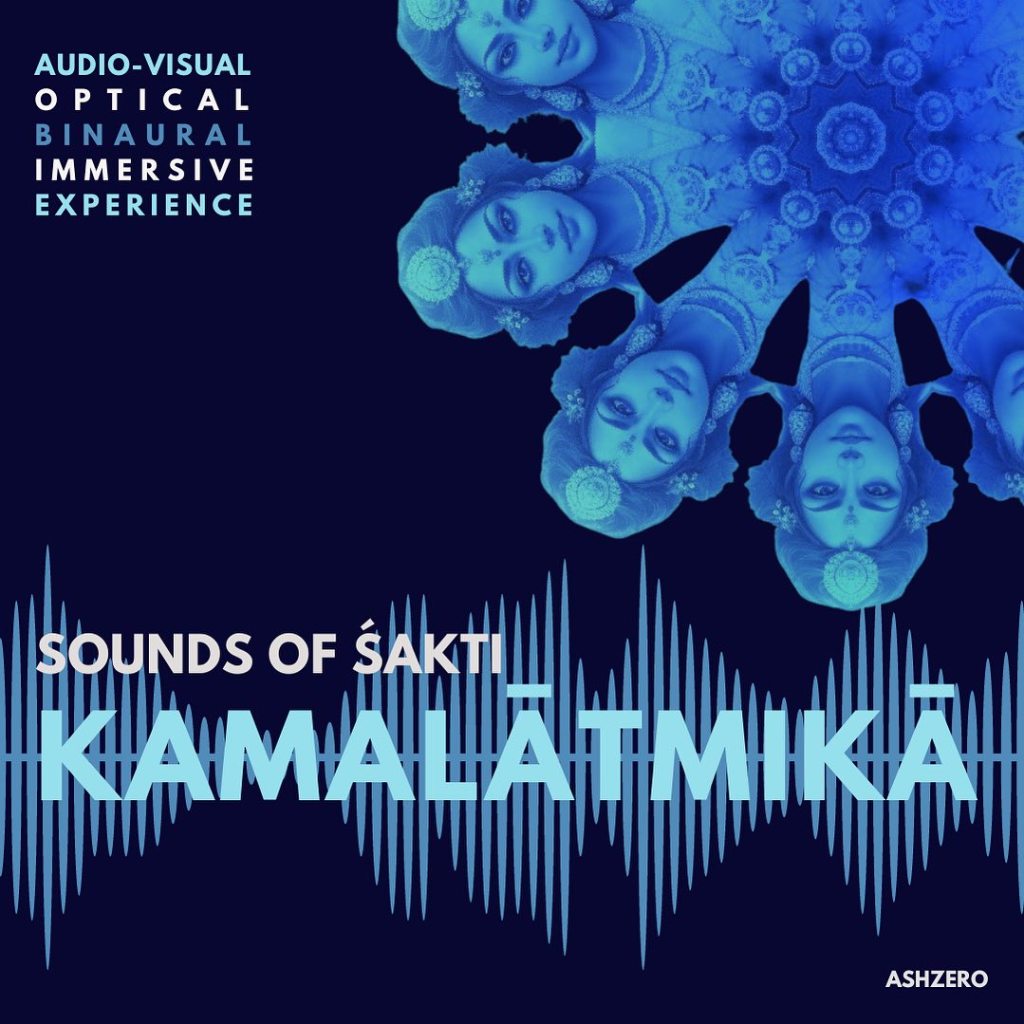
tomorrow marks three weeks of my second continuous sound exploration of the Kamalātmikā siddhānta (collection of algorithms) through @theashzero offering of Sounds of Śakti, for which @lensonearth created a series of sound containers (sensory or audio-visual blueprints) that aim to project as derivatives of the siddhānta of Veda & Tantra, in this expansion of bījā (seed) as layered on mātṛkā & Maheśvara sūtra.
in embarking on experimentation with another wavelength, i decided not to choose one consciously with the intention to not allow any bias inferred by my programmed sense projections to influence my decision process & ulterior experience. i therefore randomly clicked on a sound, and followingly listened to it every morning and every evening, generally 4-5 times each. in the morning, after drinking espresso as sacrament, in the evening, after imbibing single malt as sacrament.
although i aimed to approach this exploration with complete freshness & to renounce any prior knowledge or expectation, there was some linearity around having explored with one ‘different’ sound already. however, the awareness of another sound quickly faded. when listening, there was no ‘other’ sound i had explored with – the sound was complete in itself. the experiences that sprang from the sound were complete in themselves. further, it would be futile to try to compare my experiences with the two sounds – in fact, it would be futile to even try to compare my experiences with the same sound in-between themselves, as even in a round of listening consecutively to one, each listening was distinct yet not separate as well as complete, with the ear picking on different frequencies, the body absorbing it in unique sensorial ways.
in the first session of Sounds of Śakti, Dr. Sumit said that, although presented as a series, each Mahāvidyā is complete, and each session is complete. we approach them as a series only as a reference point, but there is no need to approach the Mahāvidyās as such if you connect with one in completeness. my recent sound exploration offered an experiential glimpse into this.
as a final observation that i aim to make without assigning validations of ‘good’ or ‘bad’ to the process, looking back to the last 7 weeks, i have spontaneously made very different or ‘new’ choices in the realm of resources / resourcefulness or ārtha, which the Kamalātmikā siddhānta taps into.
Bagalāmukhī Siddhānta: documented entry date, 29th of december 2023.
i have been exploring the siddhantā {collection of algorithms} of the Mahāvidyā Bagalāmukhī for about one month now, through audio-visual blueprints {sound & images encoded through the algorithm of varṇa – svara -vyañjana} & colour spectrum {that of the sky} for about one month now, stimulating my brain with these tools at dawn & dusk every day, and my experience has been one of synaesthesia.
synaesthesia occurs when input received by the system which is linearly correlated with one sense stimulates more than that one sense, or stimulates the sense that is not customarily associated with said input. for example, you look at an image, and you “hear” it; the most common experience of people who have synaesthesia is that of hearing colour. in fact, this is the case of a close friend, who sees letters as colours, and i documented her experience in an article written for Plic, o revista nine years ago. back then, i was relating to her experience as an abstract, almost esoteric one, and wrote about it as such; as a foreign curiosity. i thought that you were either born with this neurological make-up or you were not.
experimenting on the AshZero platform opened my senses to experiencing synaesthesia, and to therefore experiencing input (such as colour, sound & visuals) in a multi-faceted fashion that seeped into all five senses. it made me reflect that my initial postulation of “you either have it or you don’t” was a limited one, and such an opening of the senses rests on technicality rather than on abstraction, while the potential to do so, which ultimately is to tap into different parts of the brain that are closed to us due to the linearity we entrench ourselves in, exists in all of us.
tools created by: Dr. Sumit Kesarkar || platform: AshZero || offering: Sounds of Śakti || my friend who accepted to be the subject of my study years ago: @radatreispe ❤️🔥.
“Strī” translates from Sanskrit as “woman”, while “dharma” is a complex principle with manifold meanings, in this context bearing the significance of “duty”; in simple terms, it refers to an individual conduct that contributes to harmony in a greater framework, be it societal or cosmological.
Draupadī is lauded in the Critical Edition of the Mbh several times as being the epitome of strī-dharma, of the dharma of women. (2.62.20; 2.63.25-30; 2.64). Interestingly, she is most intensely praised as such after she angrily (yet elegantly!) questions the men of the royal court and demands justice, being anything but meek and demure. I would argue that this showcases that in the Mahābhārata voicing oneself and standing up for oneself are considered responsibilities belonging to the dharma of women.
To nuance this even more, Eknath Easwaran, an eminent translator of the Bhagavadgītā, highlights that, etymologically, the term “dharma” can be traced back to the root ‘dhri’, which means ‘to support, hold up, or bear’; “dharma” therefore translates as “that which supports”, and Draupadī’s conduct therefore supports both society and cosmology.
In the Sanskrit Mbh, Kṛṣṇa does not appear in the sabhā (royal hall) at the time of Draupadī’s attempted disrobing, and no direct mention of him is made during this episode. In a conversation with Dr. Brian Black, a Mbh researcher whom I had the honour to have as my MA supervisor, we talked about the implication of this, which is that Draupadī’s adherence to strī-dharma appears to be that which shields her. A question that could arise here could be whether there is a contradiction between the Critical Edition and modern renderings of the Mahābhārata, with Draupadī being shielded by her dharma as opposed to by Kṛṣṇa.
For me there is no contradiction.
Kṛṣṇa in the Bhagavadgītā establishes himself as ‘the eternal dharma’ (14.27); and so, Kṛṣṇa is all dharmas, including strī-dharma. We tend to associate Kṛṣṇa with a fully-fledged incarnation; but he is beyond that. I would maintain that, as the divine principle, he exists in Draupadī’s consciousness and in her actions as dharma (and not only!). The latter renditions, for me, in which he is physically there, only bring forth in tangible projections the internal process extending Draupadī’s consciousness.
I will write more about strī-dharma as it appears in the Mbh.
One of my favourite interpolations from modern tellings of the Mahābhārata is a conversation between Draupadī and Kṛṣṇa that occurs after Draupadī’s sexual assault and attempted disrobing by the Kauravas.
Clutching his feet, Draupadī sobs: “Govind, why? Why did this happen to me? What sins did I commit? I am reaping the fruit of which actions of mine?”
Picking her up and caressing her hair, Arya tells her: “What happened was neither because of your ‘bad’ karma, nor did you reap the fruit of your past actions. It was the Kauravas who reaped the fruit of their past actions by engaging in such a grave misdeed. Sakhī, this is the meaning of karma.”
“But I am the one experiencing agony, Govind.”
“Then relinquish it, Sakhī. Although what happened was not the result of your ‘bad’ karma, the way you transform following these events will be your karma.”
This is such a beautiful and profound exchange which offers rich nuances to the teaching of karma. Oftentimes, when events we perceive as terrible happen to us, we create a story of unworthiness around them; we wonder if we are being punished, if the root cause is our evilness, if God or the universe are rejecting or dooming us. A question that rests on these lines that is often asked would be the common: “why do bad things happen to good people”. A first layer to this, in my view, is a deconstruction of ‘bad’ and ‘good’ as solid concepts. The second layer is the understanding that any event ‘just’ happens aleatorily, rises and falls, and karma is not a simplistic cause-effect reaction.
Karma encapsulates, in my understanding, the ingrained patterns held within us through which we act, react, and process the world around us and the events that occur in our lives. There is freedom from karma in finding new ways of reacting, engaging, processing.
Finally, a significant teaching encased in this interpolation is that the way someone treats us, ultimately, is a reflection of their karma (ingrained patterns), and not a reflection of our ingrained patterns. We cannot control another’s patterns, but we can aim to understand and rewire ours accordingly.
In response to the article about Draupadī’s disrobing that I shared yesterday, Jim beautifully questioned whether the act of violence spurred from limited views around nudity and if it would have been avoided if nudity was perceived differently in that society (if it was common, seen as sacred or normal). This was a very rich ground of contemplation for me, and the reflections I have had are the following:
First, I would like to establish that Draupadī was not wearing a sari when her attempted disrobing took place. She was wearing a single cloth which covered her body through which she was menstruating, which was the custom at the time. It can be deduced through various references toward her appearance found throughout the Mbh that, outside of the timeframe of her menses period, she did not customarily wear an upper garment, so her breasts were uncovered. At the time of her attempted disrobing, she was wearing more clothes that she usually was. The men had already seen part of her body which they wanted to disrobe. There are scholars who argue that she was not wearing a single cloth at the time of her disrobing and she was instead wearing both an upper garment and a lower garment. I would argue that this is irrelevant, as the point still remains that her breasts were covered, and they usually were not.
Second, I would maintain that, the disrobing episode, as most acts of sexual violence, was more about power than about sex or nudity, and that the key factor here, lost in so many adaptations, was not the attempted disrobing & possible nudity, it was the fact that Draupadī was menstruating, and she was brought to the royal hall in a stained garment through which she was free-bleeding. Menses was / is considered a period of purification. The act of dragging a menstruating woman by her hair to the royal hall – who, as I priorly mentioned, was wearing more clothes than usually – is exceedingly violent & cosmologically destabilising especially because it disrupts the menstruation ritual of purification and it does not allow it to be finalised. Further, hair in itself is a symbol of sexual power for a woman. Duśāsana grabbing Draupadī’s hair is an attempt to curb her sexual power and own her sexuality.
Draupadī bleeds in the hall and leaves Hastinapura bleeding through her clothes. Scholar Alf Hiltebeitel argues that it was the dishonouring of her blood that held in itself the requirement for it to be paid with war; with bloodshed. In the cosmological cycle, blood pays for blood.
The Kauravas wanted to humiliate, own and disempower Draupadī; nudity was one of the means to get there, along with disturbing her purification rituals, not the end goal. However, one could argue that in a society in which nudity was seen as sacred the intention to humiliate wouldn’t have arisen in that openness or expansion of consciousness – but maybe it would have just taken a different form and found different means.
Photo: Pooja Sharma as Draupadī, bathed in the blood of her principal offender. The cosmological cycle is finalised.
The Nāṭyaśāstra is a Sanskrit treatise on the performing arts, authored by sage Bharatamuni.
Most notably, it addresses the aesthetic theory of rasā, which translates from Sanskrit as ‘essence’, ‘taste’ or ‘nectar’. Herein, eight rasās are identified, which encapsulate the totality of human expression and experience:
śṛṅgāraḥ (शृङ्गारः) (loosely translated as love or eroticism)
hāsyam (हास्यं): (laughter)
raudram (रौद्रं): (rage)
kāruṇyam (कारुण्यं): (compassion)
bībhatsam (बीभत्सं): (disgust)
bhayānakam (भयानकं) (terror)
vīram (वीरं) (heroism)
adbhutam (अद्भु) (wonder, astonishment)
The Nāṭyaśāstra pinpoints the ultimate, supreme aim of any work of performance art to be titillating the interior landscape of the one in the audience to experience pure rasā.
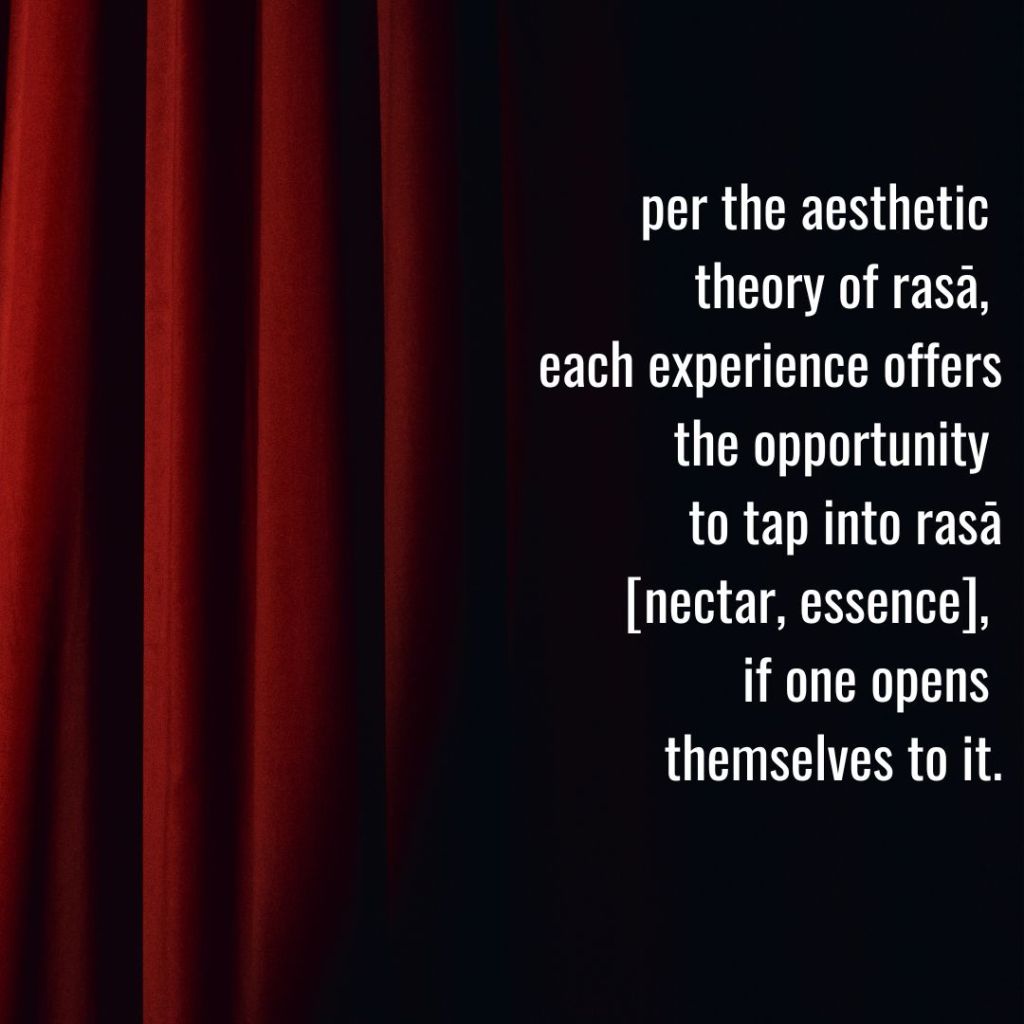
However, access to rasā in its purity is not limited to the performing arts medium; each experience offers the opportunity to tap into rasā, if one opens themselves to it.
Furthermore, rasās are given so much importance by Bharatamuni (and also by Abhinavagupta in his magnum opus Tantrāloka) because arguably it is by experiencing rasā in fullness that one can be offered a gateway to experiencing and understanding the essence of their being and consciousness.
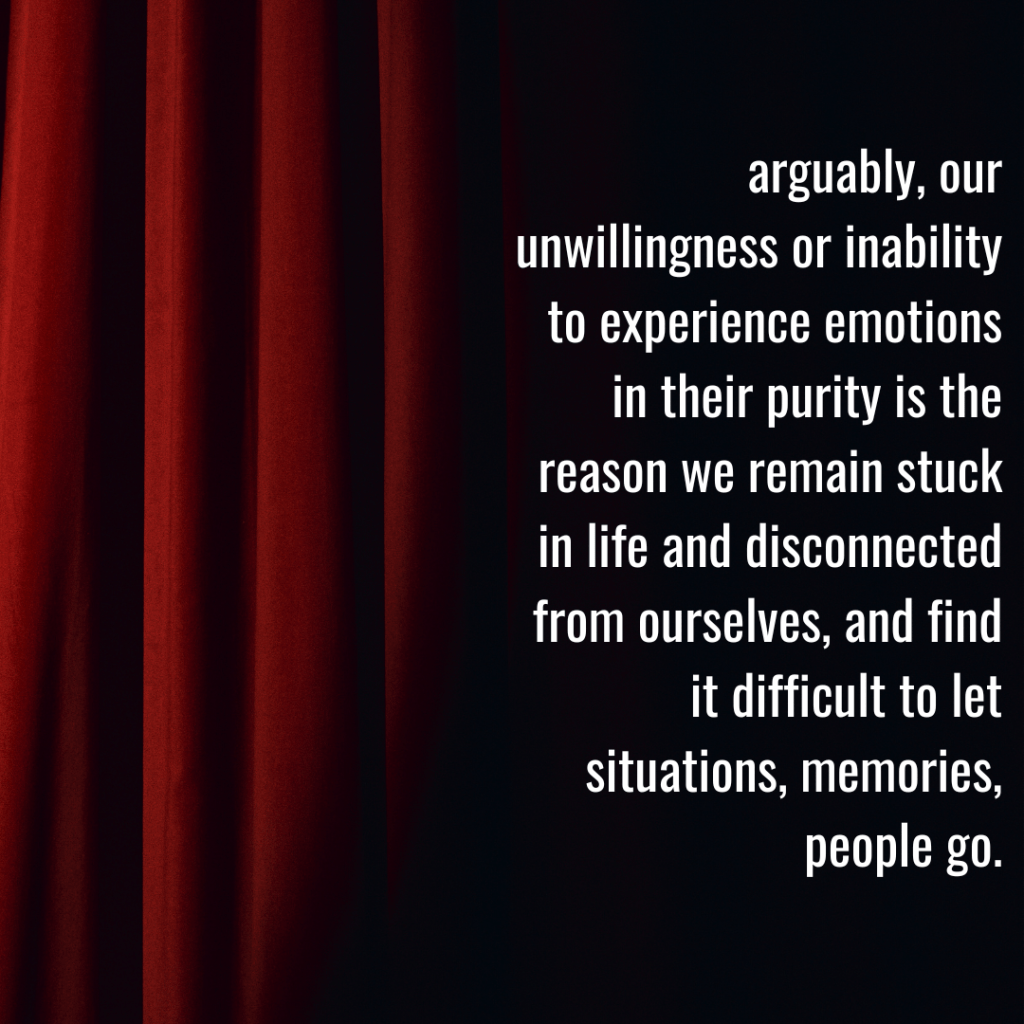
Customarily, we do not experience any rasā in its complete intensity, and we instead only taste it in partiality; muddled, adulterated. For instance, we rarely experience rage, partly because we are unwilling to open to its full intensity (perhaps out of preconceived notions of it being ‘wrong’, perhaps out of discomfort), and instead feel diluted anger. Our unwillingness to experience emotions in their purity is the reason we remain stuck in life, and find it difficult to let situations, memories, people go. (see more: The Theory of Rasa, Pravas Jivan Chaudhury, 1952)
The Nāṭyaśāstra: Life as a Stage
One of the precepts of the Nāṭyaśāstra is that life is play, and we live as actors on a stage: continuously being offered the opportunity to tap into rasā, and, ultimately, into the depths of our beings.
At the WB immersive, we had the opportunity to live this precept by playacting characters we chose or felt connected to. The darkened ambiance of the secluded Scottish manor we stayed in (which included a real-life bar located in the heart of the house!) was a rich opportunity to delve inward, effects of which continue to percolate for me. I won’t provide an account of the three plays we were engaged in, as I believe it would be futile to try to describe the experience, and a chronological or narrative account won’t serve anyone who was not there; I will however centre on the effects of it.
Interestingly, the experience of life as stage, not as lived for me while on-retreat — in which my direct experience was more one of passive enjoyment in the absorption of delight of the senses (with an emphasis on taste, touch, and sight) — began to dawn as gradual understanding in the aftermath of the retreat. It was not very conscious, but I began to find myself recognising the different characters or personas of myself that I slip into as my day unfolds and to see how my experience of myself is ever-changing.
Even being in my body feels gradually different as the day progresses; sometimes there is lightness in my body, sometimes there is heaviness, sometimes there is tiredness. Similarly, my mind feels distinct in different times of the day; sometimes it is busy, sometimes it is easeful, sometimes it is burdened. None the better, none the worse.
I believe there was always some awareness of this inherent fluidity in me, but, in my lack of clarity, it was addled with uncertainty or fear; do these shifts in ways of being mean that I am fake or inauthentic — an impostor about to be found out?
In a way, yes; in the sense that my idea of myself as the solid identity of Téa is indeed a false one; as in, it is unstable. I am not just one character, I am many characters that come to play within me and through me in, for instance, the short timespan of a day; the friend I am to one person is different to the friend I am to another person, the scholar at university is different to the daughter I am to my parents. One’s impression of me will be different from another’s impression of me.
Neither of these facets of myself invalidate the other, only point to the complexity and fluidity of being that is intrinsic to each of us.
These reflections, triggered by the Nāṭyaśāstra experience, led me to understand the playfulness of life more in the retreat’s aftermath. Like, I am just acting characters. As my generation would say, it’s not that deep.
I only need to experience each character to the fullest.
Unleashed Anger
However, this process also led to an unleashing of an emotion I have been repressing, namely anger, and with an encounter of what Carl Jung would call ‘the Shadow’. I could not emote anger during the retreat in neither of my playacts, which made me question what blockages I had around it. Sitting with myself, I examined both my emotional landscape as well as my past conditioning and began to see the hindrances around expressing and experiencing anger that I had, coming from spiritual conditioning which dictated that it was ‘wrong’, as well as from past experiences in which I did express my anger which I internalised as shameful, and in which I felt rejected for being true to myself.
Concomitantly, I also realised I had been blocking my anger through reasoning: I am a stoic at heart, and my first reaction to any event that occurs into my life is to unpack it from distance, third-person view.
Every time anger arose for me, my intellect labelled it as irrational and diminished the emotion by unpacking the event as neither right nor wrong, and as the person who triggered my anger as an individual found in their own process lacking any malicious intention. In the face of reason, I felt hindered to follow or express my anger.
It was irrational, after all.
This was a limiting perspective: first, not only are emotions irrational by nature, but, both perspectives can co-exist: I can be angry at someone while also holding in my awareness the discernment that the person is not inherently evil or wrong and reality is complex. But when it comes up, I can enjoy my anger and viciousness to the fullest, with the sole of intention of extracting the rasā out of it — which gives me the freedom of space: space in which I can choose to both channel it in creative ways, and not to project nor repress it, I find.
(To be noted that I am still very much a beginner in familiarising myself with anger so my reflections might change.)
Second, a loosening happens: even if I do have a slip in discernment and I end up projecting my anger or viciousness onto another (we’re not perfect, right?), it is not a catastrophic event. As I ultimately am just a character playing themselves to the fullest in that context.
It sounds all good and reasonable on paper, but this loosening in my intellectual process triggered a true unleashing of all the ‘negative’ emotions I had suppressed throughout the years, from pure rage to envy, which came to me in waves until they hit me in full force.
I have been processing this unfolding by referring to my beloved Carl Jung’s theory of the Shadow.
Jung and the Shadow
Filling the conscious mind with ideal conceptions is a characteristic of Western theosophy, but not the confrontation with the shadow and the world of darkness. One does not become enlightened by imagining figures of light, but by making the darkness conscious.
“The Philosophical Tree” (1945). In CW 13: Alchemical Studies. P.335
Jung’s theory is that our individual consciousness is split into two: the conscious impulses, and the subconscious, repressed impulses we have, which we actively conceal from our awareness out of shame, guilt. He calls the repressed part of ourselves ‘the Shadow’. Jung declares that in order for one to achieve a healthy psychological state of wholeness (which he equates with the mystical ‘Self’ or the archetypal God lauded by religion), one must integrate the unconscious into the conscious. Jung even goes so far as equating encountering the Shadow with a first-hand encounter with God. (see Jung; Aion, Researches Into the Phenomenology of the Self, 1999)
However, Jung doesn’t exactly offer a roadmap to how to integrate the Shadow. He says it is an individual, possibly dangerous and maddening process that each must figure out for themselves, and also an essential journey to undertake in order to understand ourselves in our fullness.
In his view, there can be no self-understanding or self-realisation without integrating the Shadow.
In terms of a roadmap, Jung does assert that the first step is accepting your shadow and looking it straight in the eye.
That’s where I’m at right now: accepting my rage, envy and pettiness. In full honesty, part of me wants to rush through it and wishes for a quick, happily ever-after merging, and also wants a detailed handbook of how to do it. Jung says it can take years. I believe him. (See: Aion & The Archetypes)
Jungian scholars have mused that integration occurs naturally through a holding of the opposites formed by our repressed and conscious impulses, which creates tension in our consciousness, yet we are to expand our consciousness so that it holds into awareness both the shadow and the light. It is in this enlargement of consciousness that integration occurs, and one finally does not identify neither with the shadow, and neither with the light, achieving wholeness. This opens the doorway to stepping into the collective unconscious, a state of shared consciousness that, per Jung, is the base-structure onto which individual consciousness develops, and which holds all mysteries and archetypes of humanity. (See: Meeting the Shadow, edited by Connie Zweig & Jeremiah Abrams, 2020)
“Carrying such a tension of the opposites is like a Crucifixion. We must be as one suspended between the opposites, a painful state to bear. The problem of our duality can never be resolved on the level of the ego; it permits no rational solution. But where there is consciousness of a problem, the Self, the Imago Dei within us can operate and bring about an irrational synthesis of the personality. To put it another way, if we consciously carry the burden of the opposites in our nature, the secret, irrational, healing processes that go on in us unconsciously can operate to our benefit, and work toward the synthesis of the personality.”
(John A. Sanford, “Dr. Jekyll and Mr Hyde” in: Meeting the Shadow, 2020)
Incidentally, at one point last week, I experienced absolute, pure rage. I was by myself in my living room, and sank into it. At one point, the intensity of it scared me, but I didn’t turn from it. Then, it felt as if it almost exhausted itself — and it released me. It returned in waves in the following days, then dissolved again. Or flowed. How curious it is, to feel.
“Wholeness is not achieved by cutting off a portion of one’s being, but by integration of the contraries.”
Carl Jung
As a sidenote, since this process started moving in me, I have noticed an increase in my creativity, a shift in my self-expression. There’s more self-assurance. It feels like I found the voice I lost. Or some of it. 😊
Thankful to WhiskyBaba for this platform. Stay tuned for part three!
“is there something wrong with my brain?”, i genuinely wondered on an afternoon in which excruciating thoughts looped and pressed onto each other, and i felt like had lost control of my mind.
i have exhibited symptoms of mild ocd since childhood, namely physical and mental compulsions generally activated in periods of extreme stress or busyness. while i learned to gain control over physical compulsions in my teenage years by practicing inquiring into the mind and meditation as well as with the help of therapy, mental compulsions, known by psychologists as ‘pure o’, continued to emerge in different phases, under the hood, so to speak – in the sense that the lack of physical symptoms led me to assume that there were no mental latches (term utilised for a fixated compulsion), and i generally continued merrily with my life until pure o would peek back its head with a latch, and i would be left stunned, wondering what the disconnect had been; what was wrong; and if my brain was broken. this was until i discovered the work of Robert Bray, who worked with his mind & compulsions by exploring the work of the ancient greek and roman philosophers (did you know that CBT and most modern therapies have been built on their ideas?) through whom i discovered the work of Dr. Albert Ellis, the founder of REBT (the mother of CBT) which he coined in 1950s. according to them, even more important than exposure techniques, the key to working with such ‘disorders’ is to identify your core fears and irrational beliefs and deconstruct them.
although there were times i wished that my brain was wired differently, it has been being exactly as i am that brought me most richness by sending me on a quest to understand my mind. on this quest, i studied Jung in my undergrad, as well as independently conducted my own studies in the realm of modern psychology, which i paused for the past two-three years as i took a different approach to understanding myself outside of these bounds. a piece was still missing, though, and i returned to my studies a few months ago. i have since immersed myself into the application of REBT – which i was surprised to recognise as the source of most techniques of self-inquiry that i know of, which seem to have been developed from it.
i have been applying REBT in my life to both process my emotions and the world with reason and gentleness, as well as to enlarge my perspectives and to push myself past my insecurities. it is working wonders, and i will begin to share my process with REBT on my socials – both for my own clarity and to bring more light to such pioneering work that has magnificent potential for growth.
brief 101: so, what is REBT? REBT is a method in which you identify your irrational beliefs and deconstruct them through a technique called ‘disputing’.
why REBT? what is the missing piece in the popularised techniques of self-exploration?
in my very humble opinion, the premise. i am simply looking here at what has worked / has not worked for me, i don’t have an expert opinion. the premise ellis starts from is a thorough understanding of the fabric of the ego, as well as of what we know as ‘self-esteem’; eg. your very understanding of yourself as a self that you can rate as ‘good’ or ‘bad’ is IRRATIONAL. you do not exist as such. and so, REBT builds upon the disputation of this fundamental one belief: that in yourself as the person you think you are, which is nothing but a myth you constructed. enjoy the introduction to the ‘myth of self-esteem’ by Dr. Albert Ellis.
Pure O Journey, Chronological Chronicles: from fearing that my brain was broken to learning to embrace it & to work with it harmoniously. you can watch and listen to me speak about it on TikTok here.
going in more depth into my journey as well as into the techniques (such as REBT) that i use to understand myself and my brain better, as well as to live harmoniously both with myself and with others.
i have exhibited symptoms of mild ocd since childhood; at the time it would manifest mainly in the form of physical compulsions, such as repeating an action for numerous times, rearranging objects in particular geometric shapes, picking specific colours, fixating on wanting to have ‘good’ thoughts and to act with a ‘good’ thought in mind (the last still comes up!). all of this was done with a particular magical thinking mindset of ‘ensuring’ security, with a compulsion of wishing that by controlling a certain action or my external circumstance i could ensure control amidst uncertainty. the compulsions weren’t consistent, but would emerge in certain periods. i was an academically inclined child, so i would go through periods of extreme busyness and stress of competitions, exams, which was when the compulsions would manifest.
in my teenage years, as hormonal changes came into the picture and as life got busier and more vibrant, there were more such periods of busyness and i was compelled to tackle my compulsions. with the help of predominantly psychedelic explorations as well as therapy, meditation and reads in spirituality and psychology, i began to understand how i functioned more and removed the component of physical compulsions.
mental compulsions, known as pure o, continued unbeknown to me; i was not well informed on this topic and had assumed that physical compulsions were the only manifestation of a compulsive ‘disorder’.
the continuation of mental compulsions and subsequent distress and anxiety led to moments in which i wondered if there was something wrong with me, or if my brain was broken, which was painful.
flashforward, i paused my independent quest in psychology for about three years as i sought my spiritual longing, and began practicing in a (very beautiful) tradition which included a morning (very beautiful) ritual that held in it rules of cleanliness and reverence. with an edge created here by external factors, my physical compulsions came back with a force, and i would spend 2-3 hours every day with cleanliness compulsions ruling me, while, in my lack of clarity, i genuinely believed i was just following rules with care. after my path organically took me onto another direction (for radically different reasons, of course ), i renounced ritual at one point, which followingly led to me realise, in retrospect, that my physical compulsions had returned in that form. i was suddenly hit by a flash of clarity into seeing how outside of this mental latches (will give examples in future vids!) had continued throughout the years. i realised this had not been the quick fix i had assumed it was, and resumed my quest to understand my brain though psychology and philosophy.
this is how i discovered the work of Robert Bray, which derives from ancient philosophies and includes exposure therapy. through him i discovered the amazing Dr. Albert Ellis and his REBT. i have tried several action-oriented techniques through the years (i believe most very closely resemble REBT, which makes sense as REBT is considered the mother of CBT and imo what we see almost everywhere in the new-age world are repackages of CBT), but the premise of this one, which i will expand on in future shares, works best for me in leading me to harmony with my mind and with the world. more coming soon. i set up an IG where i’ll compile all of this, @easingintothemind, you can find me there if this evokes any interest. here’s to understanding ourselves!
APPLICATIONS:
IRRATIONAL BELIEF – I AM NOT GOOD ENOUGH
the formula of REBT, coined by Dr. Albert Ellis in the 1950s, is based on the work of ancient philosophers such as Marcus Aurelius. (sidenote, i’m just getting into Marcus Aurelius, and, ah, his words are gems!). i discovered it through the recommendation of OCD expert Robert Bray. out of all techniques of rewiring cognitive patterns i’ve used, it has proved most efficient in deconstructing pure o so far!
known as the A-B-C-D-E-F model, its premise is: most of the distress we experience is unnecessary suffering which arises from holding onto irrational beliefs. (i think this differentiates REBT from other action-orientated techniques of therapy, as it doesn’t promise to end suffering, but to instead dilute unnecessary suffering). it provides you this model to identify the irrational belief, dispute it, replace it & process.
let’s take an example in which i applied REBT!
situation: i want to have an experience by attending a specific event.
adversity: a thought arises; i want it, but what if i am not good enough for it?
belief: if i have this thought, there must be some truth to it. perhaps * i * should not go for it and protect myself from the possibility of rejection.
consequence: my chest contracts, i experience distress & there is the possibility of not going for what i want.
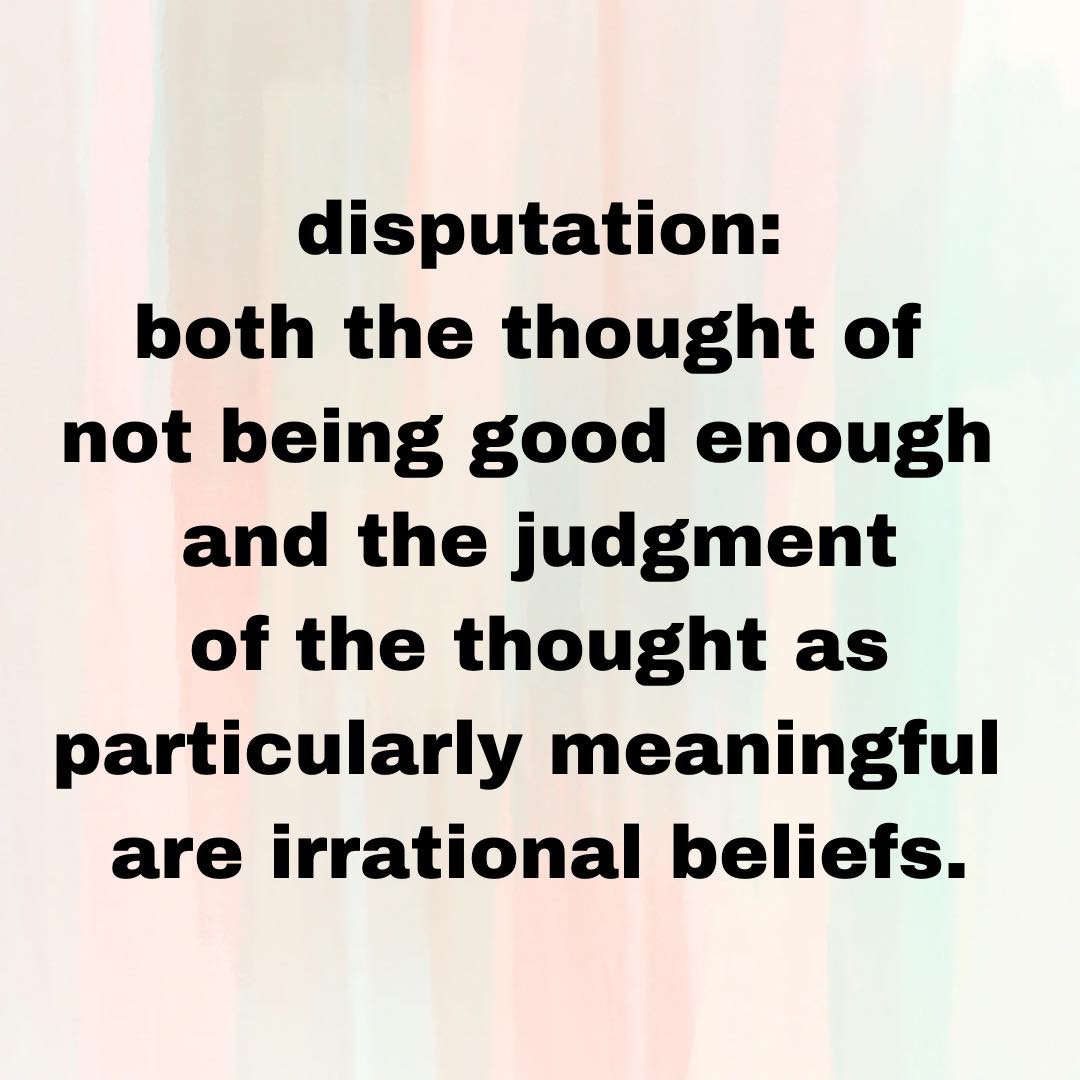
disputation: both the thought of not being good enough and the judgment of the thought as particularly meaningful are irrational beliefs. being “good enough” is a volatile concept which only exists in an even more volatile & subjective scale of comparison that cannot be quantified in reality. a thought is a cognitive process which arises from conditioning and from what we consume and have consumed on a daily basis over years with a degree of randomness; a thought is not a fact which has any inherent meaning other than that which i assign to it. if i have to label or judge my thoughts, per Ellis, it would be more rational to judge them as “effective” or “ineffective” (to one’s goal – more on this later).
effective new belief: thoughts and doubt have arisen and i can choose to remain undisturbed by either.
new feelings: relief. self-assurance. there is nothing wrong.
#pureo compulsion example as identified by Robert Bray, MD:
dissecting a past situation seen as unfavourable to catch patterns from multiple angles in order to ensure it won’t happen again. *to be differentiated from learning from past happenings in retrospect. a compulsion distinguishes itself through over-fixation as well as rooted core-fear.
my experience with this:
i dissected a particular mess i got myself into from hundreds of angles almost daily after i got myself out of it. i thought that if i dissected it hard enough, i could catch all of the giveaway signs and would ensure that i would never, ever put myself in that dynamic again – and protect myself. not only was it stressful to follow this thread, but it only stuck me into dead ends and loops of thinking which morphed into other loops of thinking.
breaking down the compulsion:
what is the rooted core-fear? that i will be in pain again.
what is the irrational belief behind this compulsion? that there can ever be a certainty.
disputing through REBT: there is no certainty that any situation would repeat itself with the same patterns and giveaway signs. life is too complex. yes, i might get hurt again. yes, i might end up in that dynamic again. yes, i might have to pull myself out of that dynamic again. it might not be pleasant.
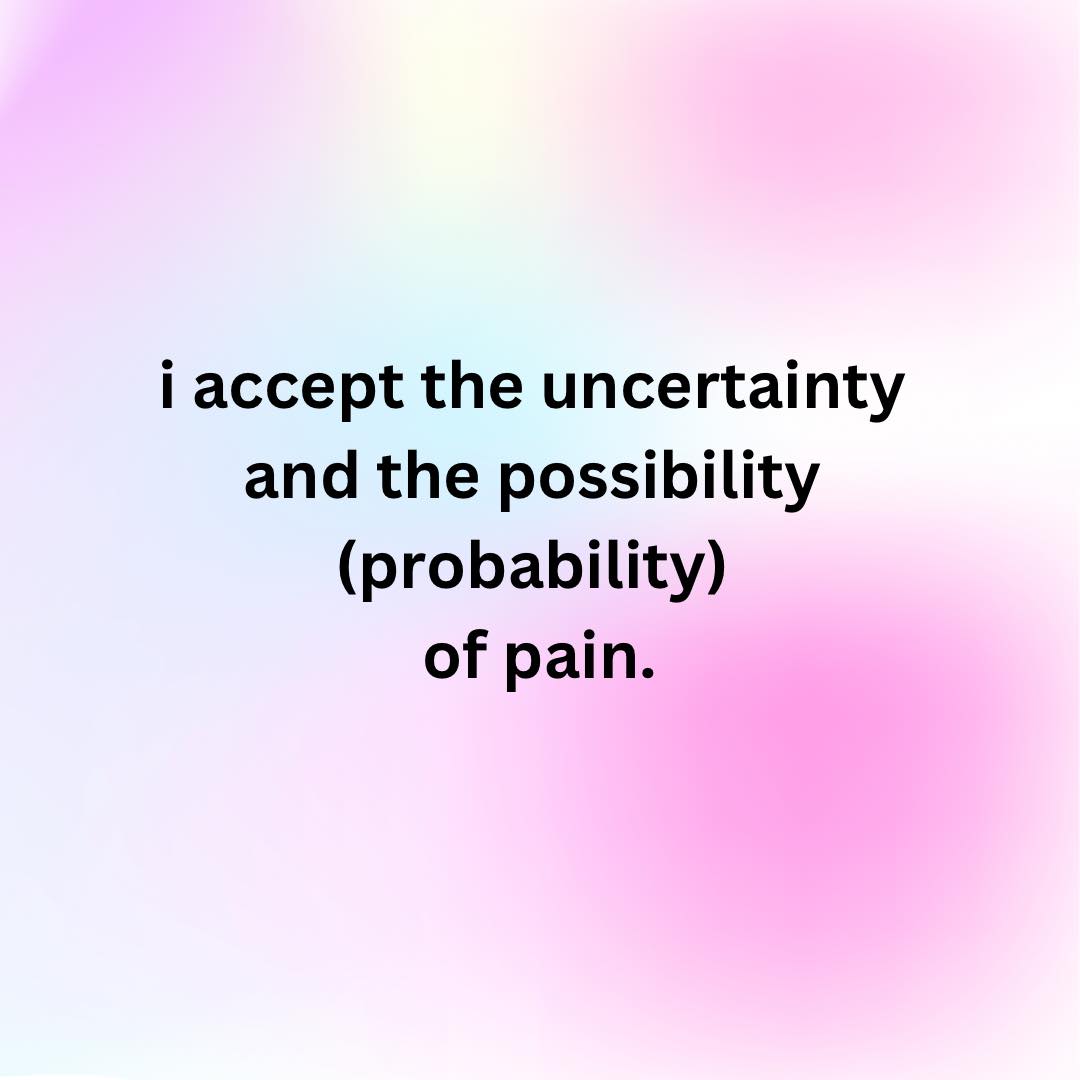
i accept the uncertainty of that and the possibility (probability) of pain.
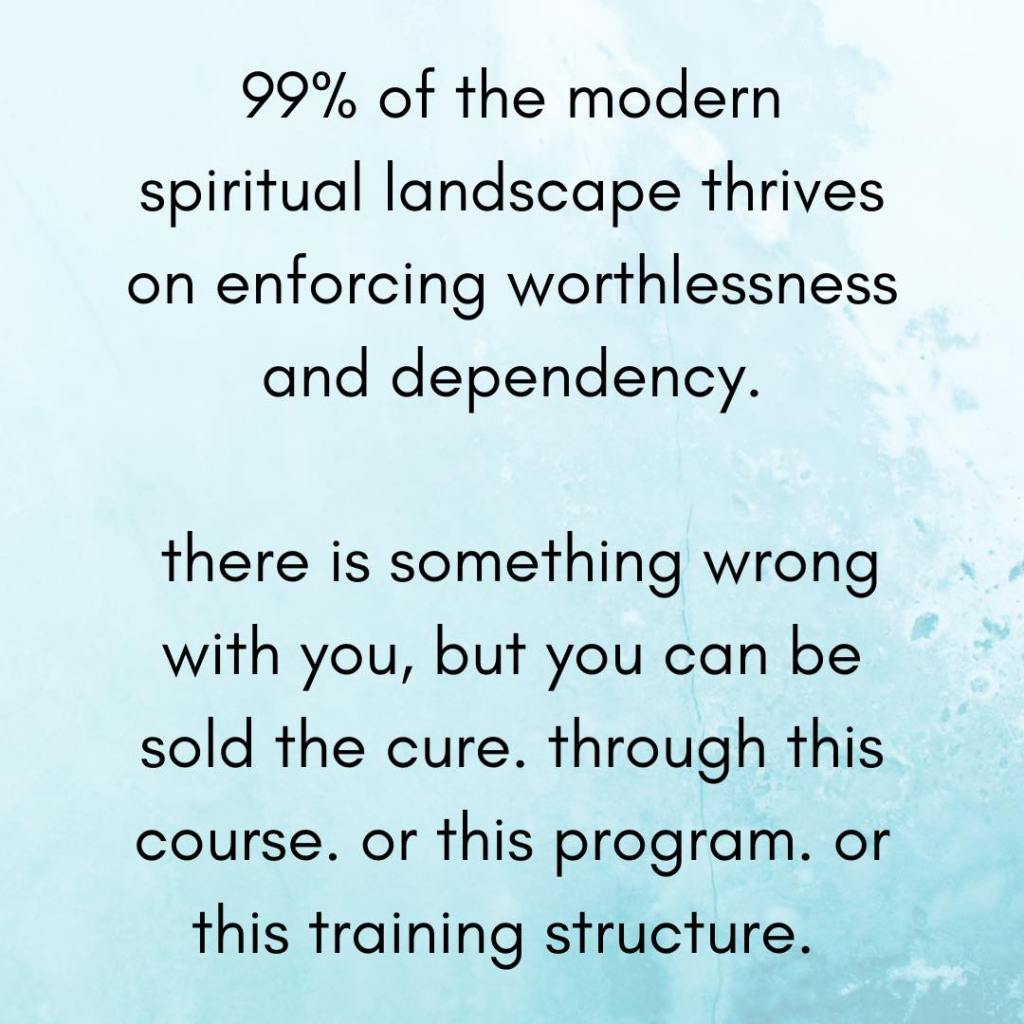
99% of the modern spiritual landscape thrives on enforcing worthlessness and dependency. there is something wrong with you, but you can be sold the cure. through this course. or this program. or this training structure.
this paradigm is packaged masterfully in esotericism and sanskrit terminology, with beacons of validatory hope offered that keep you hooked in a dopamine loop of hope: God loves you; you are God — which will mean nothing to you as long as your intrinsic experience of yourself continues to be one of absolute worthlessness.
once you are stuck in worthlessness while having access to no real tools to actually break through it, the reassuring promises of divine love or wholeness will act only as reinforcers of the one constant underlining message, which will continue to be, you are not worthy.
and because you are so excruciatingly insecure, you will believe it, and strive to become worthy. you will be cruel to yourself. you will give away your autonomy. you will beat yourself up for feeling anger or misalignment. for not being “surrendered”. for making what you fear are mistakes. you will compare yourself to others, you will become dependent on others. you will mistrust yourself. you will repress yourself.
you will think that the experience is anywhere but here, in you.
Sweet, energetic, and entertaining, Greta Gerwig’s Barbie is a delightfully camp blockbuster that I thoroughly enjoyed. The cinematography is excellent, the colour palette is perfect, and the actors are a treat. However, I did find its feminist thesis to be lacking. Although I acknowledge that the film is in itself a comedy which does not aim to solve social justice and functions primarily as entertainment, it still does construct a social, feminist commentary, which is why I found it fitting to utilise as a stimulus for analysing the deficiencies of pop-feminism culturally, as well as within myself.
Barbie offers its female characters the space and opportunity to muse on their condition and on the pains of being a woman, such as the contradictions of having to be extraordinary (attractive, successful, loving, kind, assertive) and yet contained, the ideal being achieving or conforming to a personal excellence that concomitantly is appeasing, controllable and tameable; yet never too much — not too powerful, nor too intimidating or destabilising. A message of: Shine, but do not shine too much.
In my personal journey, I have recently been reflecting on my self-punishing tendencies and on my self-images of having to always be kind, never angered or envious, and, while watching Barbie, I was moved listening to the monologues of the female characters, and saw more clearly how much of my own ruptures in my identity are the legacy of having been conditioned and socialised as female growing up.
“I’m just so tired of watching myself and every single other woman tie ourselves into knots so that people will like us.” America Ferrera as Gloria in Barbie.
Indeed, I have found that men are less likely to have intense hang-ups around emotions such as anger, as it is viewed as more acceptable for them to express it. However, this binary contracts all gendered expressions, as male conditioning stereotypically also rejects its own emotional range of vulnerability and openness.
The human condition is such that we all are continuously split and stretched within between who we think we should be and who we truly are. We perpetually hide, repress, contort, and harm ourselves to mould into ideals and images which we innocently construct by absorbing various messages from society, culture, history. The Barbies are given the chance to see through the mirage of constriction, the Kens are not (which, in part, saddened me), however, neither fully glimpse through into the ultimate bondage: that of the gendered self.
To successfully break through the suffering caused by female conditioning, a deconstruction of the very concept of femaleness as a rigid reality must ultimately occur — along with a deep dive into gender as a construct, both which are unfortunately glossed over in Barbie, and, on a greater scale, in pop-feminism. In my understanding, complete liberation cannot be achieved while still operating in the gender binary, which is to be dismantled within in order to open to freedom from all self-images, internal conflicts and constrictions.
Barbie both delighted me with its vibrancy, playfulness and beauty, and also reminded me that, as a woman myself, I must push through myself more for my liberation.
My arguments are based on the work of feminist philosophers such as Simone de Beauvoir (see: The Second Sex), as well as on the precepts of non-dual ‘Eastern’ philosophy.
God is not the socio-moral norms of religion. the socio-moral norms of religion are historical remnants of a time in which religion ruled society and culture and were means to both regulate and ensure harmony (eg. don’t harm another precept) or control and subjugate in the instances in which abuses of power occurred.
you won’t find God by adhering to archaic socio-moral norms belonging to scriptures from centuries ago. it might seem as an evident statement, but i have recently been struck by how insidious dichotomies of morality run inside of me, despite the fact that i adhere to a non-dual view (tldr on non-duality: the belief in one absolute, genderless, formless consciousness that pervades and is all that is).
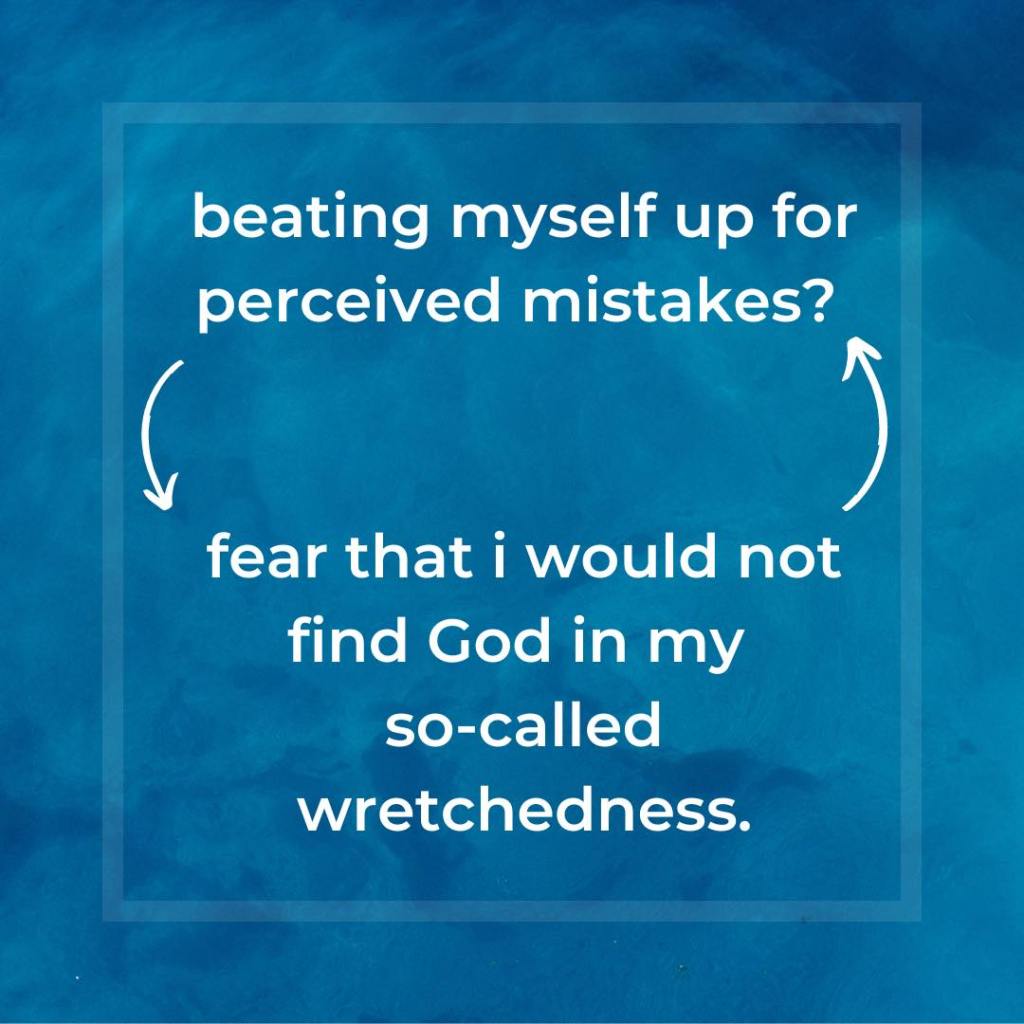
having seen how deeply remnants of morality are sown into me, i have been reflecting on: where has my obsessive streak of wanting to be a good person come from? from a subconscious understanding that it is in that morality that i will find God. what is my tendency to beat myself up rooted in whenever i do something which i perceive to be a mistake? in a fear that i would not find God in my so-called wretchedness. where does shame come from, with an emphasis on the shame that continues to shroud my connection to my sexuality? from internalising shame around sexuality as a ‘sin’, a wanton nail in the coffin that would ensure my perpetual disconnection to God.
God is beyond virtue and sin.
the other day, i told myself: damn it, use your intellect. no matter the fairytale story conjured about a higher power, how could that higher power ever punish, reject or be angered with me, or with anyone for the matter?
i was engaged in particularly unvirtuous-ly considered behaviour recently when it hit me, i feel so loved and accepted by God right now, and i am – inherently. and i don’t have to do anything else rather than be myself to be loved or accepted. note: it might seem contradictory to assign the wilfulness of love & acceptance to the non-dual understanding of consciousness, but it’s one of those contradictions that somehow just ‘is’ and i feel like can’t be explained. the love is there. 💙







 enjoy the introduction to the ‘myth of self-esteem’ by Dr. Albert Ellis.
 you can watch and listen to me speak about it on TikTok
  going in more depth into my journey as well as into the techniques (such as REBT) that i use to understand myself and my brain better, as well as to live harmoniously both with myself and with others.
 here’s to understanding ourselves!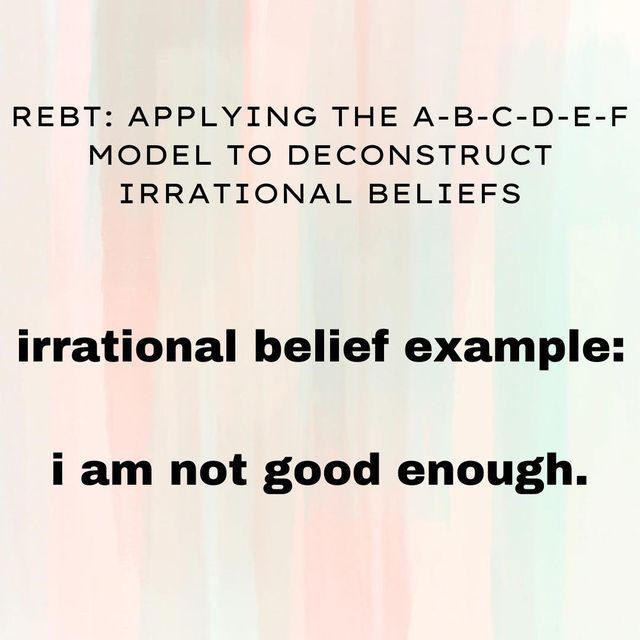








 amaryllis