amaryllis (/ˌæməˈrɪlɪs/[1]) – bears the name of the shepherdess in virgil's pastoral eclogues. it stems from the greek ἀμαρύσσω (amarysso), meaning "to sparkle", and it is rooted in "amarella" for the bitterness of the bulb. the common name, "naked lady", comes from the plant's pattern of flowering that blooms when the foliage dies. in the victorian language of flowers, it means "radiant beauty".
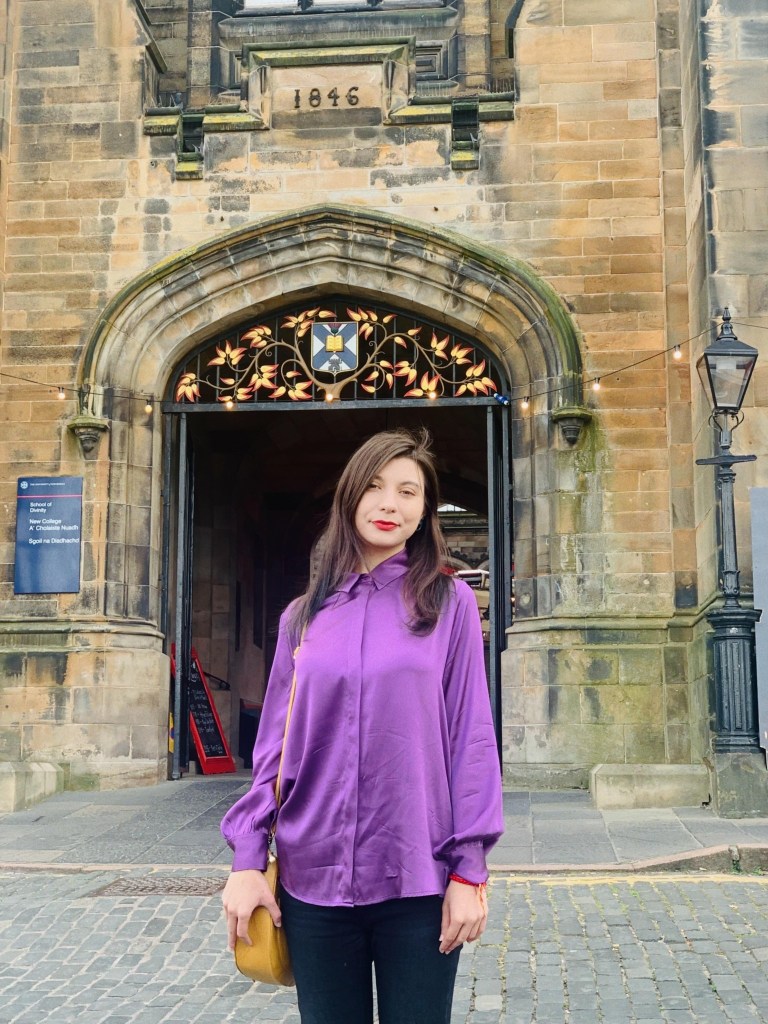
I am incredibly honoured and moved to share that I am being awarded the Edinburgh Doctoral College scholarship of the School of Divinity and will be commencing my Ph.D. at Edinburgh University in September with full funding for my research, and with a thesis entitled (as of now!) “The Goddess’s Descent to Earth: In Dialogue with the Reimaginations of the Mahābhārata’s Draupadī”. I am extremely grateful to Professors Mark Harris, Alison Jack and to the board of the School of Divinity for believing in my work. There were times when I was close to not believing in it myself, but the love for the work has pulled me to keep moving forward even in the greatest moments of doubt. More exactly, the love has grown to be greater – and, to be honest, more interesting – than my doubt or uncertainties about myself, which are less exciting to follow than the mysteries that are to be uncovered.
Once, a teacher of mine shared that, if you quiet the mind and listen to your depths, you will be able to feel a thread, a glimmer – pulling you to where and how life wants to move through you. Where that is, as well as getting there, could seem unattainable by way of reason or logic, but the thread will pull you through in ways unimaginable to your perception, with its current limitations and insecurities. This has been my experience, as well.
Follow the thread. Let the love for your work guide you and pave your path.
recommendations for abridged and unabridged translations of the Mahābhārata, as well as reading and referencing tips 🤍.
to reiterate the last point i made in my video first, i would like to accentuate that those of us who rely on translations and are inhibited by the language barrier are already working with a diluted version of the Mbh; it is for this reason that it is exceptionally important to work with the best and most authentic translation that is accessible for us, especially if we are scholars. in this, we can ensure that we are not perpetuating any misunderstanding or false information in the world. 🤍
🔱 unabridged translations:
🔱 for the first five parvas – J. A. B. van Buitenen | for the remaining books of war – Clay Sanskrit Library | these are exquisite, elegant, all-encompassing, and delicious works of translation.
additionally, i use the abridged translation created by John D. Smith and published by Penguin Classics as a handbook or manual to find my way through the unabridged versions when i write papers. this is extremely efficient for referencing – a compass or map to guide you through the verses. i expand on this in the video, and will additionally create a separate video about how to reference the Mbh.
🔱 the recommendations i have shared have been given to me by my amazing MA supervisor from Lancaster University, Dr. Brian Black, who instilled within me the love for the Mahābhārata in academia, and supported me through my research and my PhD application process. in my opinion, he is one of the most dedicated and passionate contemporary researchers of the Mbh, and i am most grateful to him. his book, ‘In Dialogue with the Mahābhārata’, is a fantastic work of research. read more here: https://www.routledge.com/In…/Black/p/book/9780367547271
🔱 TIPS: for those unfamiliar with this epic, i would recommend they begin with an abridged retelling. note: a retelling, and not a translation (John D. Smith’s abridged work would be considered a translation as it follows the epic poem verse by verse). retellings are easier to digest! the Mbh is vast and can be overwhelming, so use the retellings to
familiarise yourself with the characters and with their narrative arcs, and, when you feel familiar enough with the Mbh’s universe, move onto the unabridged versions.
please be aware that, due to the nature of reproducing an epic poem in prose, most retellings include errors, omissions or interpolations. hold these lightly while you read through and also hold in your awareness that the author might have taken many liberties. use the unabridged versions to correct and reorientate yourself within the universe. this is how i started my own journey with it 😊
demonstrating how to reference the Mbh
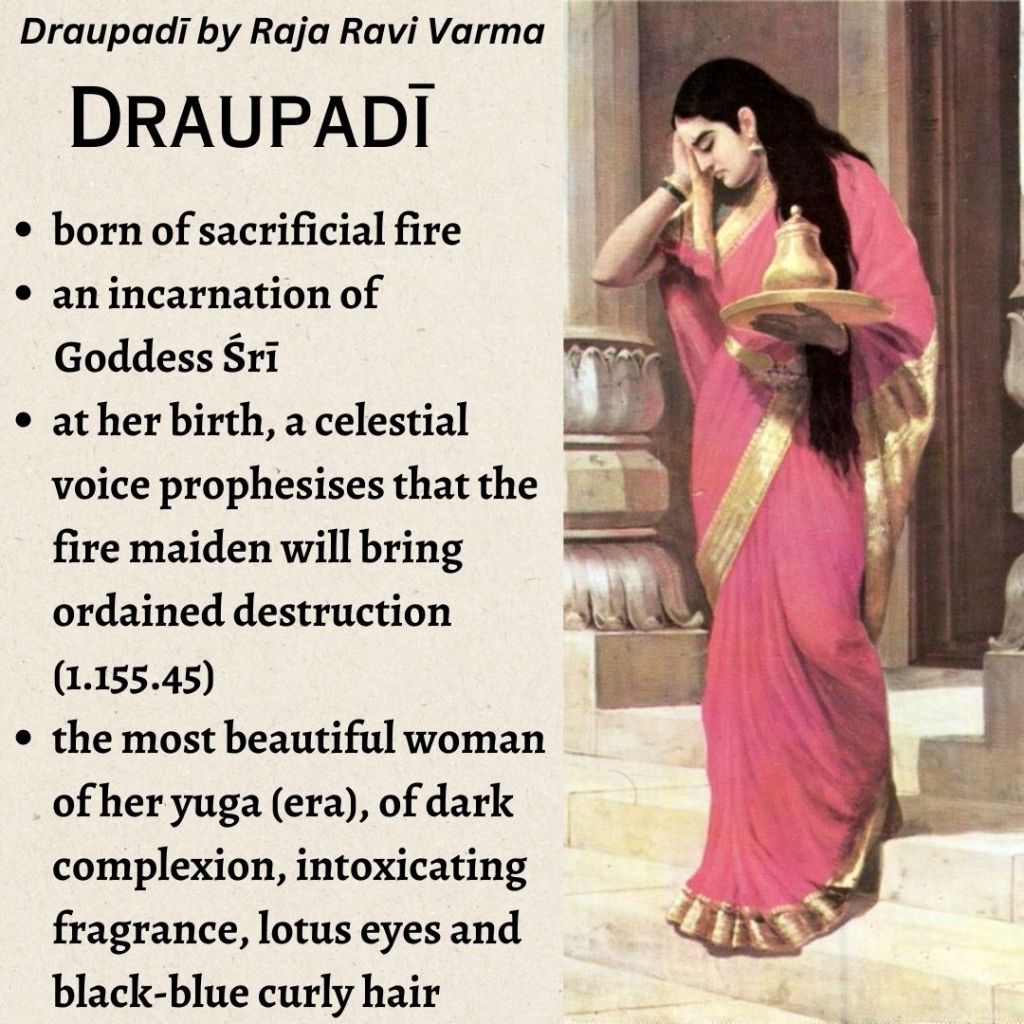
a thorough Mahābhārata reference consists of three parts: the number of the parva in which the event in question takes place in, the number of its corresponding verse, and the number of the secondary verse. in have created a video in which i am demonstrating how to most efficiently reference the Mbh by utilising the abridged and unabridged translations with the example of Draupadī’s birth from fire (1.155.45).
note the difference in detailed expansion between the two versions, and the importance of continuously referring to the unabridged translations:
abridged: “A beautiful, dark girl emerged from the altar, and the voice proclaimed that she was destined to accomplish the purpose of the Gods by annihilating the Kṣatriyas. [She was] named Kṛṣṇā (Draupadī).”
*Kṛṣṇā means She of Dark Complexion.
unabridged: “Thereupon a young maiden arose from the center of the altar, the well-favored and beautiful Daughter of the Pañcālas, heart-fetching, with a waist shaped like an altar. She was dark, with eyes like lotus petals, her hair glossy black and curling – a lovely Goddess who had chosen a human form. The fragrance of blue lotuses waited from her to the distance of a league, the shape she bore was magnificent, and no one was her peer on earth. And over the full-hipped maiden as soon as she was born the disembodied voice spoke: ‘Superb among women, the Dark Woman shall lead the Kṣatriyas to their doom. The fair-waisted maiden shall in time accomplish the purpose of the Gods, and because of her, great danger shall arise for the Kṣatriyas.’ Hearing this, all the Pañcālas roared like a pride of lions and earth was unable to hold them so full of joy”.
this might seem as an over-scholarly topic, but much of the written material you are going to encounter on the Mbh will include this, and i find it relevant to have a framework for it. 🤍
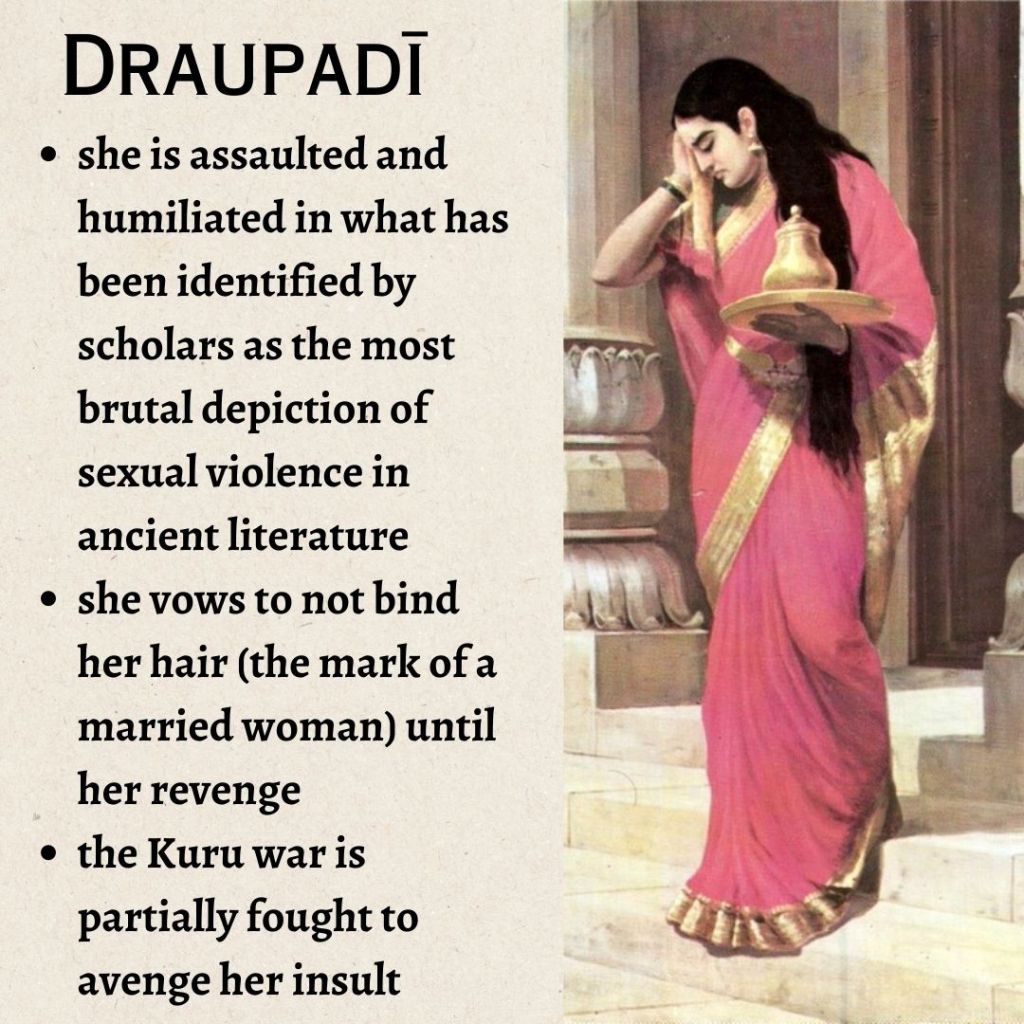
The Mahābhārata is a love of my life, and one of my main research interests – as well as the subject matter of my upcoming PhD thesis! for awhile now, i have been reflecting on how to meaningfully share about the Mbh on my social media platforms. generally, i would say that there are two main approaches to the Mbh in contemporary discourse: one is the academic and scholarly approach, which, although i both adore and adhere to, i find to be largely inaccessible and limited to the academic niche. the second, which seeps more into contemporary discourse, i find to be a moralistic, religious outlook. although i consider both approaches to be valid and needed in society, i believe that what is missing is more intimate, personal sharing about the Mbh. i, for one, am not in love with the Mbh purely out of intellectual curiosity. for me, The Mahābhārata is alive; it exists within me and within the collective consciousness as a mirror to our own thought processes and individual universes. i would therefore like to challenge myself past my usual scholarly approach and share earnestly about what it means for me to immerse myself in this marvellous epic. for instance, what does it mean for me as a modern woman to read about Draupadī’s disrobing; how can i understand myself better through her character?
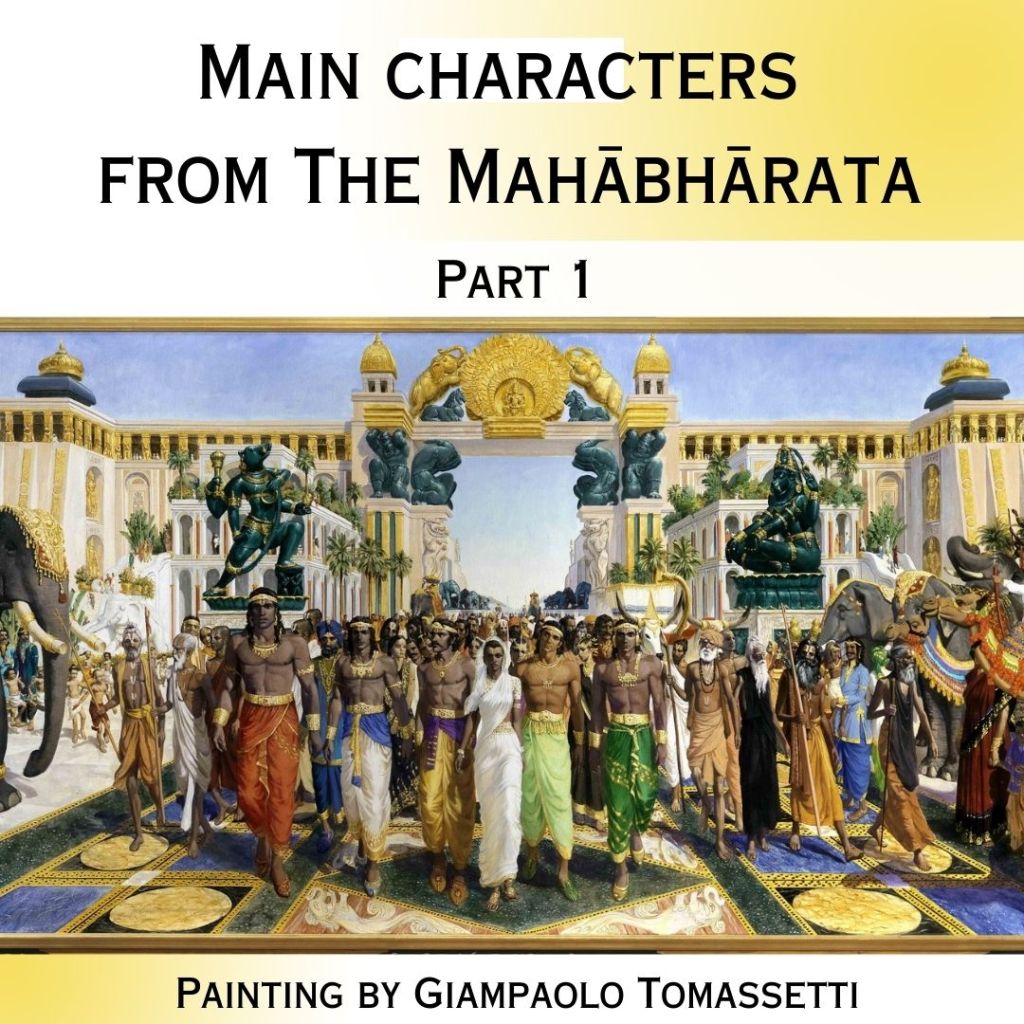
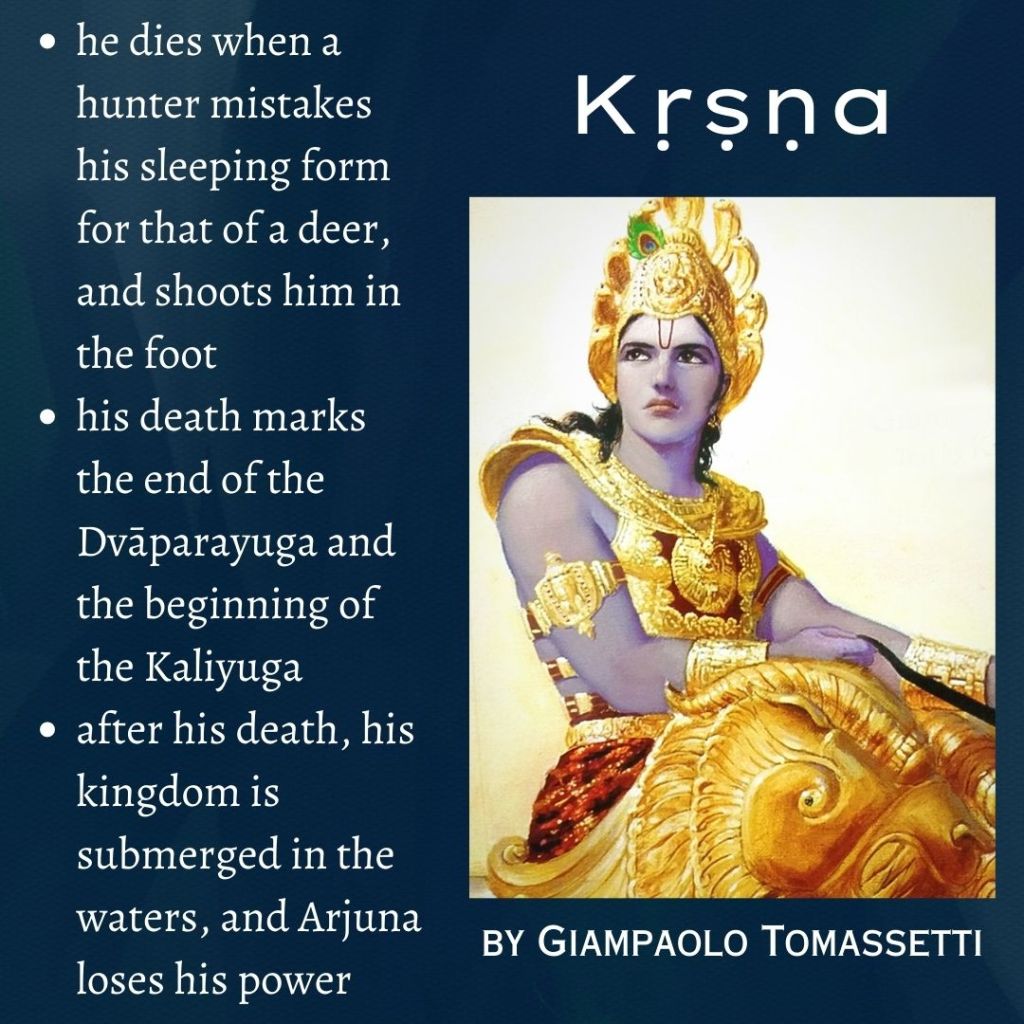
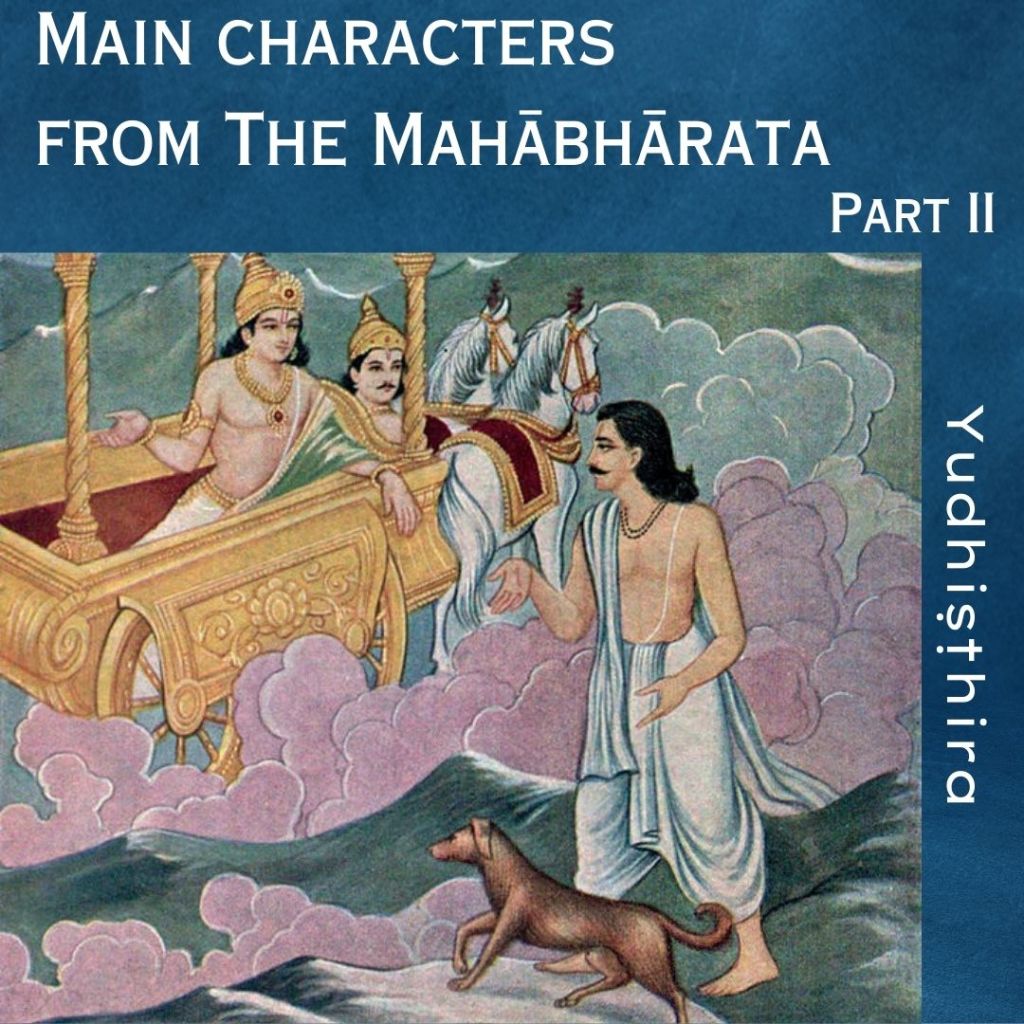
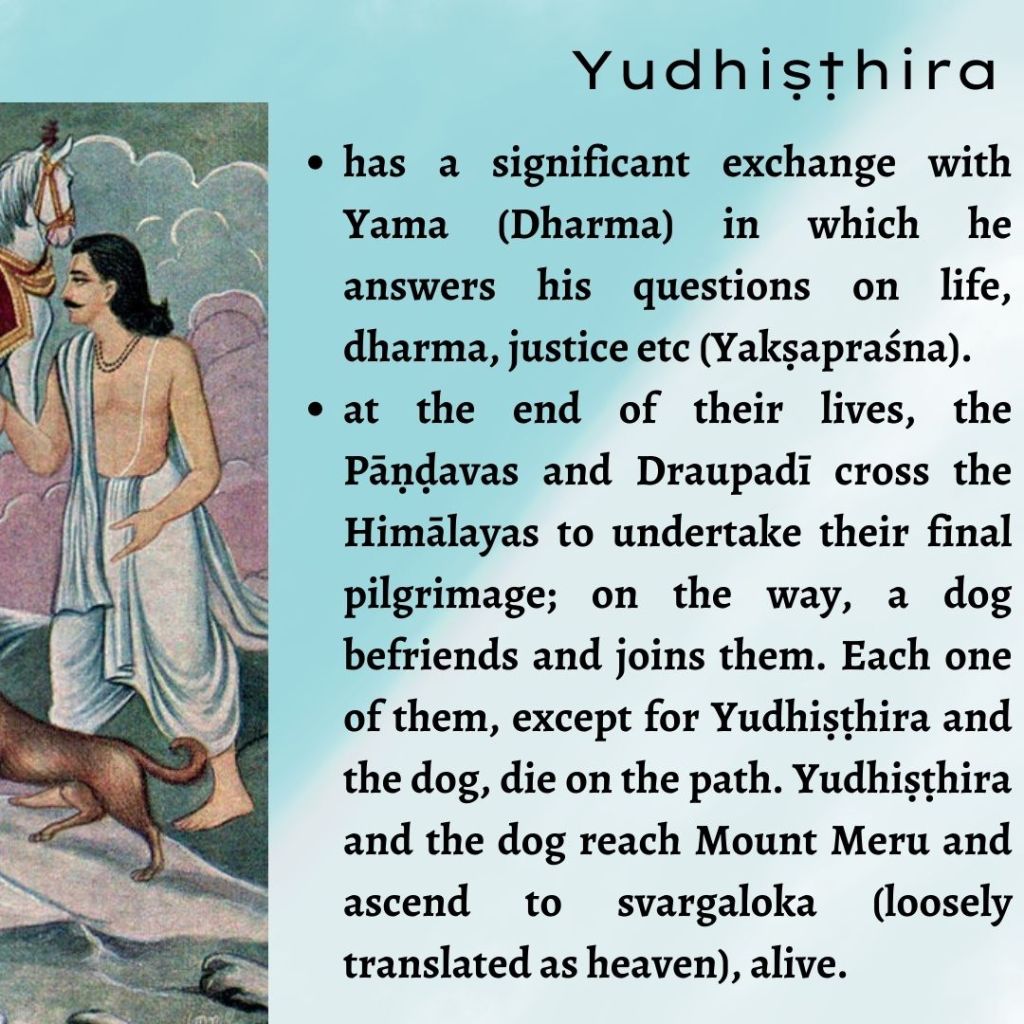
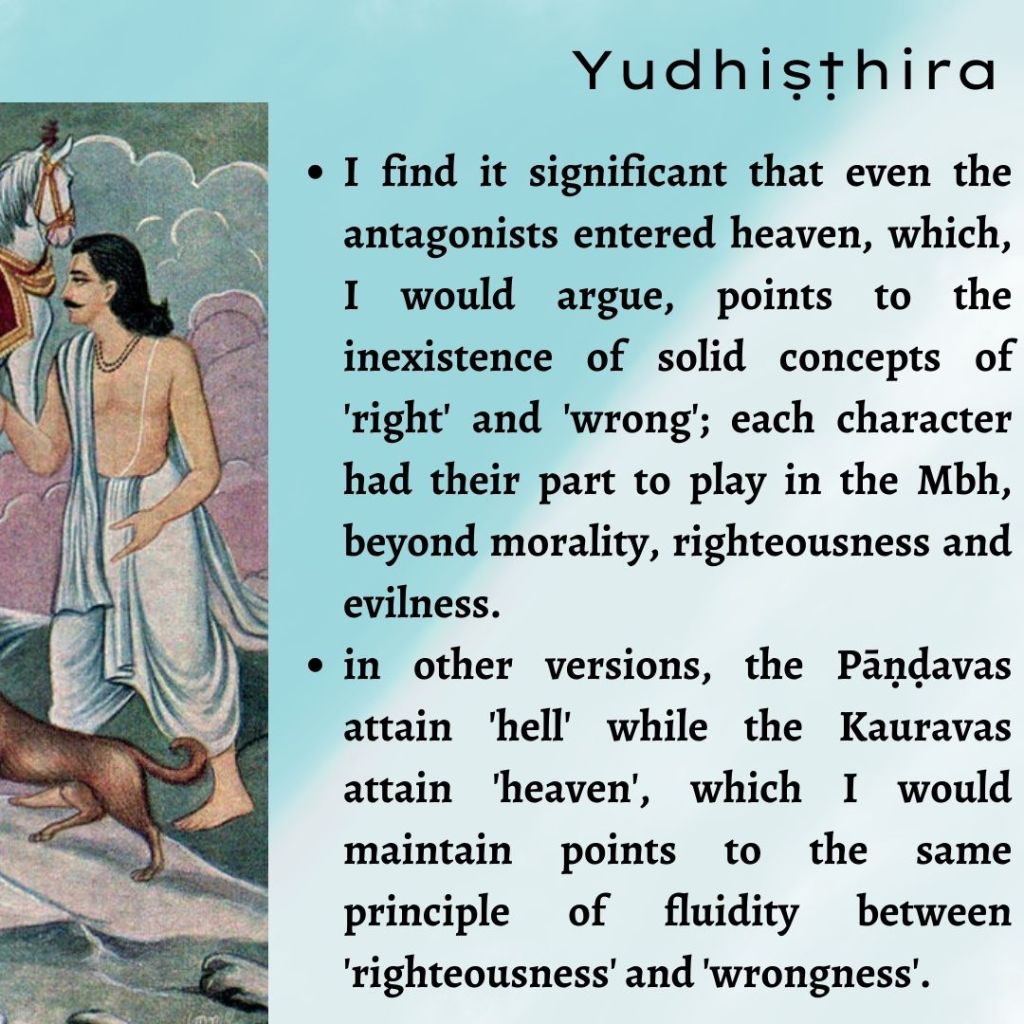
to ground these discussions more, i will create infographics about the plot, the historical context & main characters (created more out of love for the Mbh than for these discussions, to be honest!).
very excited for this and am looking forward to establishing myself further in the epic’s framework through this interactive approach!
to begin with,
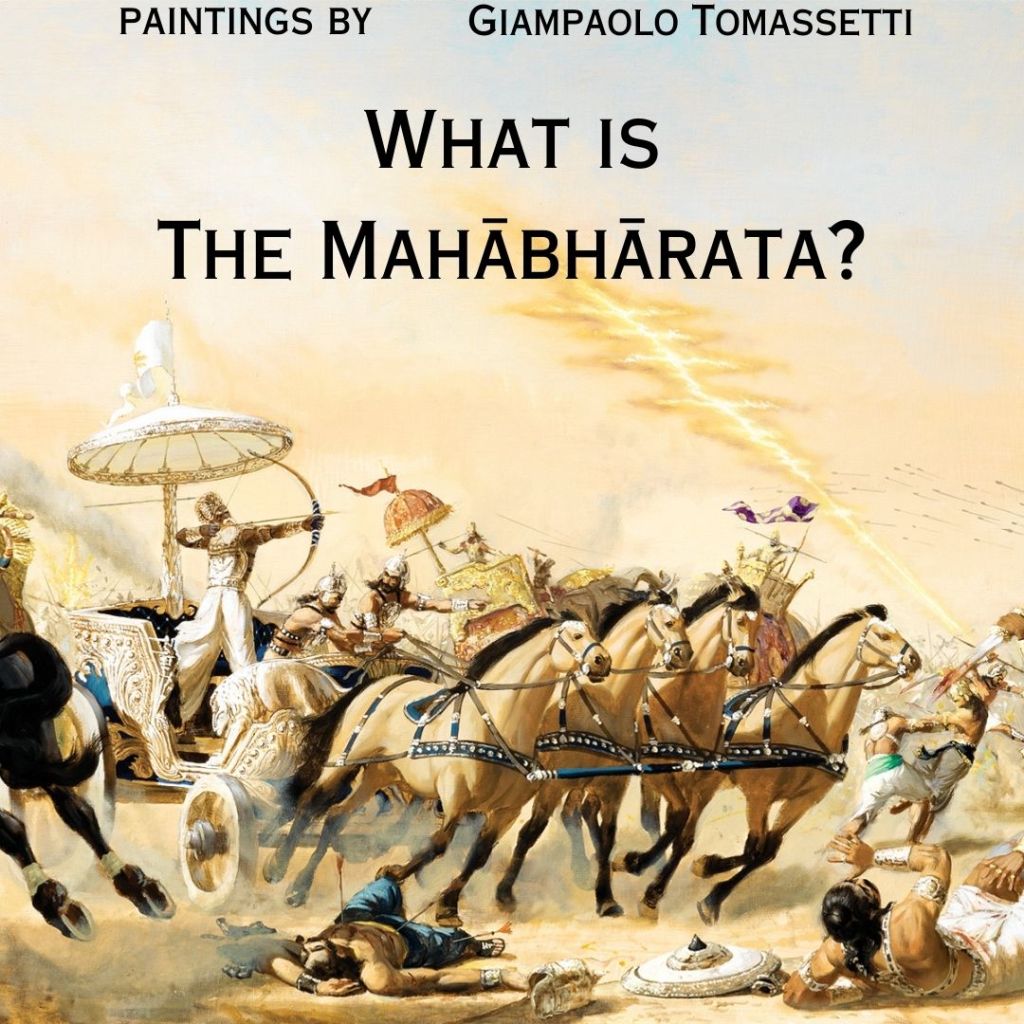
WHY THE MAHĀBHĀRATA?
a question any scholar should ask themselves, i would argue, is why? why is my research relevant, why should i conduct this research in the first place, and how can it answer to questions of the present?
today, i am going to answer to this question with regards to the Mahābhārata. why should we care about an ancient epic poem? first of all, because the Mbh is not a dead, lifeless piece of literature. i would argue, and this is one of the main claims i will construct in my phd thesis, that the Mbh is ever-fluid and ever-changing. throughout centuries, there have been countless of retellings of the epic, each bearing differences, interpolations. does this mean that they are invalid? i would maintain that they are very much valid, and the continuous changes shaping and re-shaping the epic come as a result of its aliveness: it is alive, pulsing in the collective consciousness. in this full aliveness, the Mbh is moulded by society and culture as they evolve, acting as a mirror.
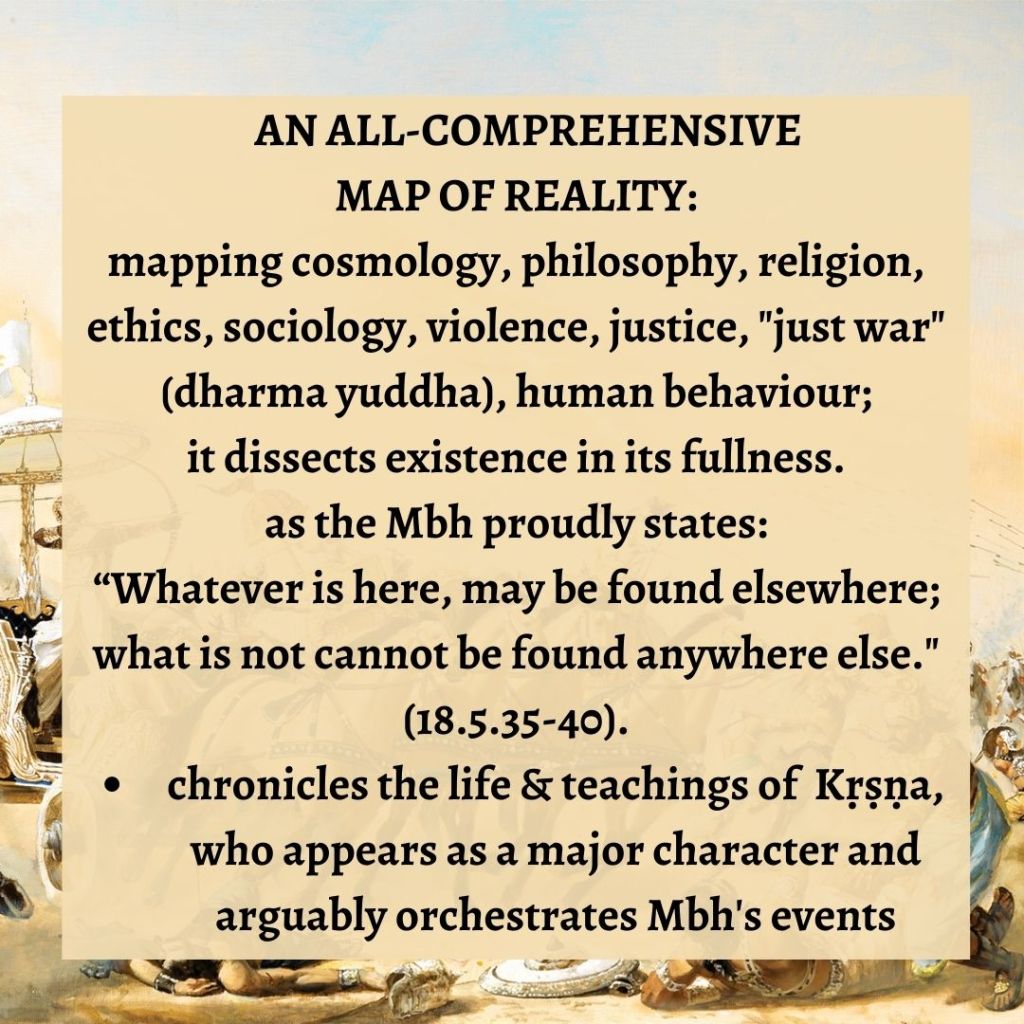
on the other hand, the Mahābhārata in itself proudly states that what you can find in it, you can find anywhere else, but you cannot find anywhere what does not exist in the Mbh; there is nothing that it does not address. in this, it tells us that it contains all answers and questions we can have – albeit in a very abstract and cryptic manner. for instance, it contains futuristic themes (for its time of creation), such as IVF and AI, and it addresses themes which are very relevant to the present day: religious violence, women’s rights, ethics. it answers to all questions we can have about the human condition; as although times are ever-changing, the human experience always remains the same, or so i would maintain: the questions we ask ourselves at their core remain the same, although the experience will be manifested or expressed differently at surface level. the Mbh thus contains inexhaustive areas of self-exploration and opportunities to understand ourselves and the world.
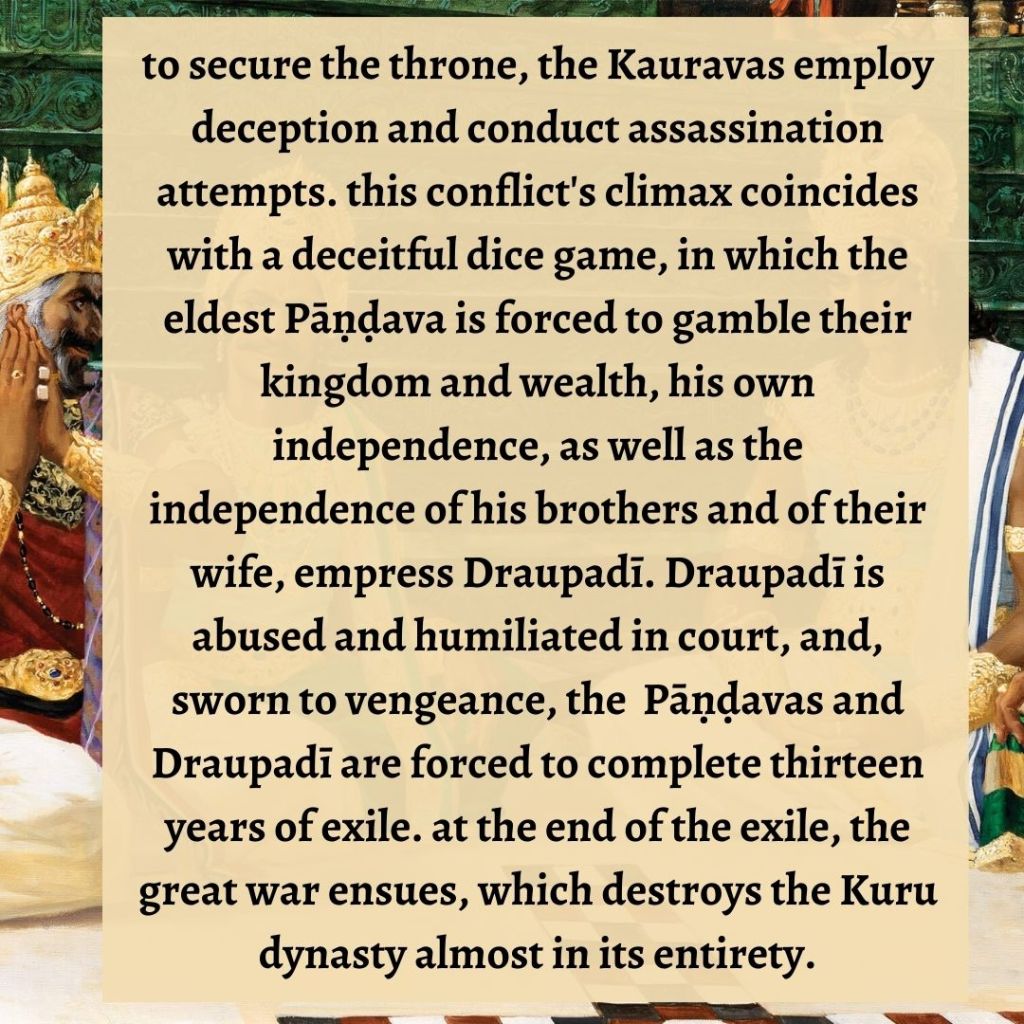
101 on the Mbh – infographics below! (parts 1, 2, 3… of many!)
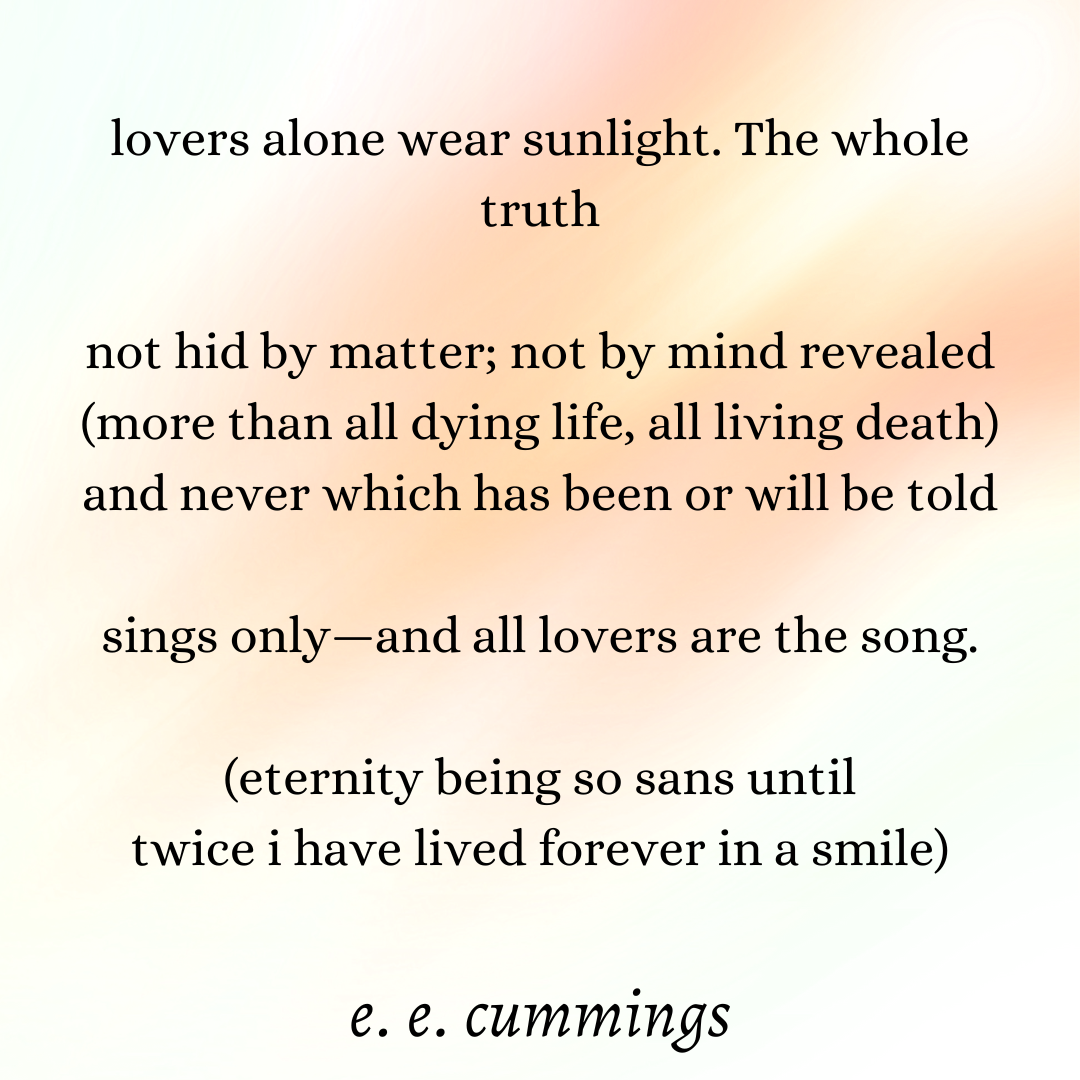
in my undergraduate degree, i studied western poetry, and one of the poets i focused on was the beguiling e. e. cummings. in the past two years, i have been exclusively exploring eastern poetry in my postgrad, and it is only recently that i have begun to see how the two apparent different worlds and approaches illuminate each other. one of the elements i am most interested in at the moment is the process of individualising the universal experience; or how to express the universal through means of individuality.
this, with relation to cummings and bhakti poetry: cummings, a pioneer of experimental poetry, created his own language, which functions, i would maintain, like an authorship stamp: he used conjunctions as nouns, rewrote linguistic rules, introduced spacing as verbs etc. his poetry addresses themes looked down upon by other avantgarde poets of his time (and our time!) such as love and nature, yet it is the creation of his own language and the erotic notes of his poetry that revolutionise and freshen the apparent cliché of his subject matter.
similarly, bhakti poets, who write about ‘common’ topics such as love and separation, revolutionise these universal themes by pinpointing the object of desire to be God, and by introducing eroticism as worship. and, their authorship stamps (example: Akkā Mahādevī’s Chennamallikarjuna – more on this later!) distinguish and establish their poetic voices as individual in the context of universality.
fascinating how the experience can be both universal yet unique as it expresses itself individually through us, and how marvellous the intricacies of language and poetry are, how beautifully they thread us together through traditions, genres, times and worlds! 🤍
sidenote, i did use the word ‘cliché’ as a convention, but i don’t believe in clichés exactly because of this reason.
part of my #poetrybeautyseries, in which i share my favourite poetry lines and muse on their significance! on pessoa:
to me, fernando pessoa is one of the most fascinating poets to have graced this earth. he created 81 heteronyms for himself – meaning, 81 different characters or identities he assumed while writing. each had a different personality, background story, style. in awe with the mind-blowing imagination of this beautiful man. here’s a fragment from ‘discontinuous poems’, which he wrote as alberto caeiro, and which is grounded in a non-dual view, in my opinion. planning to make a video about him soon 🖤
on ginsberg:
although this quote is well-known, its context isn’t! it’s an excerpt from an interview with Ginsberg from Writers Digest, edited by Bill Strickland (p.47), in which he talks about the importance of expressing yourself without caring for validation or recognition.
“It’s more important to concentrate on what you want to say to yourself and your friends. Follow your inner moonlight; don’t hide the madness. Take (William Carlos) Williams: until he was 50 or 60, he was a local nut from Paterson, New Jersey, as far as the literary world was concerned. He went half a century without real recognition except among his friends and peers.
You say what you want to say when you don’t care who’s listening. If you’re grasping to get your own voice, you’re making a strained attempt to talk, so it’s a matter of just listening to yourself as you sound when you’re talking about something that’s intensely important to you.”
very excited to share the first academic paper of mine that is published in complete form in a peer-reviewed journal! it is entitled ‘The Western Revival of Goddess Worship’ and it has been published in Feminist Theology, volume 31(2).
‘[Western] Women are resisting secularism and are connecting with the transcendental on their own terms, while seeking self-understanding and self-realisation in a gynocentric cosmology. From deifying female sexuality to revering the cosmos as the womb of an all-pervading Mother Goddess, the Goddess Movement encapsulates women’s defiant quest for wholeness.’
i wrote this article two years ago (which is the approximate duration of academic publishing, haha!) during my first MA at Lancaster University, under the supervision of the fantastic Dr. Brian Black, whom i am most grateful to. this paper encapsulates my views at that time, and although my perspectives have become more refined since – both as a scholar and as a practitioner – i remain pleased with this work and i am hopeful that it contributes to the illumination of the phenomenon of religious revival in scholarship. 🙏
i have officially completed my first year of the Warwick Writing Programme ✅! 🥰! it has been absolutely delightful. 🤍🙏 my gratitude to my professors for guiding me on working on my first collection of bhakti poetry, in researching devotional literature & in translating from sanskrit, as well as from my mother-tongue. 🤍
it was so much fun to venture into freelance writing & to work with my colleagues on different projects – a highlight of this year has been a collaborative audio-translation of my beloved Draupadī’s imposing speech from the Mahābhārata created with Sumithreyi Sivapalan! it is always a joy to work on anything Mbh-related, but it truly is an honour to collaborate with someone equally enamoured with itihāsa! 🙏
indeed, what i adore about academia is the opportunity to meet and connect with people with similar (or identic!) research interests! it truly is so enriching to discuss your research with someone as equally passionate about it as as you, and these discussions unmistakably propel each of you towards greater growth and understanding. in my case, it has been one of the greatest gifts to meet someone as madly infatuated with the Mahābhārata as me!
it wasn’t until meeting my colleague Sumithreyi that i realised how much i had longed to dissect the Mbh with a fellow lover of this magnificent epic, and I can wholeheartedly say that the insights we shared together refined my understanding of the intricacies of its narrative – a narrative so grand that it undoubtedly humbles anyone who dares to venture in it. thank you, dear sakhī! here’s to continuously learning and to emptying our cup of the arrogance of knowing.
pics: all smiles after 7 hours of editing work for the Warwick Anthology 2022!
happy to share my academic article, “Jungian Reflections on Mainstream Cinema”.
“Jungian Reflections on Mainstream Cinema” was written during my undergraduate degree, and i expanded on its conclusions in my undergraduate dissertation. my research interests have shifted since then, and, as i dive deeper into other topics in academia, i want to briefly share some of my past findings – how perfect the form of an academic letter is for that! thank you to AL for gifting me the opportunity to publish open-access and, graciously, free of cost, my swift farewell to Jung, psychoanalysis & to the mystical gaze of cinema.grateful to all i’ve learned about myself while immersed in Jung, grateful for the bridge this individuation journey of mine represented – a transition to my postgraduate studies in philosophy & religion. very much looking forward to sharing complete papers centred on religion & philosophy in the future – if i’m ever done with obsessively editing them, that is!
end-note: have loved conversing with other Jung enthusiasts since this came out. i thought – oh! so this is the magic of presenting & sharing ideas with those who have similar interests as you do!
ACADEMIA Letters Jungian Reflections on Mainstream Cinema Téa Nicolae, Lancaster University
Fantastical worlds have been enchanting humans for centuries. From fairy-tales and legends to science-fiction blockbusters, we have been drawn to bewitching stories of heroes, magic and supranatural creatures since the dawn of creation. (Zipes, 2006) Although this subtle desire to encounter mysticism in art has been labelled as ‘escapism’ (Addis and Holbrook, 2010; p.823), I propose that the phantasmal imagery of mainstream cinema offers valuable insights into the human psyche.
I am building my assumption on the work of psychoanalyst Carl Jung (1875-1961), who believed that fantastical images of mythology and religion are allegories, cohesively constructed to supply ideas about the psyche. According to Jung, mythology and religion resemble psychology by perfectly creating ‘archetypes’ packed with meaning, which allow humans to dwell upon images of rebirth, transformation and self-realisation. (Jung, 1998)
The psychoanalyst was unconvinced that our ancestors went to great lengths to interpret the happenings of the natural world through religious iconography because they lacked scientific explanations. Instead, he considered that mystical imagery does not serve as a rationalisation of the physical world, but of the inner one. Thus, such images use the external, chimerical universe to decipher the complex layers of the mind. (Jung, 1998) Therefore, in Jungian thought, images that cross religious and modern myths reveal the nature of the Self, which represents one’s authentic identity. The Self emerges when consciousness and unconsciousness are united; Jung considered this union to be the nucleus of all psychological and spiritual inquiries, as he associated this psychological aspiration with the spiritual yearning for the Divine and believed that the ‘God’ referred to in religion is the Self. To allow the Self to arise, one undergoes psychic processes such as ‘individuation’ and integration, which are reflected in religious iconography within prototypal storylines and quintessential imagery. Hence, Jungians believe that humans have been telling similar stories for centuries: stories that are imbued in our collective unconscious because they are meaningful, soulful, because they guide us to understand our humanity. (Jung, 1998)
Jung considered that new myths are continuously created in lieu of ancient ones. (Jung, 2002) The concept of modern myths greatly interests me. As cinema has undoubtedly become one of the most accessible and popular artforms, I am inclined to believe that it is a medium where modern myths are crafted.
Accordingly, as technology allows our unconscious to rapidly absorb images and ideas without properly processing them, Jungian scholars consider that cinema ‘offers both a means and a space to witness the psyche in projection’, thus proving to be an ‘antidote to the modern assault on the unconscious’. (Hauke and Alister, 2001; p.2) I would thereby maintain that, while watching aspects of their humanity and layers of the world unravel on screen, spectators are guided to understand themselves and to find meaning in cinematic tales.
Indeed, numerous mainstream films encode traditionally religious beliefs that interlace with the Jungian worldview. For example, Star Wars: A New Hope (George Lucas, 1977) is heavily influenced by Hindu thought and is rich with archetypes, whereas George Lucas himself based his work on Jungian conceptions. The Lord of The Rings (Peter Jackson, 2001-2003) embodies Catholic consciousness and constructs a distinct individuation process. Both Interstellar (Christopher Nolan, 2014) and Inception (Christopher Nolan, 2010) include influences from Eastern schools of thoughts and address the concept of the collective unconscious, while Avatar (James Cameron, 2009) mirrors Hindu convictions and illustrates unity of consciousness. These works have been enthusiastically received by audiences and critics alike.
I suggest that the popularity of these cinematic pieces arises from a collective subconscious yearning for modern myths and self-reflection. The archaic nature of images that appear in the enumerated films allows cinema, even in its mainstream form, to engage the psyche, and to guide spectators to find purposefulness in life and in themselves. A Jungian analysis of mainstream cinema would thus unveil commercial films as psychic expressions of the unconscious that transcend individuality and collectively touch upon the complexities of our humanness, thus resembling religious myths.
I would therefore reject the dismissal of commercial films as ‘escapist’, embracing scholar Christopher Hauke’s articulation that ‘their very popularity (…) demonstrates a resonance with unconscious needs in the collective psyche to which the cinema frequently responds.’ (Hauke, 2001; p.9) Additionally, I would sustain that ancestral symbols present in film have the capacity to perform healing functions and to ‘indicate a psychic reality to which each person potentially has access’, which ‘transcends bounds of personal history’. (Frederickson, 2001: p.29) In a fast-moving society which allows little space for introspection, cinema makes complex psychological inquiries approachable and attainable: ‘when an intensity of experience is mixed with the less intense, psychological and emotional replenishment and growth may be made bearable and possible’. (Hauke and Alister, 2001; p.2)
In conclusion, I propose that cinema is becoming a religion of our own: it is a medium where stories of self-understanding and self-realisation are crafted, where our shared humanity reverberates in archaic images that are pregnant with meaning. Films, our modern myths, invite us to embark on inner, earnest journeys which lead to the Self: the nucleus of humanness.
‘I believe there’s spirituality in films, even if it’s not one which can supplant faith… It’s as if movies answer an ancient quest for common unconscious.’
Martin Scorsese (Scorsese and Wilson, 1995)
Corresponding Author: Téa Nicolae Citation: Nicolae, T. (2021). Jungian Reflections on Mainstream Cinema. Academia Letters, Article 3814. https://doi.org/10.20935/AL3814.
you can read the bibliography and the filmography of this article visiting the link pasted above.
this week is one of beginnings for me, and i am delighted that it coincides with the auspicious time of Navarātri… overjoyed to share that i am joining the Warwick Writing Programme to complete my second master’s degree in poetry & literary translation, as well as commencing my study of Sanskrit at the Oxford Centre of Hindu Studies and, this week i’m beginning my new job as a transcriber-translator! in typical fashion, i will turn this around to the Mahābhārata, and hope that this paves the way to translating some of its most beautiful ślokas… sometime in the far future
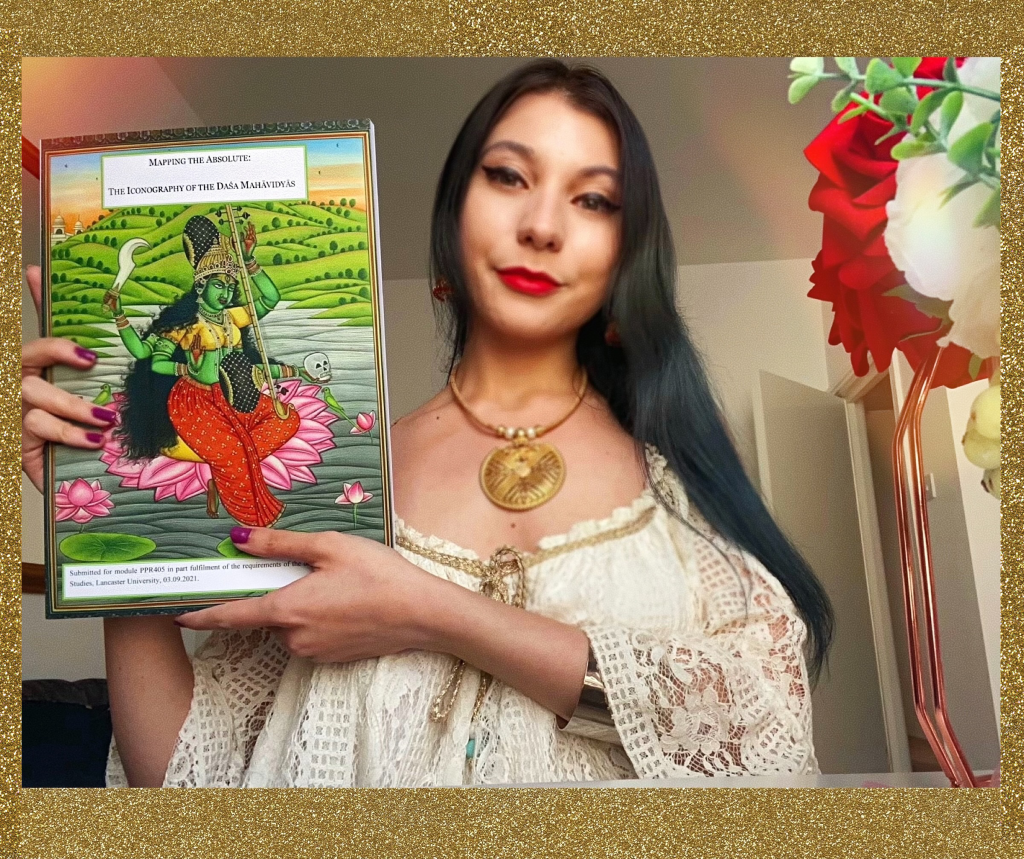
over the moon to share that i have submitted by MA dissertation, entitled: “Mapping the Absolute: The Iconography of the Daśa Mahāvidyās”
my dissertation has been fuelled by Dr. Kavitha Chinnaiyan’s books & courses addressing the lustrous wisdom embodied by the ravenous sequence of the Mahāvidyā Goddesses. my intention (icchā, if you will ) to explore the deities from a cosmogenic standpoint was sown during a retreat i attended in 2020 that was centred on the first five of the Mahāvidyās, led by Kavithaji & Hareesh Wallis. i was spellbound listening to Kavithaji present the Goddesses as non-dual expressions of cosmological creative forces and i was concomitantly dismayed to realise that all the material i had encountered which addressed them was rooted in strong misconceptions. poignantly, the distortion & appropriation of the Goddesses in popular culture & western scholarship appear to majorly stem from the legacy of colonialist writings – and, i tried to offer my small contribution towards the deconstruction of the colonial / orientalist gaze through this thesis. if there’s one thing i know for certain after writing my dissertation is that one needs dozens of lifetimes to come to grasp the vidyā embedded in one Goddess – and my 100 pages have barely scratched the surface:
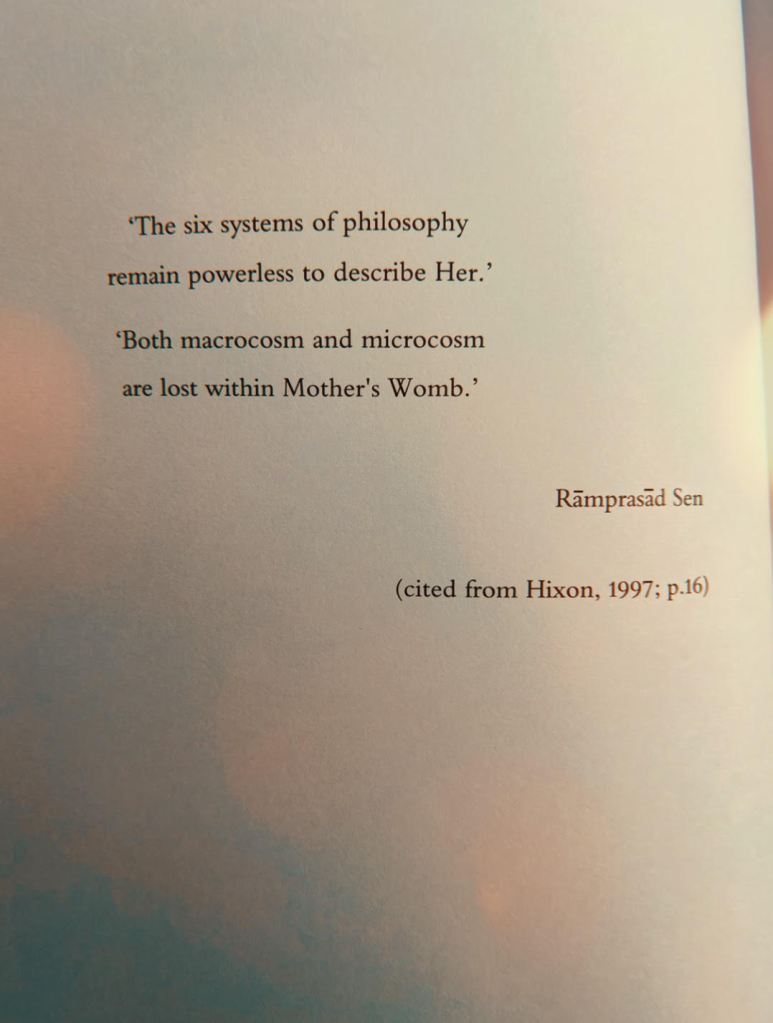
“The six systems of philosophy remain powerless to describe Her. She is the inmost awareness of the one who realises that Consciousness alone exists. She is the life blossoming within the creatures of the universe. Both macrocosm and microcosm are lost within Mother’s Womb. Now can you sense how indescribable She is?”
Śākta poet Rāmprasād Sen, translated by Lex Hixon.
very grateful to my supervisor, Dr. Brian Black, who has encouraged and guided me through the entirety of my MA. (and who shares my obsessive love for the Mahābhārata!)
*the painting appearing on my cover-page: Mātaṅgī by Kailash Raj.
today i presented my paper “purity, impurity & pollution in non-dual philosophy” at the “philosophy across disciplines” conference organised by newcastle university! it was my first time presenting at a conference! i was nervous and excited. incredibly grateful for this wonderful opportunity!






















 in typical fashion, i will turn this around to the Mahābhārata, and hope that this paves the way to translating some of its most beautiful ślokas… sometime in the far future

 over the moon to share that i have submitted by MA dissertation, entitled: “Mapping the Absolute: The Iconography of the Daśa Mahāvidyās”
  ) to explore the deities from a cosmogenic standpoint was sown during a retreat i attended in 2020 that was centred on the first five of the Mahāvidyās, led by Kavithaji & Hareesh Wallis. i was spellbound listening to Kavithaji present the Goddesses as non-dual expressions of cosmological creative forces and i was concomitantly dismayed to realise that all the material i had encountered which addressed them was rooted in strong misconceptions. poignantly, the distortion & appropriation of the Goddesses in popular culture & western scholarship appear to majorly stem from the legacy of colonialist writings – and, i tried to offer my small contribution towards the deconstruction of the colonial / orientalist gaze through this thesis.
 today i presented my paper “purity, impurity & pollution in non-dual philosophy” at the “philosophy across disciplines” conference organised by newcastle university! it was my first time presenting at a conference!
 amaryllis