amaryllis (/ˌæməˈrɪlɪs/[1]) – bears the name of the shepherdess in virgil's pastoral eclogues. it stems from the greek ἀμαρύσσω (amarysso), meaning "to sparkle", and it is rooted in "amarella" for the bitterness of the bulb. the common name, "naked lady", comes from the plant's pattern of flowering that blooms when the foliage dies. in the victorian language of flowers, it means "radiant beauty".
In the recent months, I have been deeply reflecting on independence and personal power, and the reflections that I am sharing in this article are emergent from interactions with friends, from browsing social media trends, as well as from contemplations on my own journey.
What I’ve become familiar with, within and without, is recognising fear: the fear to stand on one’s own, in full autonomy and independence, which, I find, stems from deeper, more rooted fears of our own incompetence; fears of something just not being quite right with us.
I have observed, within and without, how, controlled by fears, we shy away from paving our path by ourselves, and fall into wanting it to be paved for us by an external agent. Insecurity leads us to wanting to be told how to think; how to act; how to be treated; what to aspire for. We desperately want to feel okay within ourselves, so we seek comfort and security in dependence — be it on a person or on a thought process. We conceal our gifts, infantilize ourselves and make ourselves small in exchange for what we think is love.
And, in a desperate quest to, very simply put, not feel awful about ourselves, we seek help: in the work of great thinkers, philosophers, spiritual leaders and mental health coaches. However, what I’m noticing is that, in such fear-based seeking, we don’t even trust ourselves to absorb these thought processes on our own. We rely on others to interpret them, and, in this, we remain even more stuck; dependent on someone, or something, for information, knowledge, comfort; dependent on someone to offer us an experience.
In a paradigm of co-dependency and fear, self-help and coaching businesses, as well as pop-psychology thrive. I want to underline that I find nothing wrong with either, and consider them to be essential in the great design, as well as helpful on an individual to individual basis. However, in my view, there is a worrisome element to the structure of these businesses as they prevail on social media, and it is this very element that enables much of our mental dependence: which is that, in an effort to appeal to the masses (which, again, is a logical and natural goal to have in the context of sustaining business), pop psychologists, health coaches distil the knowledge of great thinkers in consumable bites: rephrasing, extracting, simplifying, sometimes even appropriating without reference. So much is lost in this; we end up engaging with pruned versions of philosophies and pruned truths which only give a taste of the encompassing worldview we want to grasp and embody; we don’t enter that door of perception, we only hang at the frame. Our fears and mistrust in ourselves, combined with a modern short attention span and desire for quick fixes, provide the perfect context for us to fall before the illusion of knowledge, and not before the knowledge itself, as well as facilitate our dependency on surface-level content for relief, comfort, and insight. We remain alienated from ourselves and cling to external sources (coaches, teachers) in the absence of connection to ourselves and to direct sources of knowledge (which, ultimately, I am learning are our internalisations of our own experience). We end up extolling people and not knowledge, and, in impaired autonomy, remain perpetually unsatisfied, powerless, and stuck in one-dimensional echo-chambers, believing truth is held or experienced outside of ourselves, and can be offered to us by an external force; instead of attained within through our own power — yes, supported, and, yes, with guidance, but not as a passive, powerless actor, but as an active, free agent.
What I personally want to tackle within is dependence, and not trusting myself to pave my own path. After years of remaining stuck in personal mistrust, perpetual insecurity and in the fear of losing myself to myself, what I am coming to see is that it is only by having my own experience of the teachings that I want to follow that I can both understand them and break from my patterns of churn; so, for instance, if I resonate with Marcus Aurelius decreeing ‘no one can keep you from living as your nature requires’ (6.58), what I want to do is, after satisfying my intellectual curiosity by reading and inquiring into this precept, is to followingly FEEL, experience and embody what my nature is;to FEEL what it is to live as is; understand how I cannot be kept from living it; then decide if it’s a precept that I want to live by based on whether it brings most growth to me at this particular point in time. And, revisit, recheck if this remains valid as I move through life — as Aurelius says himself, your nature is of continuous change. Contrarily, what I have done until now is to read and either stop there by assimilating others’ takes without forming my own, or by relying on the experience of an external source / individual to teach me what it is for them to live as nature requires, and build my worldview, mould myself on that. Both approaches have left me powerless, insecure, and ultimately in pain.
I am learning that no intermediary is needed between me and knowledge — between me and understanding myself.
Of course, this does not mean that teachers, mentors, friends and guides are not needed; for me, this understanding, however, implies self-reliance and steadiness in my own knowledge and experience. Why is this important? Because, when these arrive, you will choose to stay at, or to leave a place you are learning in, or to stay with or leave a person you learn from, from a fearless place of autonomy, in which your discernment is not clouded by the fear of being alone. By the fear of being wrong.
I am learning that it is in the absence of fear, hierarchy, and personal gain that knowledge flows most abundantly, a place in which individuals can join each other in complete freedom of being, in mutual respect and openness, with the purpose to enrich each other’s understanding of their own self. A place where you enter and walk away as a captain of your own soul, steering the ship toward yourself.
Concluding this article by reminding myself that it is not enough to peer through the doors of perception, expression so beautifully coined by Aldous Huxley; we must enter.
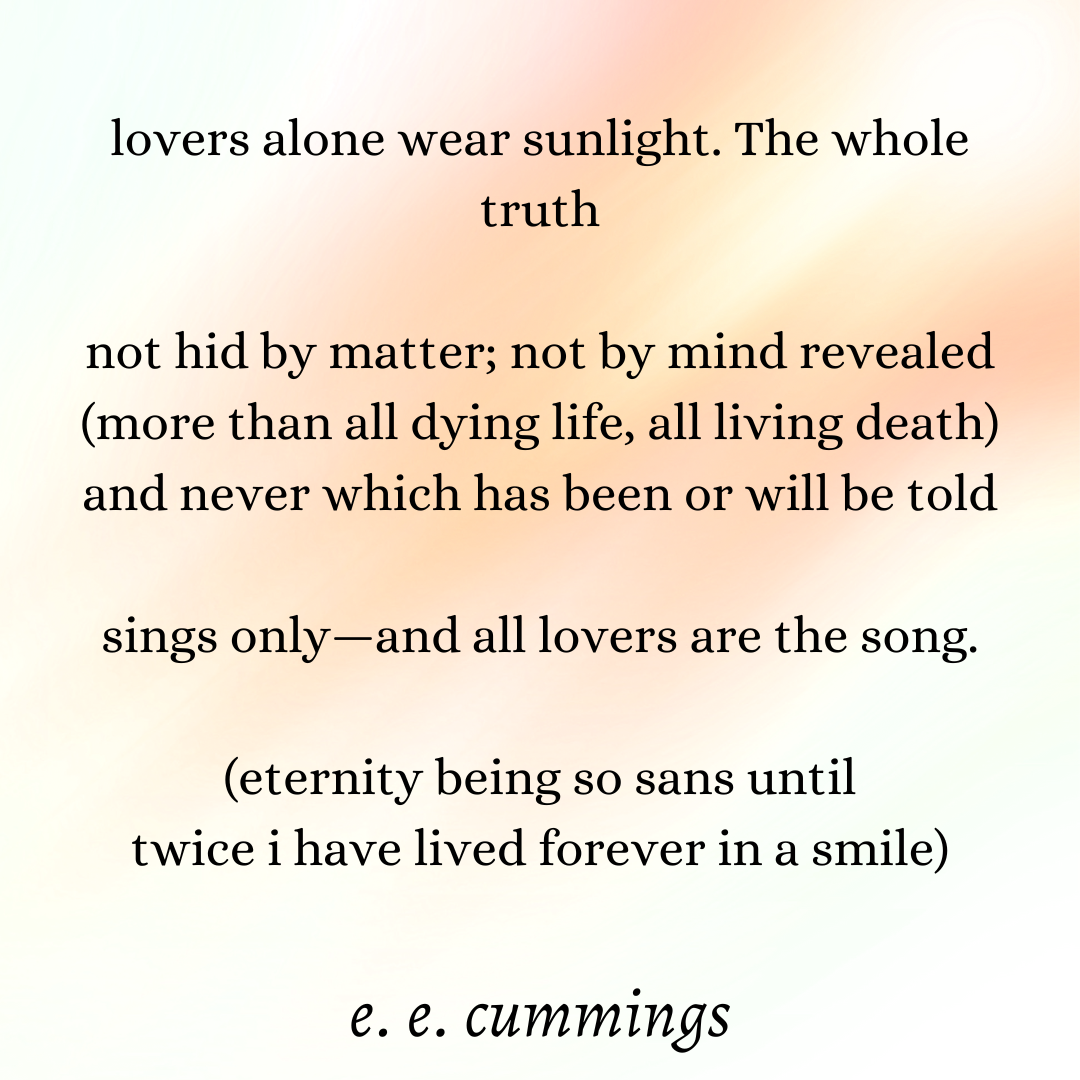
in my undergraduate degree, i studied western poetry, and one of the poets i focused on was the beguiling e. e. cummings. in the past two years, i have been exclusively exploring eastern poetry in my postgrad, and it is only recently that i have begun to see how the two apparent different worlds and approaches illuminate each other. one of the elements i am most interested in at the moment is the process of individualising the universal experience; or how to express the universal through means of individuality.
this, with relation to cummings and bhakti poetry: cummings, a pioneer of experimental poetry, created his own language, which functions, i would maintain, like an authorship stamp: he used conjunctions as nouns, rewrote linguistic rules, introduced spacing as verbs etc. his poetry addresses themes looked down upon by other avantgarde poets of his time (and our time!) such as love and nature, yet it is the creation of his own language and the erotic notes of his poetry that revolutionise and freshen the apparent cliché of his subject matter.
similarly, bhakti poets, who write about ‘common’ topics such as love and separation, revolutionise these universal themes by pinpointing the object of desire to be God, and by introducing eroticism as worship. and, their authorship stamps (example: Akkā Mahādevī’s Chennamallikarjuna – more on this later!) distinguish and establish their poetic voices as individual in the context of universality.
fascinating how the experience can be both universal yet unique as it expresses itself individually through us, and how marvellous the intricacies of language and poetry are, how beautifully they thread us together through traditions, genres, times and worlds! 🤍
sidenote, i did use the word ‘cliché’ as a convention, but i don’t believe in clichés exactly because of this reason.
part of my #poetrybeautyseries, in which i share my favourite poetry lines and muse on their significance! on pessoa:
to me, fernando pessoa is one of the most fascinating poets to have graced this earth. he created 81 heteronyms for himself – meaning, 81 different characters or identities he assumed while writing. each had a different personality, background story, style. in awe with the mind-blowing imagination of this beautiful man. here’s a fragment from ‘discontinuous poems’, which he wrote as alberto caeiro, and which is grounded in a non-dual view, in my opinion. planning to make a video about him soon 🖤
on ginsberg:
although this quote is well-known, its context isn’t! it’s an excerpt from an interview with Ginsberg from Writers Digest, edited by Bill Strickland (p.47), in which he talks about the importance of expressing yourself without caring for validation or recognition.
“It’s more important to concentrate on what you want to say to yourself and your friends. Follow your inner moonlight; don’t hide the madness. Take (William Carlos) Williams: until he was 50 or 60, he was a local nut from Paterson, New Jersey, as far as the literary world was concerned. He went half a century without real recognition except among his friends and peers.
You say what you want to say when you don’t care who’s listening. If you’re grasping to get your own voice, you’re making a strained attempt to talk, so it’s a matter of just listening to yourself as you sound when you’re talking about something that’s intensely important to you.”
foreword: “The one consistency in my life, from childhood to the teenage years of angst and to the blooms of young adulthood, has been writing. I wrote to make sense of the world around me and of myself, I wrote to express myself, I wrote to connect to the world and to myself.
This is a collection of poetry written between the ages of sixteen and twenty. Brian Molko of Placebo, who was the soundtrack to my teenage years and the one who hypnotised me with rawness and alluring born-to-die sadness, once said that, when you are a teenager, you react to the world that surrounds you with great emotionality and intensity, with full heart. He mused that growing older is a process of finding semblances of sanity. This collection aims to illustrate exactly that; it is not written by an adult looking back with maturity, nor tenderness to their early years, but by the teenager who is in the midst of experiencing the turbulent highs and lows of being thrown into life.
This collection of poetry was a creative project I compiled as an undergraduate student of Creative Writing at Lancaster University. It includes unpublished work, as well as work that has already been published.
It is structured in three sections: ‘teenage angst’, ‘my loss is my root’ and ‘at last, light’, which chronicle the journey to adulthood through churn, grief, and joy.
You may notice that the poetry is written in lowercase. More than an aesthetic choice, lowercase marks the teenage search for identity and reflects how disconnected teenagers feel to themselves. As a teenager myself, I found it difficult to capitalise ‘I’-s, as it seemed as if I was proclaiming who I was before I knew.
This collection explores the beginning of the search for the ‘I’.
Enjoy.”
the cover art i fall in love with more and more every day is by Holly Robinson
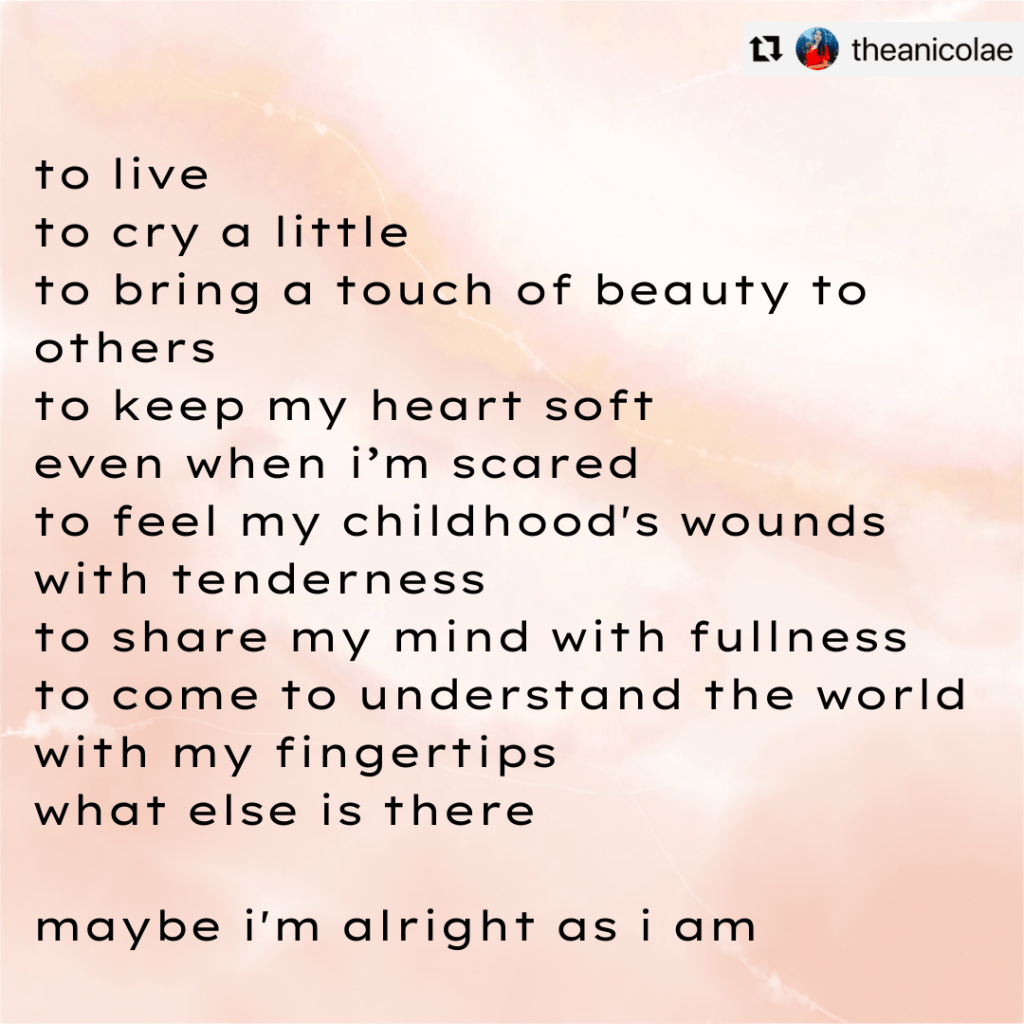
the last few days have been tender, and last night i was happy to reconnect with a friend from university whom i studied film with. we exchanged kind words as well as poetry. after we both shared that we warmed each other’s hearts, i found myself thinking how much i treasure these brief moments of connection, yet how i often don’t enjoy them fully because i generally am so immersed in my mind palace and narratives, so overly focused on my insecurities, internal drama or questions of right and wrong that the beauty of life passes me by. i mentally noted a line i could have seen in a poem, ‘to bring and receive a little beauty to and from others is enough’, and i scribbled this quick poem this afternoon.
to live to cry a little to bring a touch of beauty to others to keep my heart soft even when i’m scared to feel my childhood’s wounds with tenderness to share my mind with fullness to come to understand the world with my fingertips what else is there
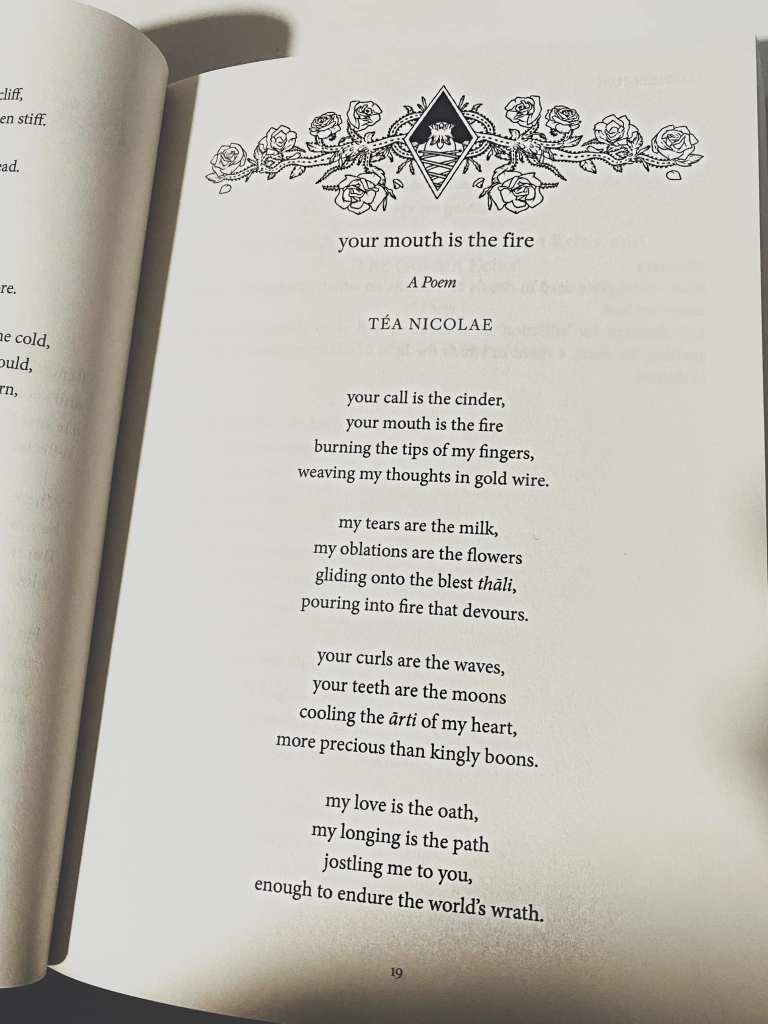
your call is the cinder your mouth is the fire burning the tips of my fingers, weaving my thoughts in gold wire.
my tears are the milk, my oblations are the flowers gliding onto the blest thāli, pouring into fire that devours.
your curls are the waves, your teeth are the moons cooling the ārti of my heart , more precious than kingly boons.
my love is the oath, my longing is the path jostling me to you, enough to endure the world’s wrath.
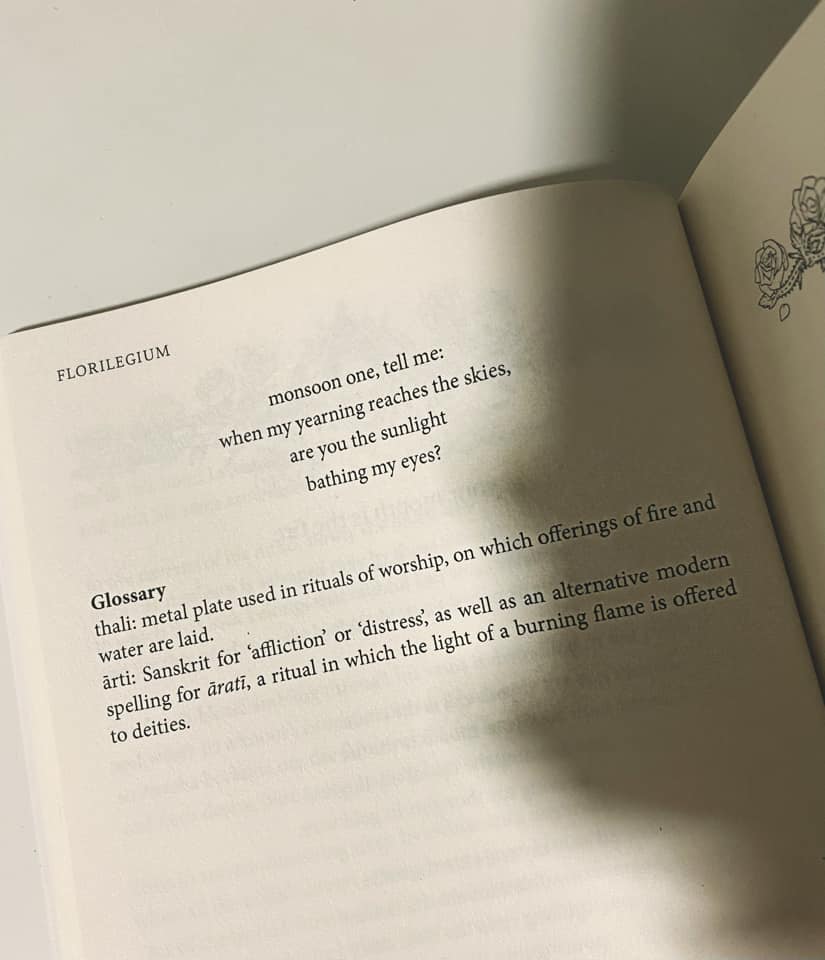
monsoon one, tell me when my yearning reaches the skies are you the sunlight bathing my eyes?
Glossary thāli – metal plate used in rituals of worship, on which offerings of fire and water are laid. ārti – Sanskrit for ‘affliction’ or ‘distress’, as well as an alternative modern spelling for āratī, a ritual in which the light of a burning flame is offered to deities.
.❀。• *₊°。 ❀°。 my creative contribution to the Florilegium Anthology .❀。• *₊°。 ❀°
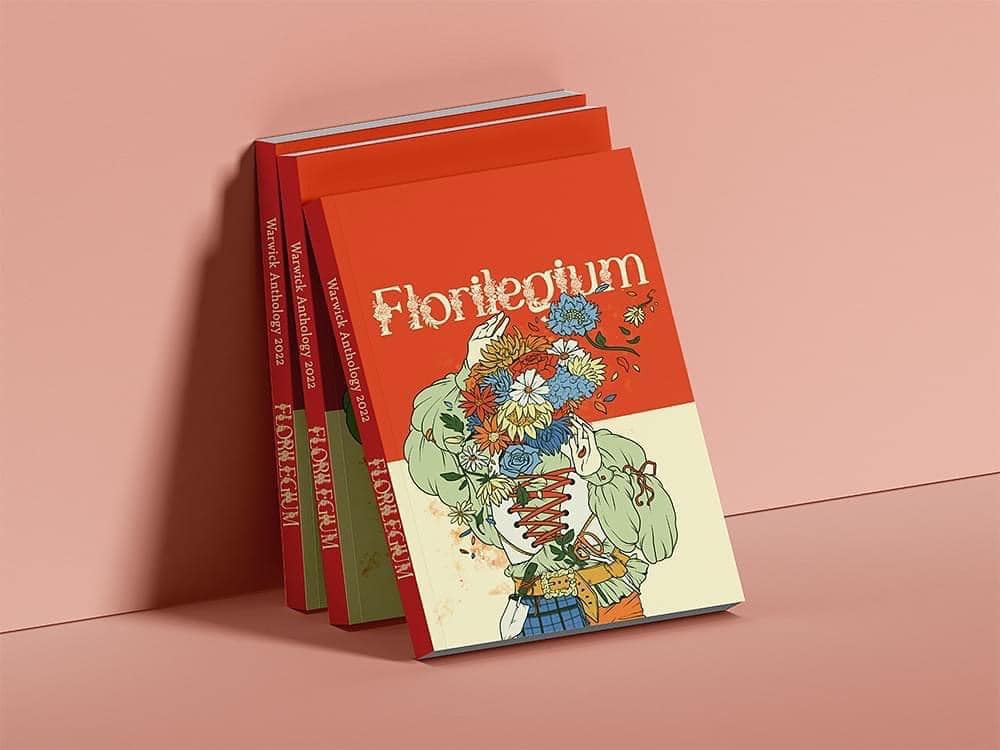
🖤🥀🌼 FLORILEGIUM 🥀🌼🖤 is an anthology of fiction & non-fiction literature compiled by the 2022 cohort of the Warwick Writing Programme, birthed out of love for writing and out of commitment to expression and self-discovery through the art of writing. Florilegium features 21 emerging writers and it holds short stories, flash fiction & poetry. it was a pure delight to work on this collection with my very talented colleagues and it is a joy to see it out in print! the Florilegium launch was held in february in London 🖤 photos from the launch below!
i had thought that i was just a girl who wanted to plant lemon trees but my hot blood scorched the vine trailing on the windowsill.
Keśava, you are pulling me to you by my teeth and i follow happily.
exploring the warm tones of warwickshire beauty 💛
i followed you into the seven seas and i followed you into the circle of mountains i have been calling you with folded hands and now i will dance to you with my mouth open and with flowers woven into my skin tissue.
monsoon one, did you know that the crevices of my heart can hold you whole? did you know that the fire in my belly can swallow the three worlds?





 the cover art i fall in love with more and more every day is by






 amaryllis