She dances me to her call | bhakti poem by Téa Nicolae

in the depths of my being, She dances me to her call:

“come to me. I want all of you, my child. no part of you is too dark, too gritty, too cruel for me. I claim all of you.”

Māiyā! your waves carry your call and roll it against my chest. i seek you with my breath, eyes, hands, and knees. my lungs seek you like they seek air.

Ya Devī! soothing her tears,

Kṛṣṇa told Pāñcālī

that just as you, Śrī Gaṅgā, hold and wash all pollutions yet are ever-pristine,

so does the fallen empress remain untainted by her shame.

aches bathed in your luster,

i plead:

take all of me, Devī.

leave nothing of me behind.

establish me in knowing

that despite my wrongs, fears and corruptions, i, too,

your fragment in the microcosm,

remain unmarred.

may the holy flow of your untamed waters

sweeten the harshness i bear towards myself and the world

soften the rigid corners straining my being

loosen the knots hindering you from coursing within me.

Śrī Mātre Namaḥ. 🙏

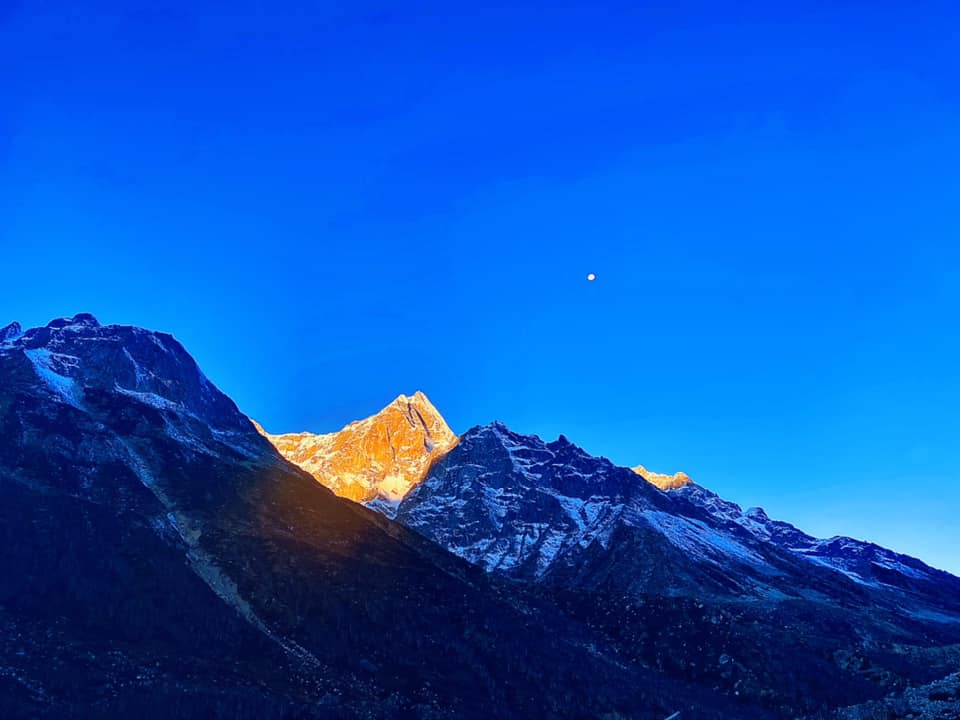
photos: before & after bathing in the waters of Śrī Gaṅgā in the auspicious Gangotri. Śabda Yātra. 🙏 the blessing of blessings. 💙

for how many lifetimes have you been calling me to You? | bhakti poem

for how many lifetimes
have you been calling me to you, Devī?
for how many lifetimes
have i cowered?

for how many lifetimes
have i been lost, Devī?
for how many lifetimes
have you watched me stumble?

i have been through many wombs
to rest my head at your feet today.

yet here i am,
my Devī.

would it be
greedy of me
to plead with you
one more time?

will you
grace me?
will you
wash away
my good, my ugly?
my irreverences, my pride?
my agonies, my beauty?

will you
cleanse this heart
until i am nothing but flow
rushing forth to meet your shores
like the water running between your locks

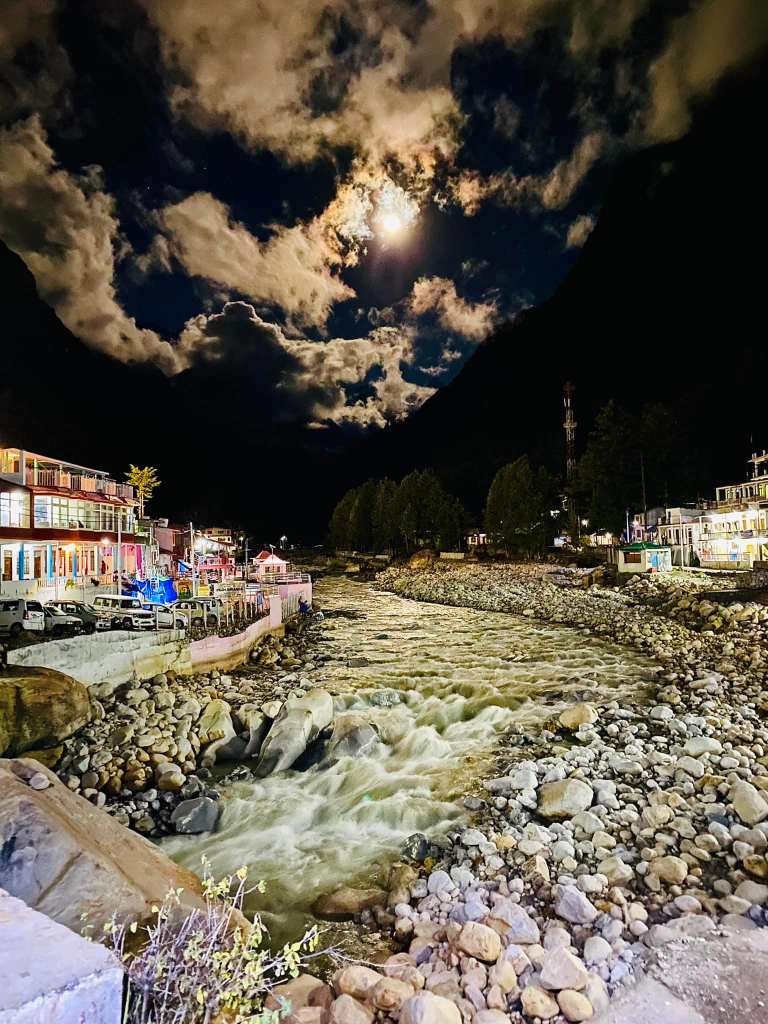
🤍 what came to me upon seeing the magnificence of Gaṅgā Devī for the very first time. pictures: Gangotri. Gomukh, Her Source. they fail to encompass Her beauty.

you elude me: bhakti poem by Téa Nicolae

you elude me,

my Beloved.
your nectarous call
trickles in my ears
and i run to you,
maddened.

i run to you,
enamoured,
clothed by longing
and with tears as jewels.

i run to you,
bare,
silk dress in shreds,
ripped slippers.

i’ve been running to you
since before i was born.
i am tired, Hari.
my dignity and pride
are long forgotten.
my toenails are cracked,
the skin peels off my feet.
my hair is rumpled,
my breasts are bruised;
your wayward bride.

whenever i get close
to throwing myself at your feet
my mind entangles me.
my wrongs push against my bones
and i fall on my face.
my blood smears the ground
and i grovel. i cry. i howl.

when your nectarous call
trickles in my ears,
i jolt forwards.
and i run to you,
maddened.

~ poem to Madhav, published in Śabda Magazine, volume II. my offering of longing as we approach the auspicious day of Vijayadaśamī! may we be victorious in our quest to merge with the Divine Beloved. 🙏

aegina, greece, 2018.

Hymn to the Empress of Kings by Téa Nicolae

Praise be to The Empress of Kings
seated on the throne of five corpses in the palace of ruby.


Her blinking eyes birth and collapse the cosmos,
and her crown is the lunar half-moon.


She whose reddened eyes roll ecstatically,
She is Mahātripurasundarī,
The Great Beauty of the Triads.


Praise be to Parā Aṃbikā,
of allure so exquisite that, enchanted,
Śiva grew his third eye just to worship her beauty.


Her body is anointed with sandalwood,
and her fragrance bathes and deludes the three worlds.


She is Śrīmātā,
The Auspicious Mother.


Praise be to Lalitā Aṃbikā,
The One Who Plays,
whose girdle of tinkling bells stirs creation into being.


She who gifts the sun his effulgence,
Her toenail holds the universes,
and Her auspicious thighs are known only by the fortunate Kāmeśvara.


She is Kāmākṣī,
She whose eyes are desire.


Bhavānī,
you are the nectar of the ocean of compassion:
grace this songstress to only sing of your praises.


🌺 “Hymn to the Empress of Kings”, one of my poems offered to Devī at the magnificent Siri Jyoti Pūjā in Seattle. inspired by the verses of the Lalitāsahasranāma which extoll Lalitā’s rapturous beauty. Śrī Mātre Namaḥ. Happy Navarātra!

Warwick Anthology and Re-introduction

#Repost @thewarwickanthology with @make_repost
・・・
Introducing the Team of Warwick Anthology 2022: Florilegium! 

Meet Téa Nicolae! Téa is a marketing co-head and an editor of this year’s anthology. She joined the Warwick Writing Programme to delve deeper into poetry and literary translation.

Téa is a poetess and a scholar-practitioner. She writes devotional (bhakti) poetry and her research interests are Śāktism, Mahābhārata and non-dual philosophy.

Téa holds a BA in Film and Creative Writing and an MA in Philosophy and Religious Studies from Lancaster University. She is studying oral-practice traditions enrich her writings with the insights, delight and fervour unearthed only through practice.

Yajñasenī by Téa Nicolae

she who was born of fire

she whose beauty enticed even the sun

i garland thee

she whose blood spilled on royal floors of marble

she whose woe scorched the Kurus

i weep with thee

she who was touched yet remained stainless

she whose dishevelled hair holds the griefs of woman

i pray with thee

Draupadī,

she who cried the tears of the women who walked this earth

i am thee.

*poem published in Śabda Magazine, vol. II.

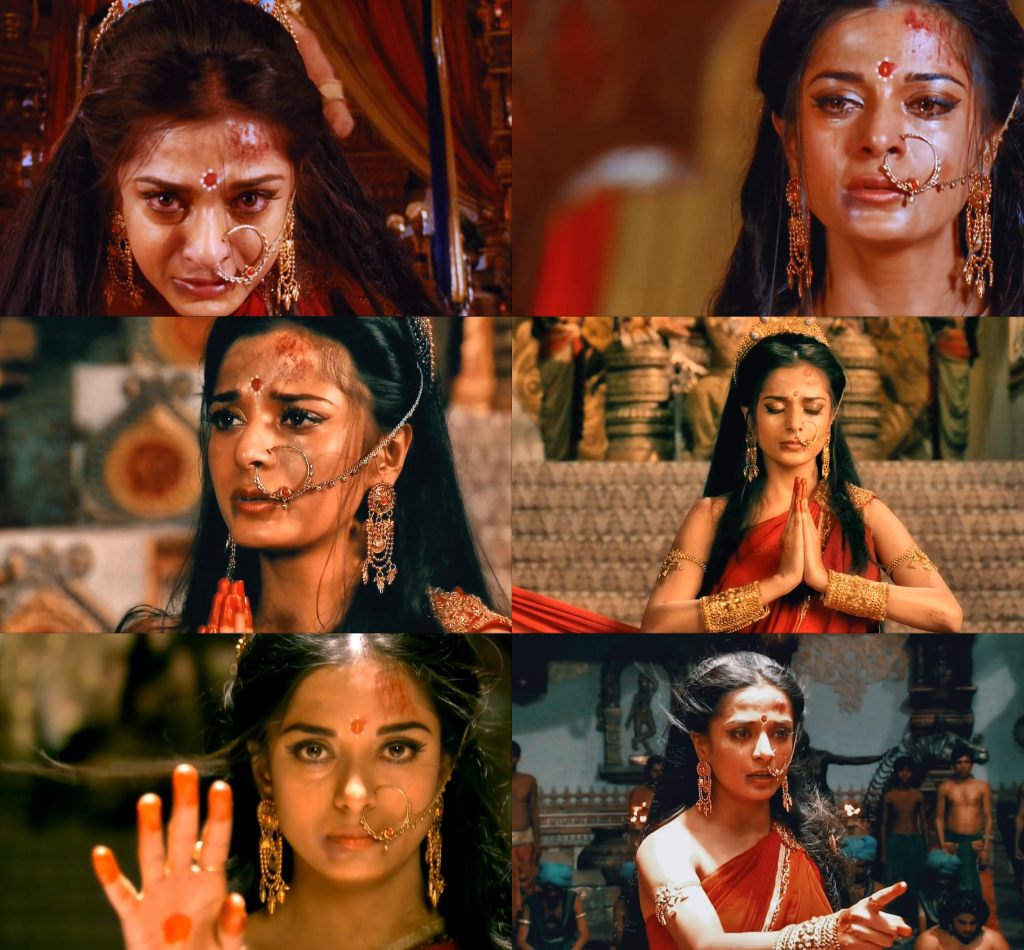
collage i made of pooja sharma as the beloved empress. her performance is etched to my heart!

The Internal Freedom of the Mahābhārata’s Fire-born Heroine

Perhaps one of the most jarring episodes of the Mahābhārata, the disrobing of Draupadī has been etched to my mind since my first introduction to the epic. The story of the Mahābhārata’s fire-born heroine goes as follows: the empress Draupadī, an incarnation of the celestial Śrī, is violently dragged to the royal court after her husbands, the Pāṇḍavas, are enslaved through deceit. Draupadī is tearful, menstruating, and the Pāṇḍavas’ offenders, the Kauravas, attempt to enslave her. However, she fiercely debates them and proclaims her freedom. Enraged by her rebuttal, the Kauravas decide to disrobe her. When they mercilessly begin to pull her clothing, Draupadī’s garment endlessly unfolds, and she remains clothed — by what is presumed to be the grace of Lord Kṛṣṇa.
My fascination with Draupadī first began as awe of the female endurance she embodies. As a woman myself, I deeply identified with her pains, and found our sufferings to mirror each other. In my reflections, my being melded with her character, whom I felt connected to through the thread of shared female experience. I found comfort in her triumph. As I continued mulling over her story, I became inexplicably moved by the imposing testament of devotion that is showcased in her tale; in most renditions of the Mahābhārata, Draupadī, while being abused, earnestly prays to her dearest friend, confidant, and God, Kṛṣṇa, who, out of boundless compassion, answers to her calls and envelops her in his grace. It is a touching picture: as the men of the court hang their heads in shame, bound in silence and inaction by their royal vows, Draupadī, deserted by all, is shielded by her devotion to Kṛṣṇa — and her devotion is enough.
However, my greatest personal and transformational shift has occurred when, with my beloved guru’s guidance, I was able to deconstruct the tale of Draupadī’s anguish in order to delve deeper into the teaching encased in it. Before doing so, there was slight anxiousness in my heart: there was self-doubt, and there were questions; Draupadī had been ‘saved’ through her devotion, but would I be? Would I be saveable or worthy?
Indeed, my mistake had been not delving deeper into the teaching encased in Draupadī’s anguish by remaining stuck at the level of storytelling. The liberating conclusion I have reached is that, in truth, whether the empress’s garment endlessly expanded or not is irrelevant. The teaching veiled in Draupadī’s disrobing is that she was untouchable because she was internally free. The horror she was subjected to did not shake her internal freedom, nor did it dismantle her devotion. Throughout it all, she was rooted in her love for Kṛṣṇa, and immersed in her independent power. As she says in a recent rendition: “You cannot make me your slave because I do not allow it. Independence lies within me; it is not a piece of clothing you can snatch.” All along, the question was not whether I would have been saved; it was whether I could unearth Draupadī’s fearlessness in myself.
The Mahābhārata’s fire-born heroine has taught me that freedom lies within me. It is not given to me by others, and it cannot be taken from me. My freedom is married to my devotion, and my heart holds the keys to both.


This article has been published in the second volume of Śabda Magazine.

Collage I made of Pooja Sharma as Draupadī in the 2013 Mahābhārat. Although the TV series presents many distortions, her brilliant, fiery performance makes viewing it a joy for me.

pūrṇam | wholeness

yesterday, we concluded three weeks of intense study at Śabda Institute. my beloved teacher, Amma (Dr. Kavitha Chinnaiyan), and her beloved teacher, Sumitji (Dr. Sumit Kesarkar), helped decode the esoteric meaning veiled within the magnificent Īśopaniṣad, and, with great expertise, made its heavy and charged verses applicable for us – as both householders and as practitioners. i was most touched by the chant’s invocation & by its teaching of wholeness, which inspired me to write a poem that i was greatly honoured to read at the beginning of our fifth class. 🧡


oṃ | pūrṇamadaḥ pūrṇamidaṃ pūrṇātpūrṇamudacyate |

pūrṇasya pūrṇamādāya pūrṇamevāvaśiṣyate ||


Oṃ is the entirety from which everything we see as parts has emerged. The whole remains whole even when a part is taken from it. The whole was born out of the whole. What appears as a part is the whole, and the leftover is whole. The whole cannot be split even when it appears so.
(translation by Sumitji).


☀️ my poem (written as a ghazal):


pūrṇam | wholeness


you were always whole
the grief on your tongue was whole


when longing cut like a knife
the woe stuck to your eyelids was whole


when anger brimmed in your belly
the burn of your cruelty was whole


when the sun washed your cheeks
the glee warming your fingertips was whole


when your heart cracked open
the light trickling through was whole


my parents named me ‘Gift of God’
what gifts are there when all’s already whole?


☀️ praṇām to our two illustrious teachers & to the vidyā they graciously transmitted to us in these three weeks. 🧡 the wonders of Śabda Institute 😊

reading my poem

“defeat me” – poem, prayer for Naraka Caturdaśī

defeat me,
monsoon one.
pierce through the weaponry of the self
until my armour plate breaks in two,
and i crumble at your feet
the way Naraka fell before you and Satyā.

show me mercy,
monsoon one.
before your sudarśana delivers my final blow,
hold me as one’s beloved would.
cradle me
the way you embraced your gopis
when swaying with the woods of Vṛndā.

dance me,
monsoon one,
to your flute’s tune
show me the hills
where the milkmaids bathed your feet with their tears.

let our waltz come to end
when my hand slips from yours…
then claim your victory over me,
Hari.
unchain me from my bonds of delusion
burn the bitterness weighing my heart
so we meld as one.
free me into union with you,
lover of Rādhā,
the way you wedded Naraka’s imprisoned women.

purifier of the fallen,
defeat me
and
allow me
rest
within you.

“defeat me”, poem / prayer for Naraka Caturdaśī… 💛 wishing a blessed Dīpāvali to all! may our ignorance dissolve into the light of consciousness as the asuras were absorbed into the devatās.
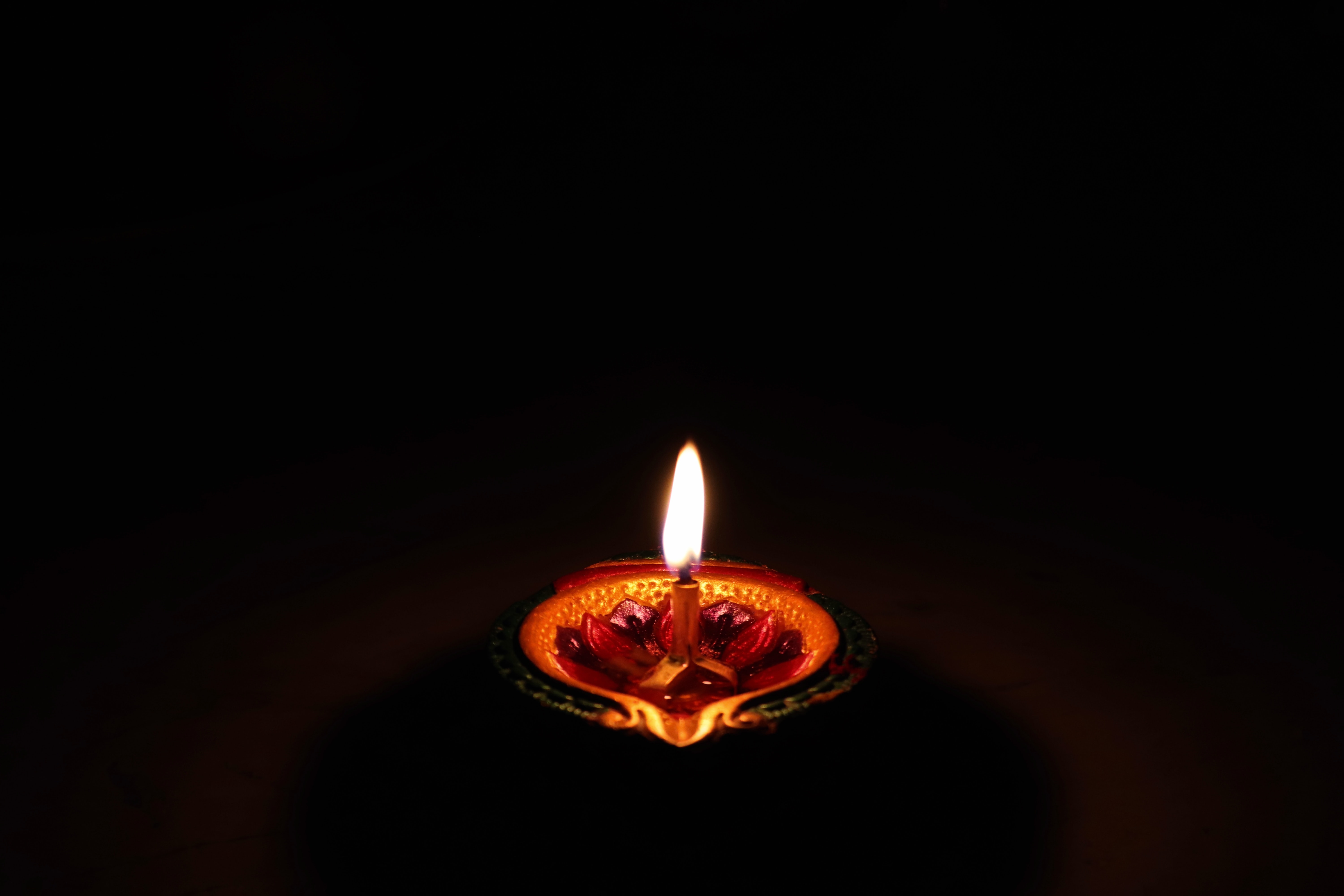
credit for the second, beautiful image: Madhav, unsplash.

tiny personal note: this is the first Dīpāvali i am spending in a place of my own, and it has been so precious to decorate my apartment (and even my rabbit’s hutch!) for the festival of lights. 💫 

grateful!

the tapestry behind me: the feet of Hari & Rādhārāṇī, by Harsh Malik. 💛

thirst, bhakti poetry

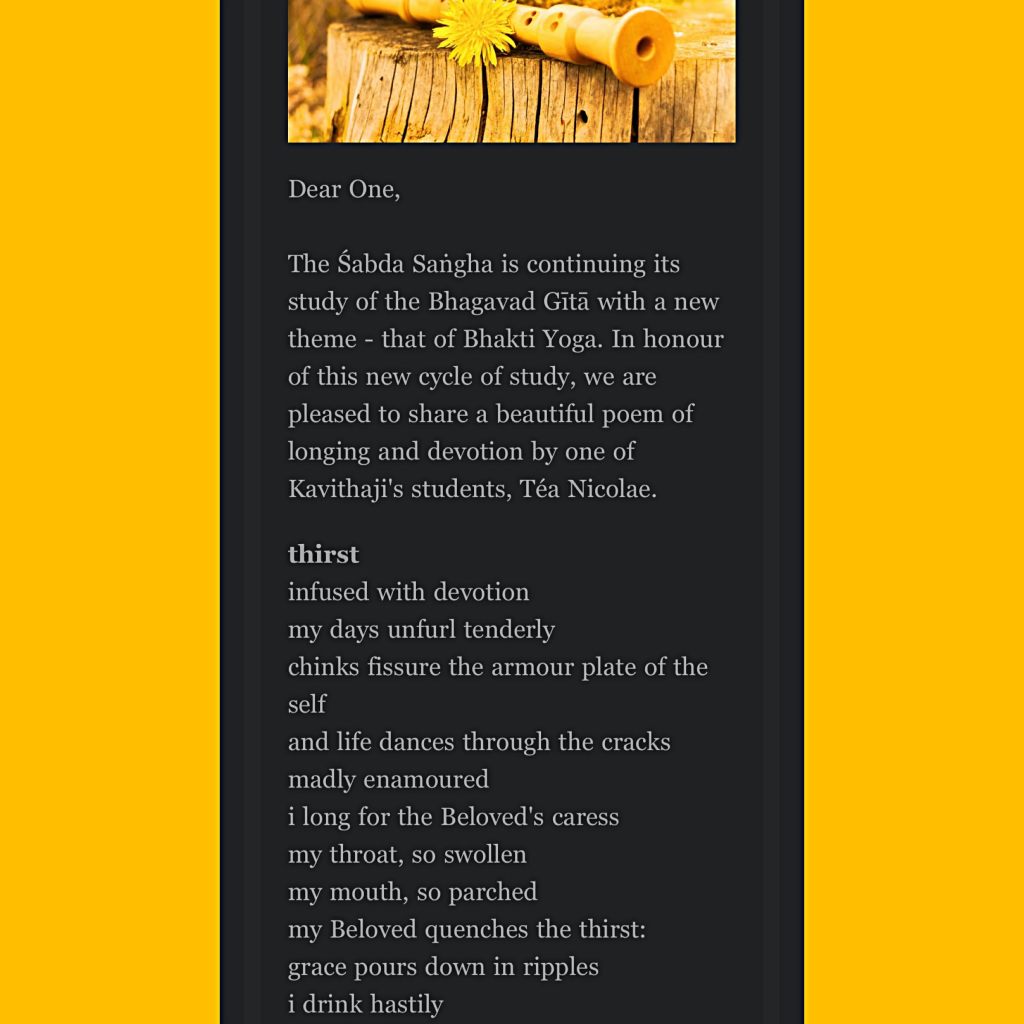
happy Vijayadaśamī! 💙 from this month’s newsletter of Śabda Institute. honoured that my poem accompanies the announcement of such an exquisite offering 💙 in this highly auspicious time, may our longing fuel our sādhanā, and may our devotion sweeten its unfolding. 💙
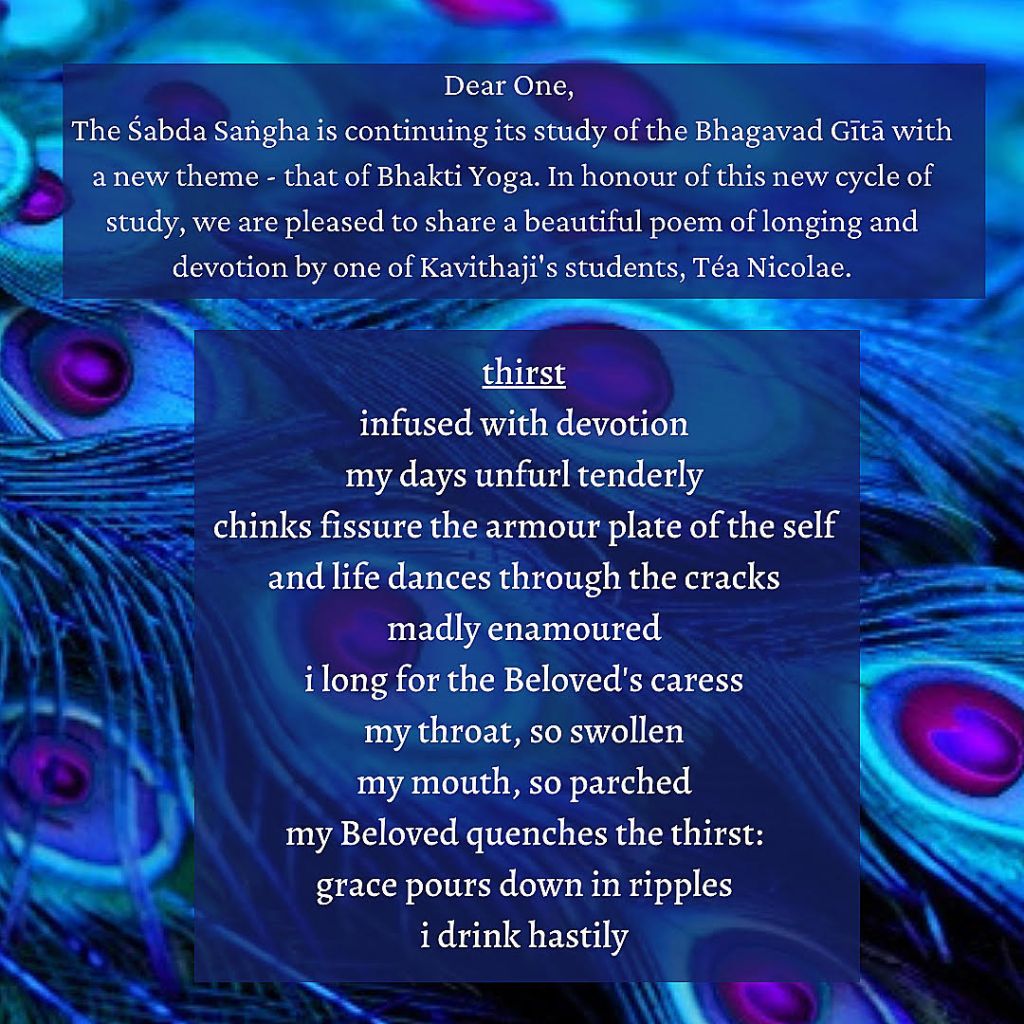
Dear One, 

The Śabda Saṅgha is continuing its study of the Bhagavad Gītā with a new theme – that of Bhakti Yoga. In honour of this new cycle of study, we are pleased to share a beautiful poem of longing and devotion by one of Kavithaji’s students, Téa Nicolae.

thirst
infused with devotion
my days unfurl tenderly
chinks fissure the armour plate of the self
and life dances through the cracks
madly enamoured
i long for the Beloved’s caress
my throat, so swollen
my mouth, so parched
my Beloved quenches the thirst:
grace pours down in ripples
i drink hastily